

Procurement leaders often hear one line from suppliers: the MOQ is fixed. In our experience, the quoted number is rarely arbitrary. It is never just a factory rule. The figure reflects setup cost, raw material thresholds, and factory risk.
Buyers assume the factory picked a round number. The factory actually optimizes line efficiency, waste control, and certainty.
This guide treats Promotional Products MOQ as a commercial variable, not a factory formality. The number shapes budgeting, timelines, and risk control for procurement managers, merchandise directors, and marketing operations leads.
The gap matters when brand customization meets campaign deadlines across trade shows, onboarding kits, test runs, and regional rollouts. Manufacturing economics show setup costs and minimum run sizes shape this floor.
LeelinePromotion's production team reviewed factory quotations, print and setup fee patterns, and tier-volume data across an audited factory network. The comparison covered how suppliers price small runs versus bulk orders. Factory managers explained where the real constraints sit: plate charges, material reels, color matching, and machine changeover time.
Here is what MOQ really is, why it exists, and how factories calculate it on the floor. The same walkthrough shows how experienced buyers reduce it or work around it without wrecking quality or delivery.
This is not surface advice. Expect an SOP-style breakdown of production setup, plus aggregated tier-pricing logic from the network. The guide also shares negotiation insights provided by supply chain leads and an honest look at quality and delivery trade-offs. The basics, core concepts, strategic benefits, and real challenges come first. A brief independence disclaimer closes the guide.
What Is Promotional Products MOQ?
Promotional Products MOQ is the minimum order quantity a supplier will accept to cover setup, material, labor, and risk. The figure is an economic floor, not a moral rule. Factories quote the number where their line runs efficiently.
Buyers often treat the quoted number as the only possible quantity. In sourcing reviews, the checklist starts with factory quotes, decoration minimums, and packaging minimums. Listed MOQs are often preferred efficiency tiers, not hard limits. The preferred tier protects the factory schedule and keeps each unit cost low. Compare quotes at the same decoration and packaging level.
Think of it like a print shop warming up a press. The first print carries the plate charge, color matching, and machine time. The next thousand units are faster and cheaper per piece.
This is why custom merchandise MOQ changes by product and process. Supply chain standards bodies treat setup and changeover costs as real constraints, as outlined by the Association for Supply Chain Management (ASCM).
1. What Changes the Number
- Stock item plus simple logo print: usually lower MOQ.
- Ready stock with no structural change: can support trial volumes.
- Full OEM or custom construction: usually much higher MOQ.
- Stocked and made-to-order items carry different raw material and packaging minimums.
- Decoration MOQ, factory MOQ, material MOQ, and packaging MOQ may all differ. The highest one controls the order.
2. Terms Buyers Should Know
- Low MOQ promotional items: stock products with light branding. Buyers use these for tests or small events.
- Less-than-minimum fee (LTM): a fee to run below MOQ.
- Setup fee: covers press setup, screens, or programming.
- Tooling or mold fee: covers custom shells, dies, or molds.
- Pre-production sample: a sample or digital proof buyers approve before mass production.
- Landed cost: product, freight, duty, and fees combined.
- Split shipment: sends goods to multiple addresses.
- Shared inventory pool: buyers share stock to lower risk.
In our experience, buyers negotiate MOQ by changing assumptions, not by asking for a discount.
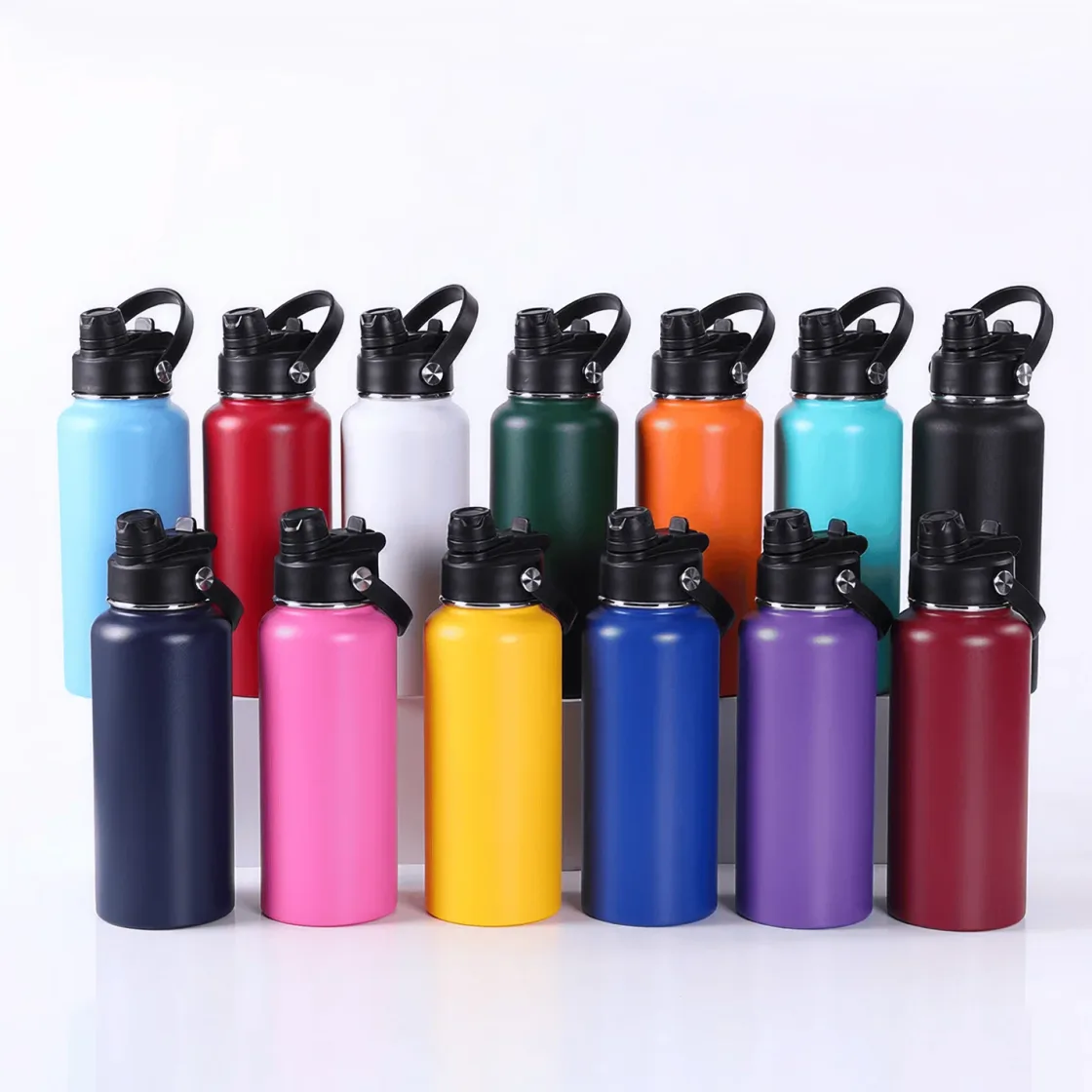
A drinkware buyer may accept a stock color. An apparel buyer may use a shared fabric. A tote bag buyer may simplify handles. A tech accessory buyer may choose a stocked shell. A metal promo buyer may accept a standard finish. Product design decisions often determine MOQ flexibility.
LeelinePromotion works as a one-stop promotional manufacturing partner across an audited factory network. Multiple production quotes get compared instead of forcing a buyer into one factory's rigid threshold. Quotes come from audited factories, not paid placements.
Why a 1,000-Unit Minimum Is Not a Random Number
Promotional Products MOQ can look arbitrary. Last month a branded tumbler quote had a 1,000-unit minimum. A single injection mold calibration that cost $2,500 explained the floor. The hidden setup drives MOQ.
The walkthrough below shows the fixed costs, factory SOP, cost math, and levers that lower effective MOQs.
1. The Fixed Costs That Drive MOQ
Factories set MOQ where one-time costs stop hurting. Five buckets drive that number:
- Raw materials. Custom-dyed fabric needs a 1,000-yard dye lot, about 500 totes. Stock fabric can run 100 units. Custom trims often need 2,000 pieces.
- Decoration setup. A screen plate costs $50 to $100 per color. Embroidery digitizing costs $100. Pad printing setup is $200. A 100-unit order carries a $4 per-unit plate charge. At 1,000 units, it drops to $0.40.
- Structural customization. An injection mold costs $5,000 to $15,000. Die casting adds $3,000. No factory spreads that tooling cost across 100 units.
- Line efficiency. A changeover can take two hours. Operators stop, clean, and recalibrate. MOQ keeps the line running long enough to justify the stop.
- Packaging. Custom polybags with barcodes need a 2,000-bag run. Stock bags have no minimum. Gift boxes with inserts add a $500 die-cut fee.
2. The Factory Floor SOP
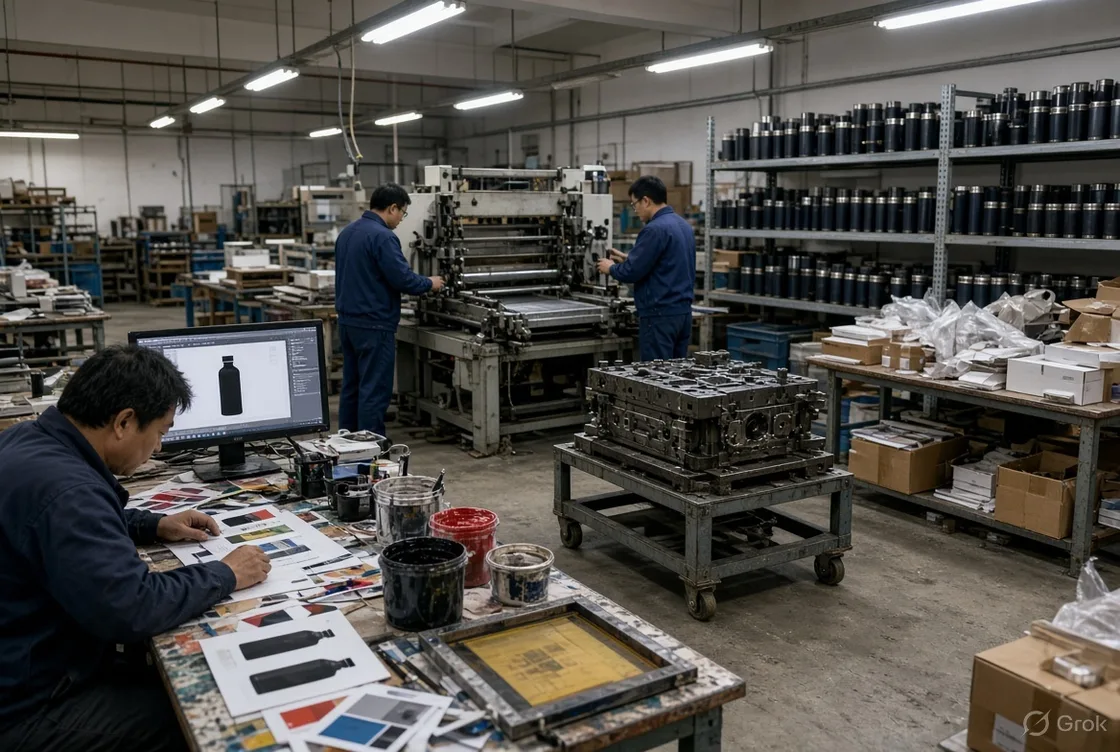
Our supply chain lead traced how a factory calculates MOQ. Here is the process, with the buyer lever at each step.
- RFQ intake. The print technician checks logo files. Vector files pass free. A low-res JPEG adds a $50 redraw fee. Lever: send vector files.
- Material confirmation. The sourcing manager checks stock. In-line fabric or plastic can support 100 units. Custom dye lots need 1,000-yard minimums. Lever: choose floor-stock colors.
- Decoration selection. Screen printing needs a $100 plate per color. Digital transfer has no plate but costs more per unit. Lever: use digital under 300 units.
- Tooling assessment. A custom mold means a 2,000-unit MOQ. A stock mold with a logo insert means 200 units. Lever: customize the surface, not the structure.
- Machine setup. Operators set the press, calibrate ink flow, and run test prints. This takes one to two hours. The print technician puts it plainly: "The plate charge is the same whether we run 100 or 10,000." Lever: accept standard settings.
- Sample signoff. The sampling team issues a pre-production sample or digital proof, usually in 3 to 5 days. Lever: approve a digital sample if color tolerance allows, but expect Pantone risk.
- Pilot run and QC. The factory runs 50 to 100 units and builds in a 5% rejection allowance. Lever: accept AQL 2.5 instead of AQL 1.0. Batch sampling details are covered in the quality control process.
- Production release. The line runs at full speed. The MOQ keeps it busy for at least four hours. Lever: bundle demand from several departments.
- Packing configuration. The packaging supervisor sets polybag printing. Custom barcodes need a 1,000-bag minimum. Lever: use stock bags with printed stickers.
- Reorder feasibility. The factory may hold excess material. A six-month reorder commitment can cut the first MOQ by 30%. Lever: provide a 12-month forecast.
3. The Cost Math: How MOQ Affects Landed Cost
Effective cost per unit matters on every low-MOQ quote. The table below shows a branded tote with one-color screen print. Setup is $200. Freight is allocated per unit. The full model is in the landed cost guide.
| Cost component | 100 units | 500 units | 1,000 units |
|---|---|---|---|
| Base product | $2.00 | $2.00 | $2.00 |
| Setup/plate fee | $200 ($2.00/unit) | $200 ($0.40/unit) | $200 ($0.20/unit) |
| Tooling/calibration | $0 | $0 | $0 |
| Packaging | $0.50 | $0.50 | $0.50 |
| Freight allocation | $0.30 | $0.30 | $0.30 |
| Total landed cost | $4.80 | $3.20 | $3.00 |
| Effective cost per unit | $4.80 | $3.20 | $3.00 |
Fixed setup creates a steep per-unit jump at low volume. At 100 units, it adds $2.00 per bag. At 1,000 units, it adds $0.20. Stock materials cut MOQ by removing the custom dye lot and waste. Delay structural customization until reorder confidence is higher, because tooling creates the highest threshold.
Aggregated data from LeelinePromotion's factory network: A branded insulated tumbler showed directional per-unit costs of $12.50 at 100 units, $9.80 at 500 units, and $8.20 at 1,000 units. The variance comes from mold amortization and bulk discounts. These are directional numbers, not universal market law.
How to Reduce Custom Swag MOQs?
MOQ drops when production assumptions change:
- Use ready-stock or in-line materials.
- Limit the first run to one SKU or colorway.
- Switch from structural changes to surface branding: logo print, laser engraving, embroidery.
- Pay setup or tooling fees upfront.
- Accept split shipments.
- Share inventory pools across business units.
- Bundle demand from several departments.
- Provide a reorder forecast or annual commitment.
In many categories, design simplification alone can cut tooling-driven MOQ by up to 80%. The promotional product design guide lists the specification choices that keep a first run small.
Negotiation Mechanics for Enterprise Buyers

Negotiation restructures the deal. Negotiation does not push the factory below cost. Experienced supply chain leads use this approach for wholesale branded merch MOQ negotiation:
- Ask first: Request setup and tooling cost breakdowns. Ask which costs can be amortized over a reorder.
- Create leverage: Pay the setup fee upfront. Offer a 12-month purchase commitment.
- Do not ask for everything: Do not request lower MOQ, lower price, and faster lead time in one email. Pick one priority.
- Trade price for quantity: For a 200-unit test, accept a 10% to 15% higher unit price. Better than 800 units of dead stock.
- Split shipments: A guaranteed annual volume lets the factory run 1,000 units and ship 200 to three locations. The factory gets line efficiency. The buyer gets a lower effective MOQ.
- Pool inventory: Pooled demand across business units reads as one 5,000-unit order. Each unit gets a different logo via digital printing. The MOQ is met, and each department gets its own version.
📋 Trial Order Ask Template "We want a trial order of 200 units. We will pay the quoted setup fee upfront. If quality and delivery meet our specs, we plan to reorder 2,000 units within 6 months. Can you quote the trial at a 15% premium with those terms?"
Key Benefits of Smart MOQ Strategy
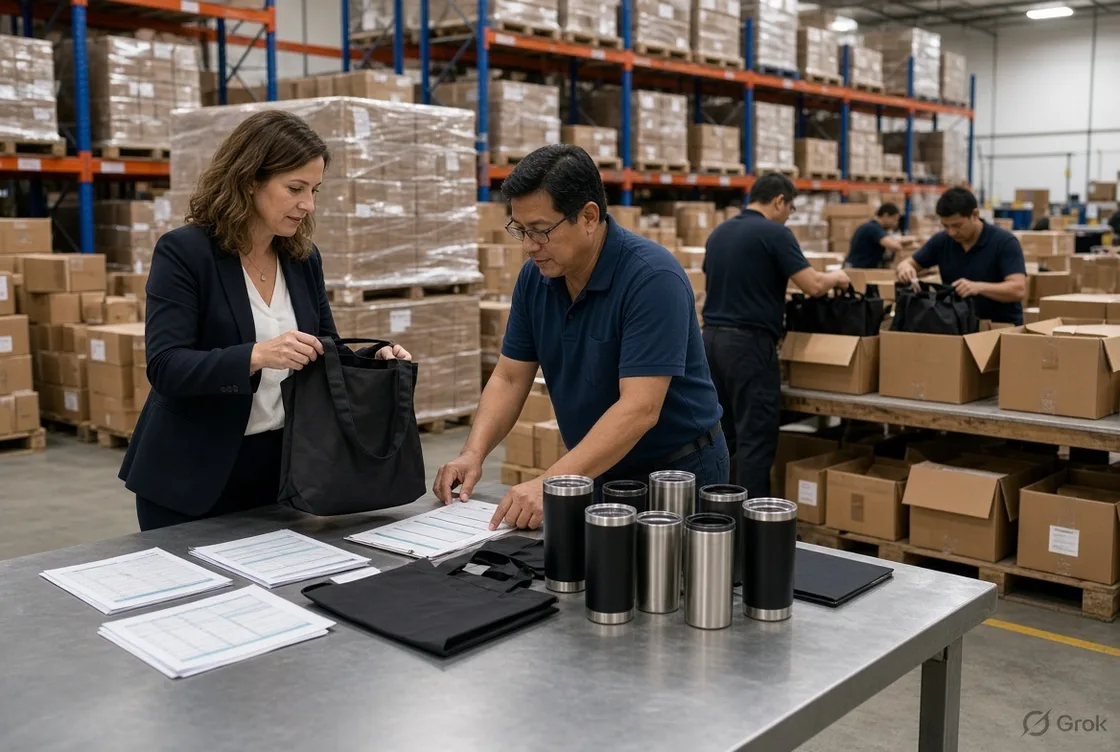
Mastering Promotional Products MOQ strategy turns a factory constraint into a business lever. The approach improves campaign economics, aligns stakeholders, and builds sourcing resilience. Tier-volume data and factory quotes across the network tell a consistent story.
1. Validate Campaigns Without Inventory Bloat
Low MOQ promotional items let buyers test before scaling. Last quarter, a 200-unit pilot for an onboarding kit validated design and unboxing. The client then ordered 2,000 units. The pilot cost 15% more per unit but avoided a $12,000 dead-stock mistake. Low MOQs suit executive gifting, regional variations, and limited audience segmentation. Accept higher unit cost when learning value justifies it.
2. Calculate True Landed Cost, Not Just Unit Price
Buyers who compare unit price alone miss the real math. The tote table above shows that moving from 100 to 1,000 units cuts landed cost by 37%. The margin funds better creative or extra testing.
Industry benchmarks commonly put inventory carrying costs at 20% to 30% of product value a year: storage, capital, insurance, shrinkage, and obsolescence (Investopedia). Use the range to find the break-even volume, then pressure-test the plan with our promotional product ROI guide.
📈 ROI Check: Find where per-unit savings at higher MOQ outweigh the carrying cost of unsold stock. For most promo items, break-even sits around 300 units.
3. Consolidate Spend and Eliminate Rogue Buying
MOQ strategy can pool demand across departments — a common approach for company swag programs. Three notebook orders became one 5,000-unit run. Each department received its own digital logo. The factory met the MOQ, and shared inventory eliminated duplicate SKUs. Split shipments sent 1,000 units to each regional office without three small runs. Procurement gains control, and finance sees one invoice.
4. Meet Deadlines Without Brand Compromise
Design simplification and stock materials accelerate programs. A trade show client needed 500 branded power banks in 18 days. Custom molding would take 30 days and add $4,000 in tooling.
A stock shell with laser engraving shipped on time and saved the tooling fee. A manufacturing partner that plans around MOQ can match the strategy to the goal, not the volume. The full schedule logic is in the promotional products lead time guide.
Share target quantity, timeline, branding method, destination, and reorder expectations early. A manufacturing partner can then fit the strategy to the campaign, not a factory default.
The Real Challenges of Low-MOQ Sourcing
Low promotional products MOQ reduces inventory risk. The same low threshold also creates real friction. Branded goods get sourced across vetted factories daily. Capacity, freight, and QC get audited before a small run is approved. Here is what that review turns up.
1. Small Runs Carry Hidden Cost Inflation
A 100-unit quote looks manageable until the less-than-minimum (LTM) fee lands. On a recent 200-unit run, LTM added $1.20 per unit. Freight allocation was $0.80 per unit versus $0.30 at 1,000 units.
Compliance testing carries the same price on a small run, but spreads across fewer items. The cheapest-looking quote is often not the lowest landed cost. Supply chain bodies treat setup and changeover costs as real constraints, not negotiable overhead.
2. Factory Priority and Scheduling Risk
Small orders go to the back of the line during peak season. Last Q4, a 500-unit order slipped two weeks while a 10,000-unit client took priority. A sourcing lead negotiated backup capacity. Weak supplier controls can also push low-MOQ jobs to secondary workshops, which raises quality risk. Ask: "Will this run on your primary line or a subcontractor?" Reserve peak-season capacity in writing.
3. Quality Control Complications
One bad setup decision can affect a large share of total inventory. On a 300-unit run, a 2mm logo shift makes 100% of stock wrong. A QC manager caught it through AQL 2.5 sampling at 50 units. Pre-production samples and Pantone matching are non-negotiable. Written QC checkpoints are required before mass production.
4. Design Compromise
Lower promotional products MOQ usually means less structural customization. Buyers accept stock materials, standard fittings, or simpler packaging. This is not failure. Often the smartest first-run trade-off.
5. Organizational Friction
Internal friction grows because teams measure risk differently. Marketing compares unit price. Operations sees freight and deadline risk. Procurement wants lower risk. Approve a spec hierarchy: must-have versus nice-to-have.
⚖️ Trade-off: Lower inventory risk comes with less design flexibility. Decide which matters more for this campaign.
Mitigation mini-framework: Approve a spec hierarchy. Insist on written QC checkpoints. Reserve calendar space for pre-production sampling. Compare air versus sea/express landed cost before approving a low-volume run. Use a manufacturing partner to consolidate orders or hold inventory.
The Bottom Line on Promotional Products MOQ
MOQ is not a factory rule. The number is set by production setup, material thresholds, and supplier risk management. Understand those three drivers, and the number becomes a negotiating surface, not a wall.
Three buyer moves separate smart sourcing from reactive purchasing:
Understand the real cost structure. Track setup fees, dye lots, tooling, and freight allocation. Know where the money actually goes.
Simplify the first run intelligently. Use stock materials and surface branding before committing to structural customization.
Negotiate around certainty, not just price. Trade forecasts, upfront setup payment, and pooled demand for flexibility.
The best MOQ strategy depends on the campaign objective. Testing demand? Buy smaller and accept the premium. Reducing landed cost? Scale toward the break-even volume. Meeting a fixed event date? Prioritize capacity and delivery certainty. Preserving brand standards? Protect the decoration and QC checkpoints. Consolidating enterprise spend? Pool demand across departments.
The right MOQ is the one that fits the campaign, not the one a supplier defaults to.
Share target quantity, decoration method, delivery deadline, destination country, and whether split shipment or inventory holding is needed. Contact us and LeelinePromotion will match the production strategy to the goal.
Still in the spec phase? Review the promotional product design guide before requesting quotes.
Disclosure: LeelinePromotion is a one-stop promotional manufacturing partner. This guide is written so buyers can audit any supplier, including us, on the same cost structure and MOQ terms.