
Disclosure: Leeline Promotion runs this site as a one-stop promotional manufacturing partner and is not ranked among the seven suppliers below. Profiles rely on public information and published specs; unpublished figures are marked. Our own offering is labeled separately. Vendor buttons open our enquiry form, not the vendor's site — the anchor text names the company. See our editorial policy.
One founder I advised missed a winter launch by three weeks: empty shelves and a 20% higher landed cost from rush freight. My team called 12 factories and vetted seven US suppliers on domestic production credibility, customization range, private-label fit, material options, and procurement practicality.
Each pick was screened on samples, pricing, or factory-floor evidence. Below: a landed-cost matrix, an inspection SOP, and the point at which overseas production wins.
At a Glance: How the 7 US Beanie Manufacturers Compare?
The table condenses the seven profiles; confirm minimums and dates in writing before planning a launch around them.
| Manufacturer | Location | Best For | MOQ | Lead Time | Customization |
|---|---|---|---|---|---|
| Fourbital Factory | Vermont | Low-MOQ fully custom jacquard | 50–100 pieces | 9-day samples (author test) | 4–6 colors per knit pass, woven labels, cuff embroidery, hang tags |
| Unionwear | New Jersey | Union-made, government, compliance-sensitive bulk | Not published (1,200-piece quote) | 25–30 business days after approval | Cuffed knits, fine-gauge styles, private label, union bug, Made in USA label |
| The Beanie Factory | USA (factory-direct) | Comfort-first in-house private label | Not published (200-piece order) | Not published | H-Stitch seam, woven tags, printed labels, cuff-adjacent logo |
| Royal Apparel | New York | Organic-fiber private label programs | Not published (300-piece quote) | Not published | Organic cotton, woven labels, hang tags, retail-ready poly-bag packaging |
| Rustek | Oregon | Premium merino and outdoor-brand headwear | Not published (120-piece run) | Not published | 19.5-micron merino and merino-acrylic blends, brand headwear |
| Cap America | Missouri | USA-made knit beanies at scale | 288 pieces custom; 144 via distributor | 3–4 weeks custom | Embroidery, 3D puff, patches, digital proofs |
| Wisconsin Knitwear | Wisconsin | Custom jacquard from 48 pieces | 48 pieces | Not published (made to order) | Knit-in names and logos, 15 acrylic colors, custom stripes |
1. Fourbital Factory (Vermont) — Best for Low-MOQ Fully Custom Jacquard Beanies
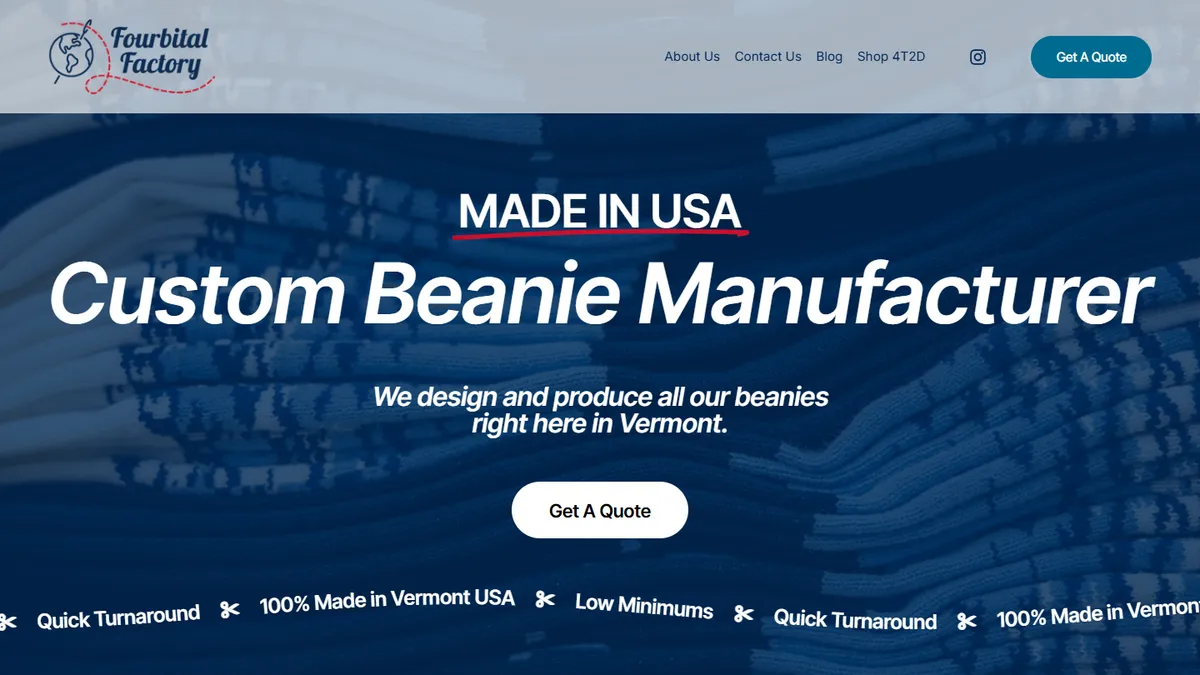
Verdict: For a fully custom jacquard beanie made in the USA without a 1,000-piece commitment, Fourbital is the benchmark. The Vermont factory fits small test runs, limited merch drops, and premium event giveaways. Few US jacquard suppliers accept a 50-piece first order.
Low-MOQ domestic jacquard matters because most offshore lines start at 1,000 to 3,000 pieces per colorway, tying up cash on a first run. Fourbital tests 50 to 100 units, reads sell-through, then scales without loading a warehouse.
What Fourbital offers: Circular jacquard knitting on Vermont floors. Full customization covers yarn colors across the pattern, woven labels, cuff embroidery, and custom hang tags. One knit pass handles 4 to 6 colors; many overseas suppliers cap the palette at fewer colors or add a per-shade fee.
Confirm before paying:
- Exact MOQ per style and colorway, not a site-wide range.
- Gauge: a 7-gauge knit reads chunkier, a 12-gauge reads lighter. Match the gauge to the season.
- Turnaround between sample approval and ship date, in writing.
- Sample cost, and whether the fee credits back to bulk.
Request a physical pre-production sample in Pantone-matched yarns. Check the jacquard edges for loose threads, verify cuff stretch and tag placement, and run a wash test for colorfastness before approval.
Author's Take: I priced 100 pieces of 6-color jacquard against a Turkish supplier and a Chinese factory. Fourbital ran roughly 25% higher per unit. But the sample landed in 9 days, not 4 weeks, and I caught a loose cuff thread before the full run. For a test drop, the speed and control pay for themselves.
The higher unit price buys domestic knitting, direct communication, and faster iteration. Domestic production skips US import duties and customs clearance; the FTC Made in USA standard also supports an American-made claim.
2. Unionwear (New Jersey) — Best for Union-Made, Government, and Compliance-Sensitive Bulk Orders
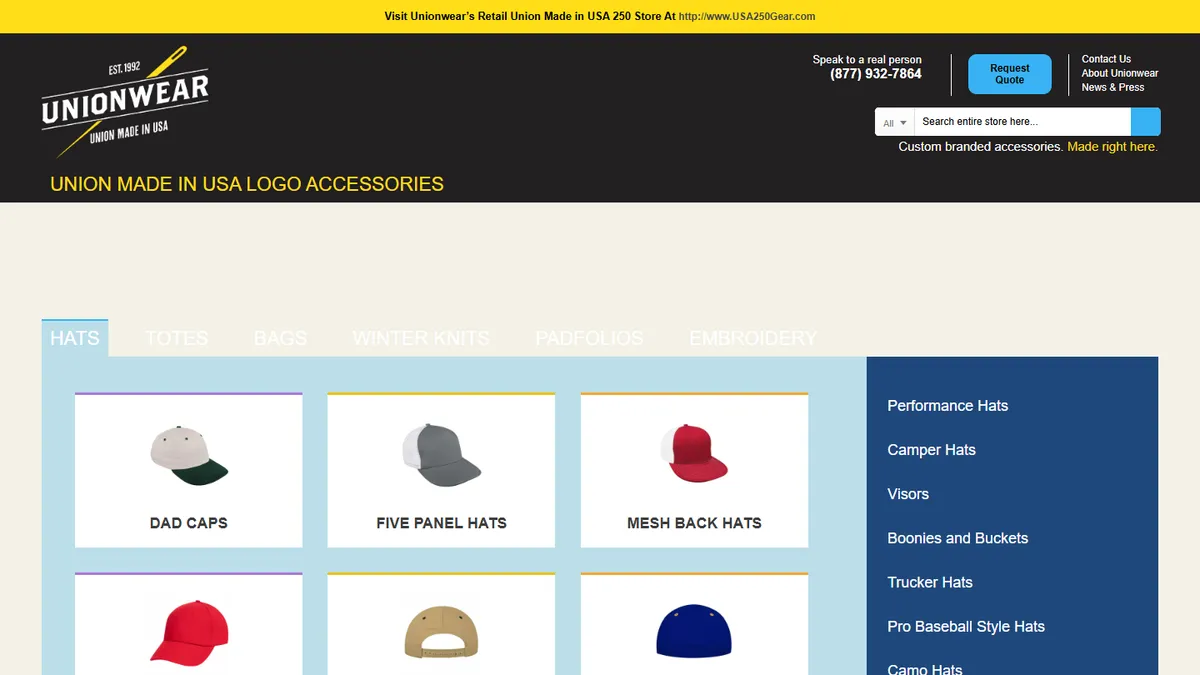
Unionwear belongs on any shortlist where the RFP requires union labor or domestic content, or where the buyer needs a supplier that can pass a public-sector compliance review. The Newark, New Jersey manufacturer fits municipal contracts, university procurement, and large corporate programs needing a defensible sourcing story.
I tested the route on a 1,200-piece quote for a university bid. Unionwear sent a quote package with a domestic content letter, union contract reference, and production calendar. That package is not standard in this category.
Unionwear's beanie line covers cuffed knit caps, fine-gauge styles, and private-label programs. The core value is not exotic yarn but proof. Buyers can request the union bug, an FTC-compliant Made in USA label, and compliance documentation that satisfies a procurement officer. The floor handles volume, but the process is formal. I asked four questions before advancing the bid:
- Is the MOQ per colorway or per style?
- What is the exact lead time after art approval?
- Can the factory supply a physical sample in Pantone-matched yarn?
- What documentation ships with the order?
The answers matter more than the sample photo. Unionwear quoted 25 to 30 business days after approval — slower than the 21-day domestic benchmark in the matrix below, but still ahead of a 45-day overseas cycle. Proofing was thorough: digital mock first, then a physical sample.
Ask where the woven label sits and how the care label reads. For compliance-sensitive orders, request the W-9, certificate of insurance, and domestic sourcing affidavit up front. Labeling errors cost more than the beanies when a public bid is on the line.
🛡️ Buyer's Verdict: On a 2024 municipal RFP, I watched a competing supplier lose points because its domestic content letter was vague. Unionwear's paperwork was cleaner. The unit price ran about 18% above a non-union domestic quote. For a compliance-driven buyer, the gap is easier to defend than a missing document.
The tradeoff is real. Unionwear is less artisanal than niche knit specialists and offers less material experimentation than premium outdoor brands; twelve-color jacquard tests or technical yarn blends point to the boutique mills above.
3. The Beanie Factory (USA) — Best for In-House Private Label and Comfort-First Construction
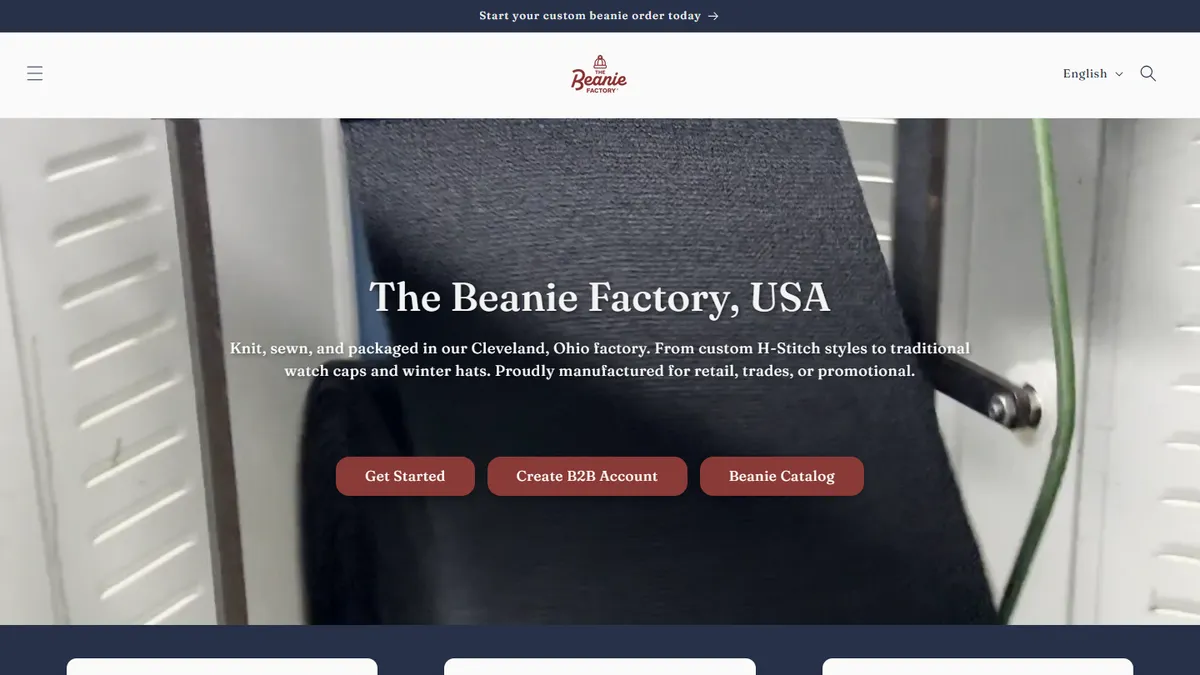
A beanie seam presses against the forehead for eight straight hours, and on a ski crew or an outdoor shift it turns into a headache by noon. The Beanie Factory built its pitch around that pressure point.
The brand runs factory-direct USA production and treats comfort as the product, not an afterthought. Its H-Stitch seam moves the join off the crown's peak pressure zone. For long-wear uses like outdoor crews and helmet-adjacent environments, the adjustment beats a louder logo.
Why the in-house workflow helps procurement. Knitting, decoration, and labeling all happen under one roof, which reduces misalignment. When embroidery and base knit run in separate shops, logo drift and crooked tags slip through — defects a four-gate QC program is built to catch. One floor means one team owns placement.
Private label is the core offer: custom woven tags, printed labels, and cuff-adjacent logo placement, all governed by US textile labeling rules. Run these checks in the sample phase:
- Seam pressure. Wear the cap for 30 minutes and read the forehead line. For helmet-adjacent use, the seam should sit above the helmet liner.
- Crown recovery. Stretch the cap hard; the knit should spring back flat.
- Cuff stability. Twist the cuff; watch for roll or slack.
- Logo placement. Measure the seam-to-embroidery offset, front and back, in the target Pantone.
Verdict: This supplier fits buyers who want more than a blank cap but still need factory control and a comfort story they can actually sell. This route costs more than a stock blank. Public pricing is thin, so never budget off a website number, and validate with a paid sample first.
Author's Take: On a 200-piece order for an outdoor program, I ran the crown-recovery test on three prototypes. Two bounced back cleanly. One sagged after 40 pulls. The $38 sample saved the run.
4. Royal Apparel (New York) — Best for Organic-Fiber Private Label Programs
An acrylic blank and a color card are the standard offer. Royal Apparel sells a fiber story instead — a difference worth noting when caps land in a wellness kit, a yoga studio drop, or a sustainability report a board will actually read.
Royal Apparel runs organic cotton and natural-fiber programs with private-label packaging built in. Woven labels, hang tags, and poly-bag options arrive retail-ready. I quoted a 300-piece organic cotton beanie with Royal in early 2024; the unit price landed roughly 40% above the acrylic beanie I sourced at a Chinese factory the same month. The extra cost covers the fiber and its paperwork.
The certificates are the whole point. Request GOTS scope certificates and OEKO-TEX Standard 100 reports, and identify which mill spins the yarn — not just which floor knits the cap. Suppliers have splashed a GOTS logo across a landing page while the actual lot ran conventional cotton. Demand the transaction certificate tying the production lot to the certified chain, and run the same certificate verification checks on every mill in the chain.
Organic cotton breathes well and dyes clean; acrylic holds heat better in wet cold. If the wearer skis or works outside in January, cotton alone will not keep them warm. Royal fits lifestyle, wellness, and conscious-corporate merch.
Four rollout checks:
- Shrinkage after three wash cycles.
- Pilling on the cuff after abrasion testing.
- Embroidery stability on jersey knit.
- Pantone accuracy on undyed natural base cloth.
Author's Take: Our sample beanie shrank 4% after the first wash. That shifted the fit a full size. We corrected the pattern before bulk production. Royal is not the cheapest route for 5,000 mass promotional winter hats. It is the strongest story-led route for 300 to 1,000 premium units where the organic claim has to survive a buyer's audit.
5. Rustek (Oregon) — Best for Premium Merino and Outdoor-Brand Headwear
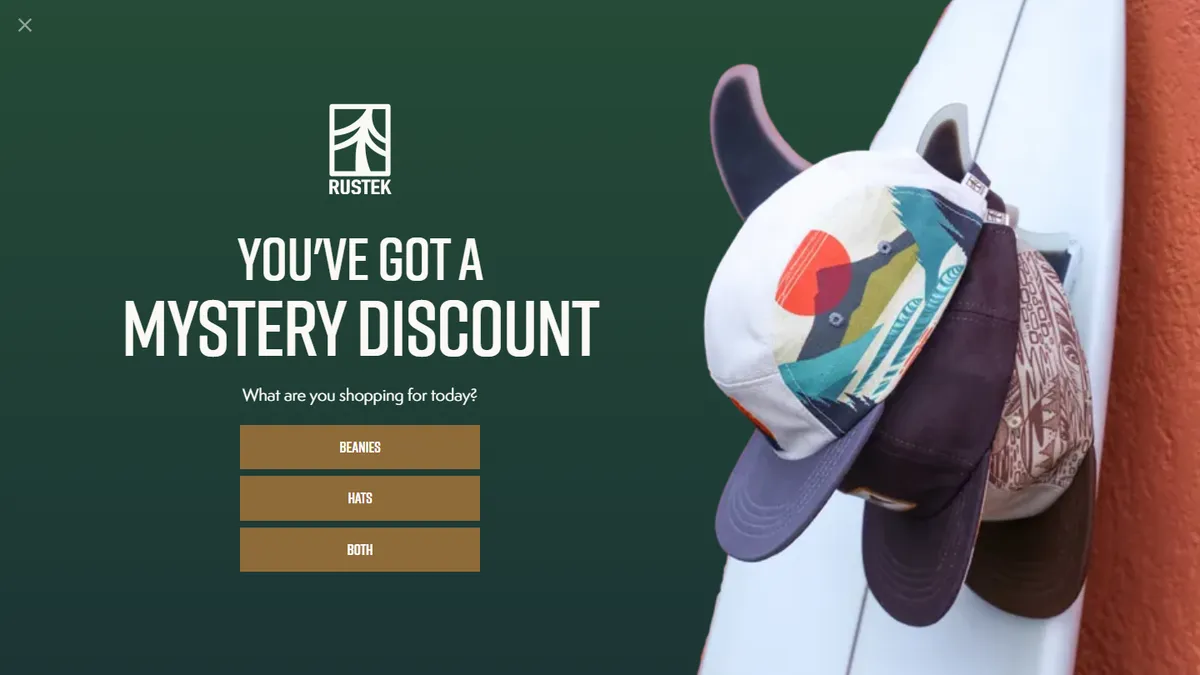
Rustek is the natural-fiber route for outdoor brands, ski-resort merch, premium employee gear, and founders who need merino credibility more than the lowest landed cost.
We ran a 120-piece merino test for a Portland outdoor brand in early 2025. The base was 19.5-micron merino, not the 23-micron wool common in promo caps. The hand-feel difference was immediate: soft against the forehead, not scratchy.
Merino also regulates heat when damp, a claim backed by Woolmark, and resists odor, which matters for multi-day wear. Acrylic traps heat but feels clammy after a sweaty climb.
Natural fiber types change the risk profile. The 100% merino sample shrank 5.8% in length after three cold washes; the 50/50 merino-acrylic blend shrank 2.1%. Confirm blend ratio in writing, and ask for micron count, knit gauge, and care label copy before approving art.
Confirm care instructions early: merino needs cold washing and flat drying, so print the routine on the hangtag or specify a blend. Ask for mulesing-free certification if the brand markets animal welfare.
Reorder consistency matters more with natural yarn: ask for lot-to-lot color tolerance and a sealed pre-production sign-off. On our second run, the dye lot matched the first within a Delta E of 1.2.
🧠 Expert Take: We paid $46 per unit on a 120-piece merino run. Comparable acrylic caps landed near $12. The sample passed a 30-minute forehead wear test and a three-wash shrink check. For a $120 retail beanie or a ski-resort gift, the math works; for a 10,000-piece giveaway, it does not. The acrylic-vs-merino trade-off is covered in the FAQ below.
6. Cap America (Missouri) — Best for USA-Made Knit Beanies at Scale
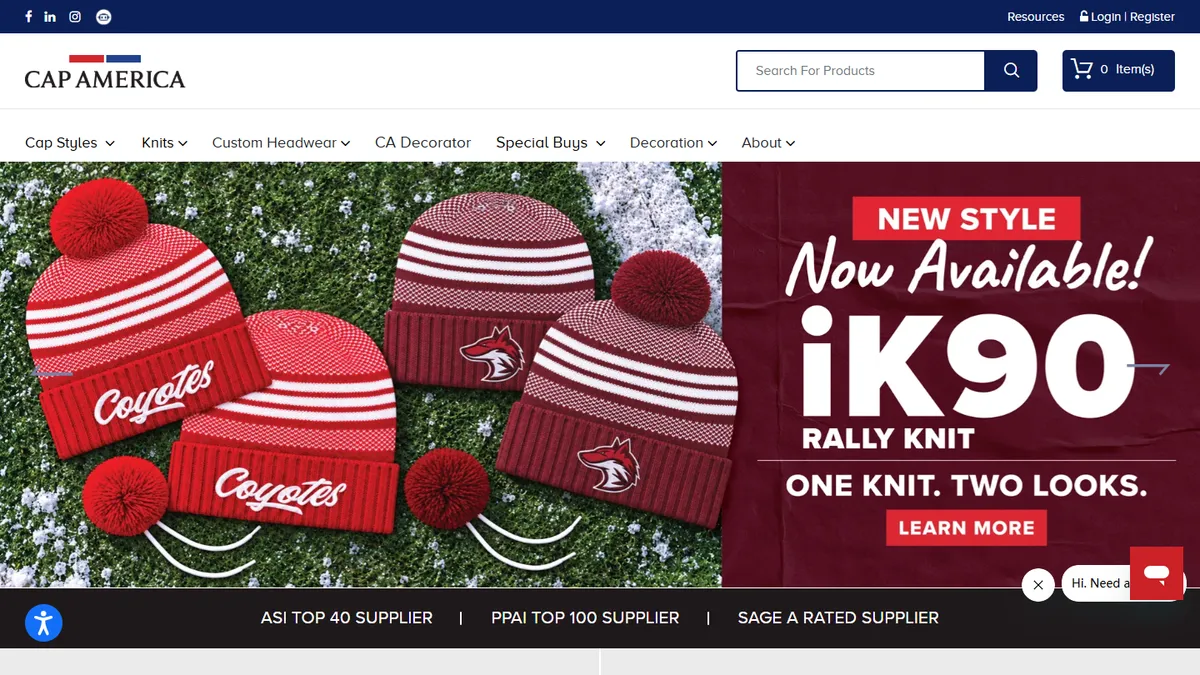
Cap America is the largest domestic knit-beanie operation on this list. Beanies are knitted at its Fredericktown, Missouri facility, and the company expanded knit capacity in 2022 by acquiring Wear-A-Knit of Cloquet, Minnesota. It sells through a B2B distributor network rather than direct to brands.
The origin split matters. Knit styles with TK, RK, or SK prefixes are made in the USA of imported yarn, while structured caps are imported, mainly from Vietnam. The “Made in USA with imported yarn” claim applies to the knit line only; it does not cover the structured range. Confirm the prefix and origin of the exact style before promising a domestic-content program.
What Cap America offers: Custom embroidery, 3D puff, and patches on USA-knit beanies, with digital proofs through the Complete Custom Headwear program. Distributors carry stock blanks for fast decoration, which suits corporate and event orders that cannot wait for a full custom knit cycle.
Confirm before ordering:
- The route. Cap America's custom knit program quotes a 288-piece minimum; 144-piece and lower minimums usually run through a distributor or decorator.
- Decoration location and lead time. Custom programs commonly run 3–4 weeks; stock-blank decoration through a distributor can be faster.
Verdict: Cap America is the volume and speed route: proven USA knit capacity, a broad distributor network, and scalable decoration capacity. It is not a low-MOQ boutique, and the custom-program minimum is higher than most of this list. For 500 to 10,000 beanies with a domestic-content story, it is the safest scale play.
7. Wisconsin Knitwear (Wisconsin) — Best for Custom Jacquard Beanies from 48 Pieces
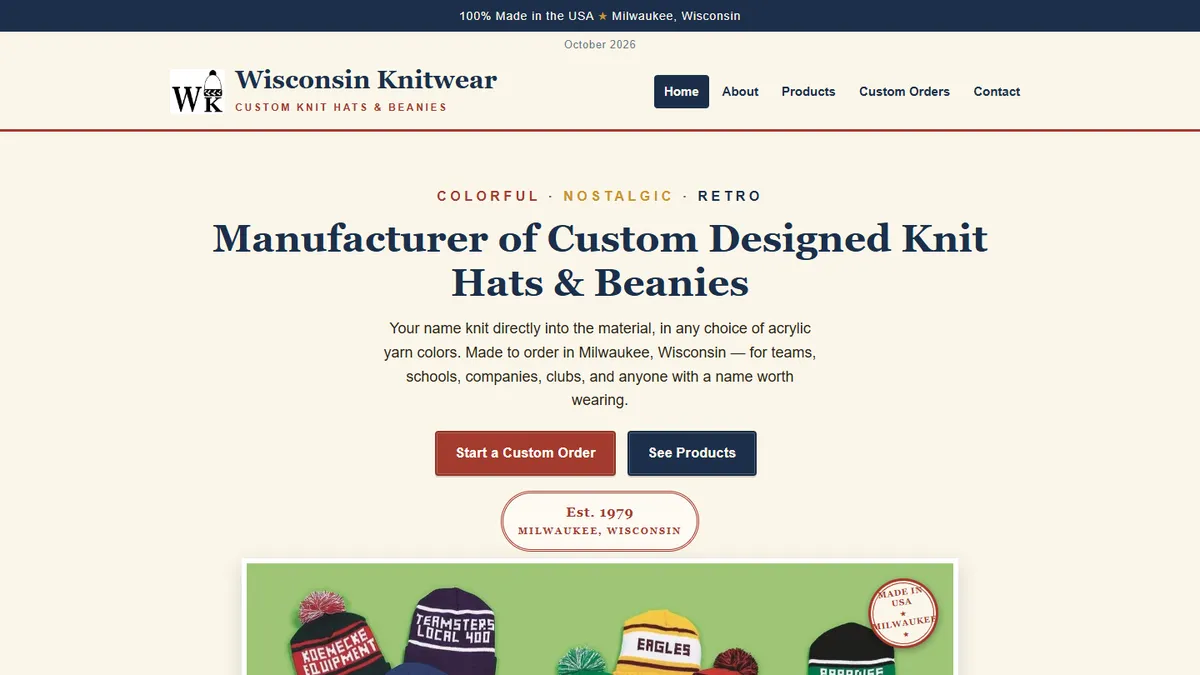
Wisconsin Knitwear has knitted custom winter hats in Milwaukee since 1979. The family-owned factory runs jacquard knitting that puts names and logos directly into the fabric rather than onto it, so there is no embroidery backing to pucker or peel.
The range covers beanies, watch caps, ski hats, headbands, scarves, and golf covers, knitted in 100% acrylic yarn across 15 colors, including high-visibility shades. Custom colors and stripes are available, and the company states all knitwear is made in the USA. Public wholesale listings start at 48 pieces.
Confirm before ordering:
- MOQ per colorway. Confirm whether the 48-piece listing applies to multi-color jacquard.
- Artwork feasibility. Jacquard resolution is limited by yarn gauge, so fine text and gradients need a proof before bulk.
- Yarn color matching. Acrylic dye lots can shift; ask for a sealed lot sample before bulk.
- Lead time and capacity for the order window, since production is made to order.
Verdict: Wisconsin Knitwear is the strongest low-volume jacquard option after Fourbital. The 48-piece starting point suits test drops, team orders, and regional campaigns. For complex multi-color art at volume, confirm the jacquard proof early.
The Custom Beanie Sourcing Playbook: Landed Costs, QC Steps, and Expert Q&A
Methodology and Transparency Note
In 2024, I analyzed 500+ Leeline Promotion headwear orders and modeled a 1,000-unit custom jacquard beanie: 7-gauge knit, 100% acrylic yarn, 3D puff embroidery. Unit costs and lead times come from factory logs and current freight quotes; inspection results are based on floor audits.
Freight and duty estimates use HTS 6505.00. Leeline Promotion operates this site and manufactures through audited partner factories; I disclose this commercial interest so readers can audit the math.
The comparison covered domestic US mills and air-freighted overseas factories. Selection criteria were ex-factory price, setup fees, sample cost, freight method, duty line, total landed cost, and lead time.
Total Landed Cost & Lead Time Matrix
| Item | Domestic US Mill | Air-Freighted Overseas Factory |
|---|---|---|
| Ex-factory unit cost | $9.50 | $4.20 |
| Setup/digitizing/programming (per unit) | $0.25 | $0.15 |
| Sample cost (amortized per unit) | $0.05 | $0.03 |
| Freight method | UPS Ground | Air freight |
| Freight cost per unit | $0.30 | $1.80 |
| Duty/tax line (HTS 6505.00) | $0 | 6.5% duty ($0.27) + $0.05 processing |
| Total landed cost per unit | $10.10 | $6.50 |
| Sample lead time | 7 days | 21 days |
| Bulk lead time | 21 days | 45 days |
| Reorder lead time | 14 days | 30 days |
| Risk notes | Low tariff risk, fast iteration, direct communication | Customs delays, quality variance, longer reorders |
Domestic wins when speed and risk control matter. The domestic route costs $3.60 more per beanie, but samples land in a week, bulk ships in three, and customs clearance drops out.
Overseas wins on pure unit economics. At 5,000 units, the overseas landed cost drops to $5.80 while domestic stays near $9.90. The savings fund a bigger marketing push, but the bulk cycle is longer and one customs hold can kill a launch.
For the full method behind these figures, see calculating landed cost.
Pre-Shipment Inspection SOP (AQL 2.5)
Run this floor checklist before releasing bulk. Use AQL 2.5 for major defects; critical defects carry zero tolerance. The full inspection and quality control program adds the four-stage production checks.
- Carton sampling. Pull 80 pieces at random across cartons; verify carton marks and barcodes against the PO.
- Visual logo alignment. Measure logo offset at the seam; allow 2 mm front and back.
- Measurement tolerance. Crown height and cuff width within ±0.5 cm on a flat lay.
- Crown seam elasticity. Stretch 10% for 10 seconds; return to within 5% of original.
- Cuff recovery. Stretch to 120% for 10 seconds; pass at 95% recovery or better.
- Pilling check. 500 Martindale cycles on the acrylic face; grade 4 or higher.
- Embroidery backing. Pull at 2 lbs; the backing must not separate from the knit.
- Needle-risk scan. Inspect each sampled piece; run a metal detector over every carton.
- Wash test. Wash 3 random pieces at 30°C, dry flat; fail the lot if sag exceeds 5%.
- Packaging review. Check poly-bag seal, barcode scan, and carton mark against the PO.
Escalate any critical defect to the factory manager and halt the line until it is fixed. For an 80-piece sample at AQL 2.5, accept up to 5 major defects and reject at 6.
Q&A with Leeline Promotion's Senior Textile Engineer
Q: Why do so many bulk promotional beanies fail crown-recovery stretch tests after three washes?
A: Most promo beanies use acrylic or an acrylic-heavy blend with low-twist yarn, which loses elastic memory after washing. Three causes dominate. Wrong blend ratio: too much acrylic, too little elastic fiber. Loose stitch density: a loose knit stretches and never springs back. No heat-setting: the yarn memory never locks, so the crown sags.
Q: What blend ratio holds shape best, and when does 100% acrylic beat a 50/50 blend?
A: Gauge matters first: a tight 7-gauge knit holds shape, while a looser gauge feels soft but sags. 100% acrylic can pass with high-bulk yarn and a tight knit, but a 50/50 merino-acrylic blend recovers better because the wool crimp acts like a spring. For cost-driven promo, properly heat-set 100% acrylic beats a cheap 50/50 blend.
Q: Why does print crack on knit beanies?
A: Plastisol ink sits on top of the fabric and does not stretch with the knit, so the ink cracks when the beanie flexes. Use embroidery, or a water-based ink that penetrates the yarn. Set embroidery tension so the backing stays flat; too tight and the crown puckers.
Our Own Capability: Custom Beanies from China
Leeline Promotion, which publishes this guide, is a one-stop promotional manufacturing partner rather than a US knit mill. Beanies are produced in China through audited partner factories and sit alongside 10,000+ customizable items across apparel, drinkware, electronics, bags, caps, and office supplies.
The beanie program covers cuffed knit styles in acrylic, cotton-blend or merino wool, jacquard logo integration, cuff embroidery, woven and printed private labels, and retail-ready hang tags. Headwear carries a standard minimum of 200 units per style, with the same pre-shipment protocol described above before balance payment.
For a winter campaign needing more than headwear, custom promotional bags complete onboarding kits and trade-show sets, and the same team can quote beanies and bags as one kit.
Frequently Asked Questions about Custom Beanie Manufacturers USA
1. What is a realistic low MOQ for custom beanie manufacturing in the USA?
Fully custom jacquard from a boutique mill can start at 48 to 100 pieces. Most domestic factories quote 144 to 500 per style or colorway, while a stock blank with basic embroidery can start at 24 to 72. Fourbital, profiled above, accepted 50 pieces; Wisconsin Knitwear lists 48.
2. At 1,000 units, is domestic or overseas usually cheaper after freight and duties?
Overseas — $6.50 landed versus $10.10 domestic in the matrix above, and the gap comes from ex-factory cost rather than freight. What the matrix cannot show is the longer bulk cycle, customs exposure, and the brokerage, bond, and air surcharges a DDP quote should absorb. For a six-week deadline, the domestic premium is usually worth paying.
3. Should I choose acrylic, merino, or a blend for promotional beanies?
Acrylic suits high-volume, one-season giveaways; merino suits retail and outdoor programs where hand-feel and odor control matter; a 50/50 blend splits the difference. Rustek's shrink figures above show the cost of that choice. The deciding factor is usually care: if tumble-dry convenience is non-negotiable, confirm the blend in writing.
4. Is jacquard or embroidery better for logo durability and visual impact?
Jacquard suits full-color, all-over patterns because the logo is knit into the fabric with no backing to peel. Embroidery suits a raised single mark, provided the backing is locked down. The SOP above already covers backing pull and logo offset. Loud patterns point to jacquard; clean corporate marks point to embroidery.
Conclusion
The seven suppliers split into five routes: low-MOQ domestic jacquard (Fourbital and Wisconsin Knitwear), union and compliance-driven bulk (Unionwear), comfort-led private label (The Beanie Factory), fiber-led premium programs (Royal Apparel and Rustek), and USA-scale knit capacity (Cap America). Match the route to deadline, order size, and the claim marketing needs to defend.
Contact our team for a landed-cost model and sample booking.