
Choosing pen printing methods by looks alone costs money. A finish that photographs well in a catalog does not always survive a year in a jacket pocket.
On a 5,000-unit ABS run, pad-printed logos on gloss barrels began to wear through around 40 alcohol swipes. Laser-engraved aluminum held past 500. The gap is why this guide is built as a buying tool, not a style gallery: each method below covers mechanics, substrates, artwork limits, durability risk, and the order size where it stops making sense.
Short answer: Pad print one to four spot colors on plastic at 3,000 to 20,000 units. Use UV digital for gradients and runs under 3,000. Choose rotary screen for full 360° wraps from 5,000 units. Specify fiber laser for metal pens that must stay marked for years. Reserve silk screen for lacquered metal when an exact PMS match is non-negotiable.
| Method | Best for | Substrates | Setup cost | Output | Wear resistance |
|---|---|---|---|---|---|
| Pad print | 1–4 spot colors, 3,000–20,000 units | ABS, PS, PP (flame or plasma prep) | ~$30 per cliché | 1,200 pens/hr | 40 IPA rubs |
| UV digital | Full color, gradients, runs under 3,000 | ABS, PS, PP with primer | ~$150 per fixture | ~400 pens/hr | 50 IPA rubs |
| Rotary screen | 360° wrap, 5,000+ units | Printable plastics | $150–$250 per color | Medium | 80 IPA rubs |
| Fiber laser | Permanent metal marks, premium programs | Anodized aluminum, steel, brass, titanium | Higher; no color approvals | Medium | 500+ IPA rubs |
| Silk screen | Exact PMS match on lacquered metal | Coated aluminum | Screens per color | Slow (adds 3–5 days) | Fails early at edges |
5 Pen Printing Methods Compared
Each method below covers the same ground: how the image reaches the barrel, which substrates accept it, the artwork it can hold, where it fails in production, and the order size where the economics flip. The table above condenses the five options into one screen; the sections carry the buying detail behind each row.
1. Pad Printing on Plastic Pens: Best for Simple Logos at Volume
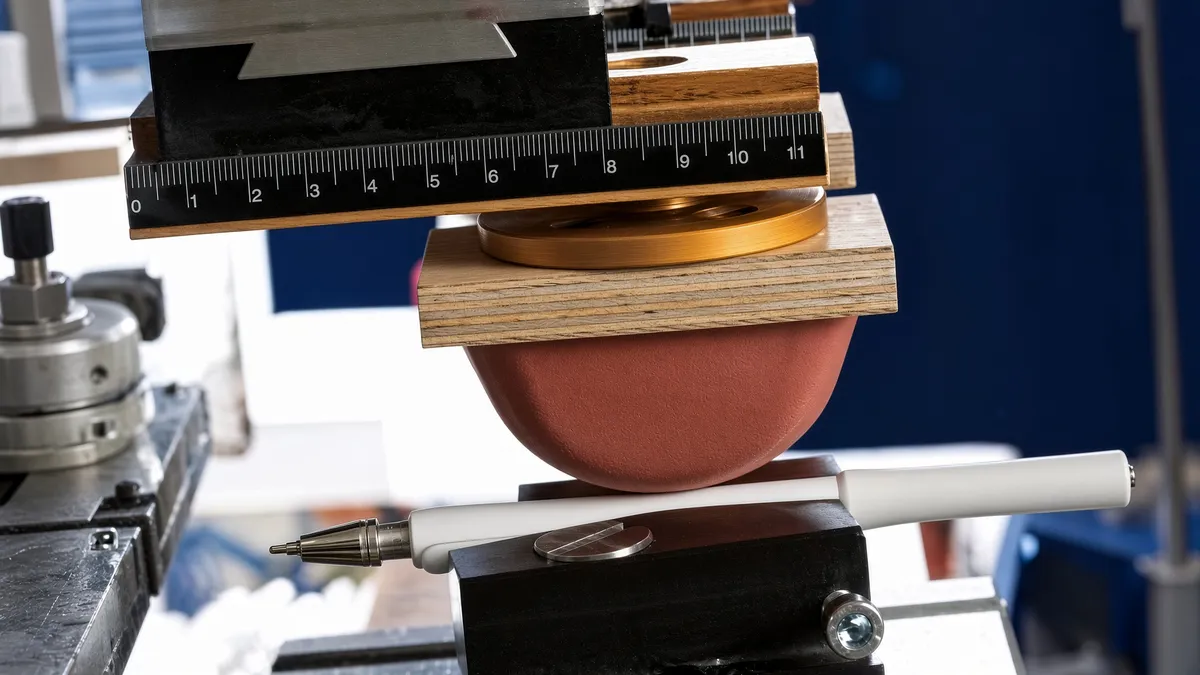
Pad printing wins on curved barrels: the pad bends, the ink doesn't.
A laser-etched cliché holds the logo. Ink floods the plate, a doctor blade scrapes it clean, and a 60-shore silicone pad lifts the image and rolls it around the barrel without stretching the art. The deposit is 8 to 12 microns, thin enough to hold a 0.3 mm line and 5 pt text. That is why pad printing remains the default for custom promotional pen manufacturing.
Substrates are gloss and matte ABS, PS, and PP after flame or plasma prep. Artwork is limited to four spot colors or fewer, with no gradients or halftones.
Six process controls decide whether the print survives:
- Incoming barrels. Pull 50 per carton; check diameter at ±0.1 mm.
- Surface prep. Wipe with 99% IPA; 90 seconds flash-off.
- Cliché. Etch depth 25 to 30 microns, re-checked at 2,000 impressions.
- Ink. Solvent ink at 18 to 22 seconds on a Zahn 2 cup.
- First-off. Pantone approval under D65 light.
- Cure and test. 18 minutes at 60°C, 24 hours ambient, then tape and rub checks.
The failure modes are process-level, not design-level: pad wear near 8,000 impressions, viscosity drift on humid days, and loose barrel tolerances that shift registration. In the 5,000-unit run, pad-printed pens averaged 1.8% rejects against 0.4% for laser.
For two to four colors at this volume, pad printing is the method to beat. For a direct durability comparison between pad-printed plastic and laser-engraved metal, see metal vs plastic pens.
2. UV Digital Printing on Curved Plastic Barrels: Best for Full-Color Artwork and Short Runs
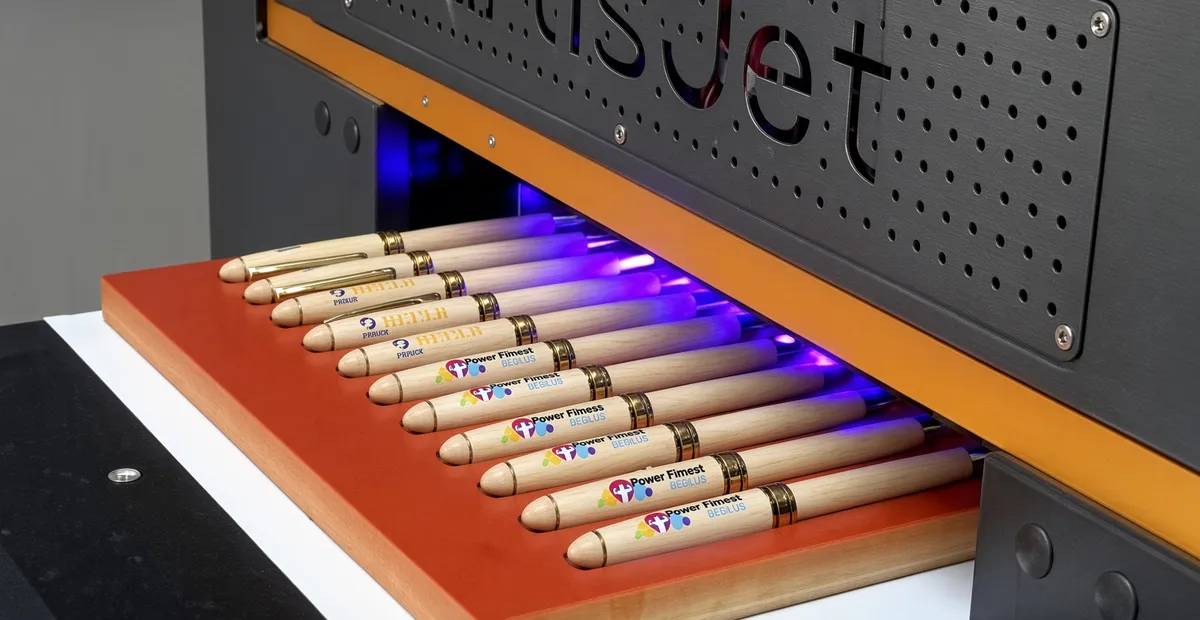
A full-color gradient kills a pad-printing plate. UV digital keeps the gradient.
The printhead jets UV-curable ink onto the barrel, and an LED lamp cures each pass in under two seconds. With no plate or cliché, color count stops driving cost.
Best for photos, gradients, six or more colors, variable names, and tight deadlines. ABS and PS print clean; untreated PP needs flame or primer; PE rejects ink outright. The rotary fixture must hold runout under 0.05 mm, or dot shape smears.
Floor sequence: IPA wipe with a 60-second flash-off, jig and runout check, primer on PP only, white base on dark plastic, CMYK plus Pantone spot passes at 600 dpi, then in-line cure and a four-hour rest before packing.
Two risks dominate. Dust drives 2% to 3% rejects, and under-cured ink passes visual inspection but fails in use, which is why a tape pull and 50 IPA double rubs belong in the acceptance criteria. Changeover drops from 20 minutes to 10 minutes, so UV suits 48-hour artwork changes but loses on unit cost once the design settles and volume climbs.
Use UV when color complexity matters more than unit price. Above roughly 3,000 single-logo pieces, pad printing is cheaper.
3. Rotary Screen Printing on Plastic Pens: Best for 360° Wraparound Branding
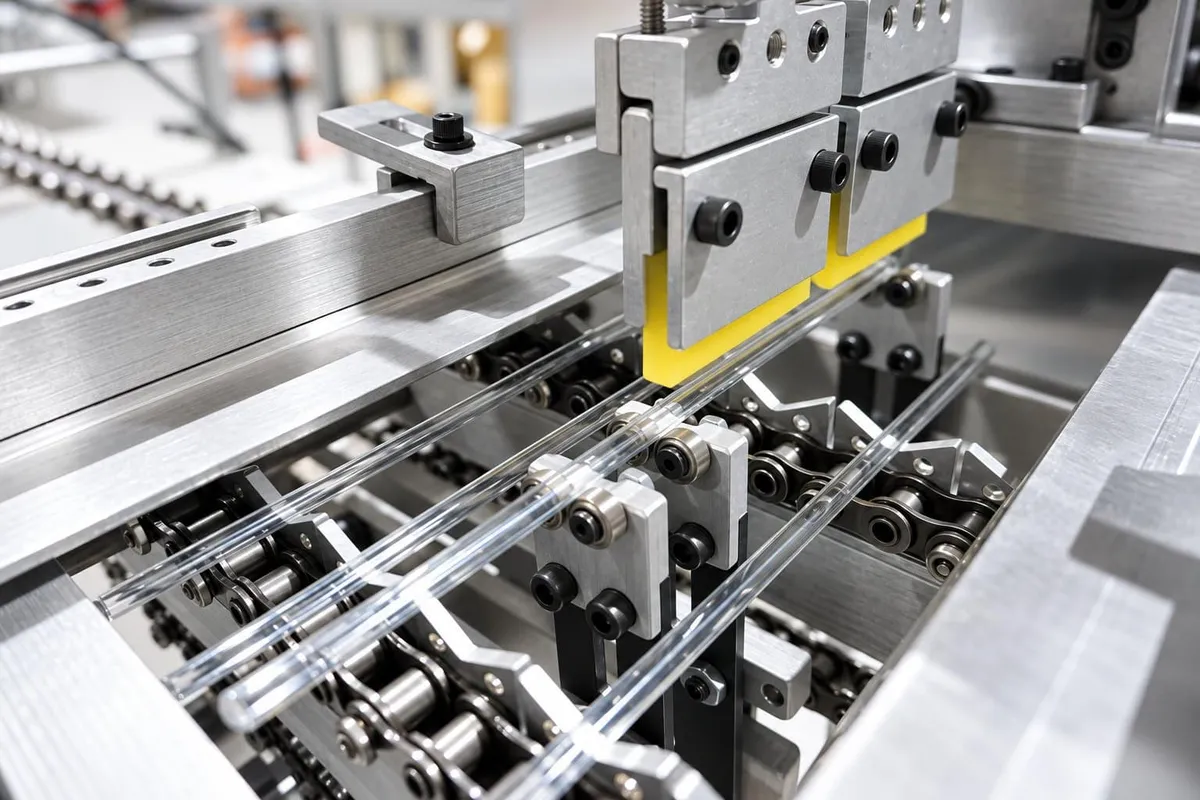
Most methods stop at one side. Rotary screen printing carries the image around the full circumference.
A cylindrical screen spins with the barrel while a squeegee pushes ink through 300 to 400 threads-per-inch mesh. Barrel and screen move in sync, so a long logo lands seamlessly, and a 70 to 80 shore squeegee at 15 to 20 degrees controls deposit and smear.
Artwork must match the barrel circumference, typically 40 to 50 mm on plastic pens. Design to exact circumference plus 2 mm bleed; short art leaves a gap and long art overlaps.
Quality gates: registration every 500 pieces, seam overlap under 0.2 mm, tape adhesion after UV cure, and a 10x loupe check on the seam. On a 5,000-unit comparison run, rotary wraps survived 80 alcohol swipes.
Economics are the constraint. Cylindrical screens cost $150 to $250 per color, which pushes the practical order range to 5,000–10,000 units; below 5,000, pad or UV costs less.
Aluminum barrels need a primer system for a durable wrap, so most metal jobs go to laser engraving instead; pen barrel materials covers which metals accept a lacquer finish. As our production technician puts it: "ABS and most printable plastics grab the ink. Aluminum pushes the job toward engraving."
Choose rotary when the logo has to read from every angle, and skip it for a single-color mark on one side.
4. Fiber Laser Engraving on Metal Pens: Best for Permanent Branding
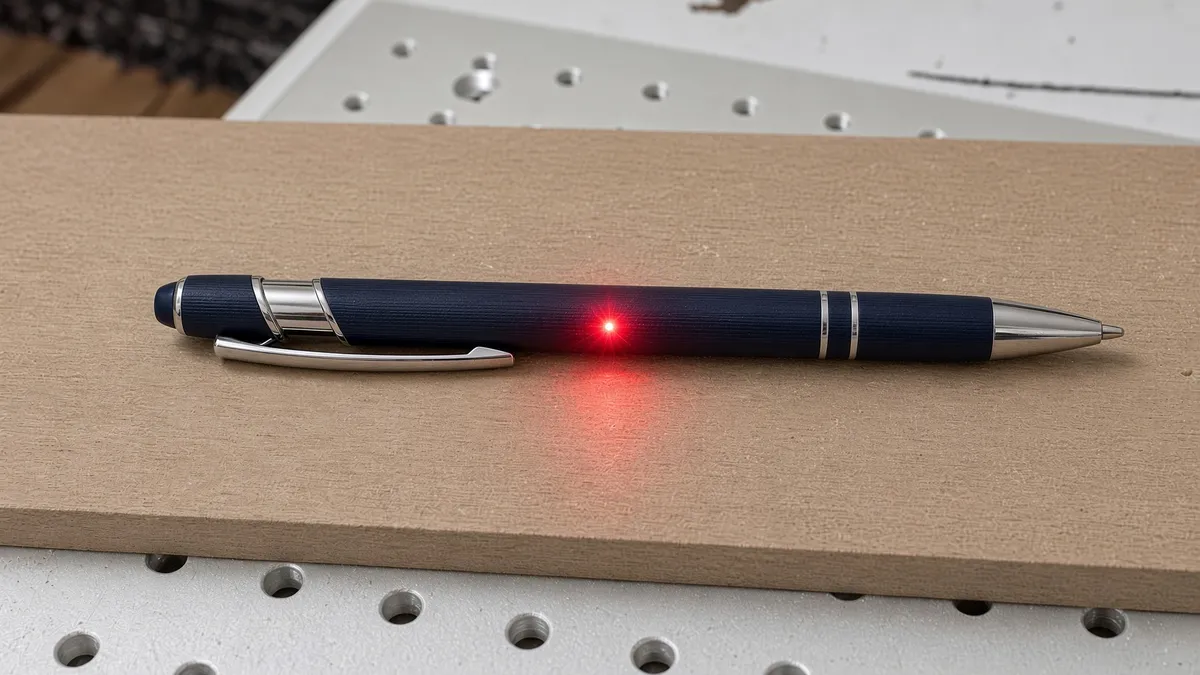
Pad and UV inks sit on top of the barrel. Fiber laser goes inside it.
A 1064 nm beam vaporizes coating or alters the metal surface. On anodized aluminum it removes the oxide layer and leaves a light mark; on stainless steel and brass it produces a dark oxidized mark. The result is monochrome but permanent, with no ink to chip, peel, or fade.
Compatible materials are anodized and bare aluminum, stainless steel, brass, and titanium. ABS and PP are out. Artwork should be vector line art, text, serials, or barcodes at 0.2 mm minimum line weight; gradients and tiny halftones wash out.
The durability difference is not marginal:
| Test | Pad-printed ABS | Laser-engraved aluminum |
|---|---|---|
| Scratch resistance, 500 g stylus, 100 cycles | 22% ink loss | 0% mark loss |
| Fade after 200 hrs QUV | 14% ΔE | 2% ΔE |
| IPA rubs to visible failure | 40 | 500+ |
That table explains why premium programs accept the higher setup cost: the mark cannot be wiped off in daily use. The trade-off is color. Laser cannot hit a Pantone chip, and contrast varies by alloy, so approve a physical first-off under D65 light before volume.
If you are shortlisting metal suppliers, review the China metal pen manufacturers comparison first.
5. Silk Screen Printing on Lacquered Metal Pens: Best for Exact PMS Matches
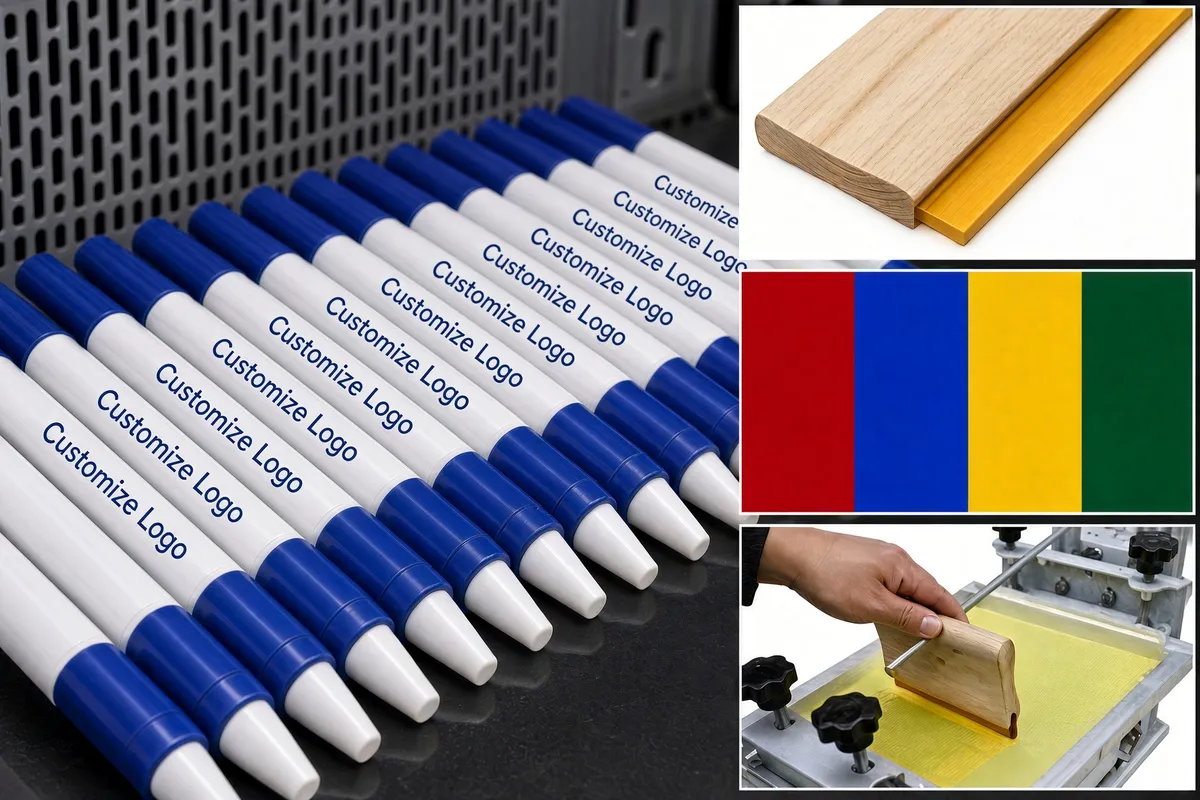
Silk screen is the one method I would not approve by default for metal pens.
Screen ink needs a cured lacquer or powder coat to bond to. Bare aluminum gives it nothing to grab, so the ink sits on slick metal and fails early. Once the barrel is coated, screen delivers what laser cannot: a true Pantone match, mixed to the chip and drawn down on the actual lacquer.
The trade-off is narrow:
- Color: screen wins outright; laser is monochrome and cannot hit PMS 185 red.
- Feel: screen leaves a thin raised ink layer; laser leaves a recessed or oxidized mark, and some gift buyers reject the raised feel.
- Durability: laser wins. In a 2,000-piece lacquered aluminum trial, 6.4% of screen-printed barrels failed at 50 IPA double rubs after edge wear, while laser held past 500.
- Lead time and rework: screen adds 3 to 5 days for ink matching, screen prep, and full cure, and carries higher rework risk because PMS drift or lacquer failure means strip and reprint.
Approve screen on lacquered metal only when brand color is the campaign anchor. Require a PMS drawdown on the actual lacquer, a 24-hour tape pull, and the same rub test before volume.
How to Choose the Right Pen Printing Method for Bulk Orders?
Step 1: Answer Four Questions Before You Compare Quotes
- Is the barrel metal? Go laser on bare or anodized metal; use screen only on a coated barrel that needs an exact PMS match.
- Does the artwork have photos, gradients, or more than four colors? Go UV digital.
- Is the logo a long continuous graphic? Go rotary, provided volume reaches 5,000 units.
- What is the order size? Under 3,000 points to UV; 3,000–20,000 to pad; a wrap plus volume to rotary.
Step 2: Put the QC Gate in the Purchase Order
Write the tests into the PO, not into a conversation. The minimum:
- Adhesion: ASTM D3359 cross-hatch plus a 3M 610 tape pull at 90°.
- Rub resistance: 40 to 50 IPA double rubs for printed ink; 500+ for laser.
- Abrasion: 500 g stylus, 100 cycles.
- Weathering: QUV fade under ASTM G154.
- Cosmetic acceptance: AQL 2.5 for visual defects, with a separate hard cap of 2% adhesion failure per batch. A passing sample does not override a cure failure.
- Registration: checked every 500 pieces.
For the QC system behind these tests, see inspection and quality control. Confirm the factory holds ISO 9001 certification and that the certificate scope covers the print line, not just final assembly.
🧠 Expert Take: "The flat face of a barrel always passes. We test the logo edge and the seam, because that is where the thumb lands and where every pad-print failure starts." — Manager Chen, QC Manager
Step 3: Attach the Compliance Documents
For global buyers, attach REACH, RoHS, EN 71-3, and Prop 65 reports for inks and coatings to the PO. The compliance center explains what each report covers.
Step 4: Lock the Spec, the Pilot, and the Supplier
Approve a 500-piece pilot before scaling. Check the first-off under D65 light, UV fixture runout, and rotary seam under 0.2 mm, then run the rub test on pilot pieces rather than on the first-off alone. Keep the approved pilot as the reference sample for bulk.
Ask for setup costs as separate line items — clichés, UV fixtures, screens, laser programming — so two quotes can be compared on the same basis rather than on a single unit price.
For pen-specific sourcing, confirm the factory runs the selected decoration in-house and can show a first-off from the same line. Still choosing the barrel? Compare types of promotional pens before you lock a decoration method.
Need factory input on a spec before you deposit? Contact our sourcing team. We help buyers choose the method, run the pilot, and lock the spec.
Disclosure: This guide draws on LeelinePromotion's production-floor process reviews and QA records. We do not accept paid placement in this comparison.
Frequently Asked Questions About Pen Printing Methods
Q1. What artwork file should I send for each pen printing method?
Send vector files (AI, EPS, or PDF) with fonts outlined and Pantone references noted. Laser and pad printing need vector because small text and 0.3 mm lines fail when traced from raster. UV digital can work from a 300 dpi raster for photographic art, but vector still produces cleaner edges.
Rotary screen needs artwork built to the exact barrel circumference, so include the barrel diameter with the file.
Q2. Why does a pad-printed logo wear off early?
The usual causes are process, not design: untreated PP or PE that never received flame or primer, ink mixed outside its viscosity window, insufficient tunnel cure, or a logo placed on the barrel edge where handling wear concentrates. Ask the factory for the IPA rub records from the batch. A batch with a documented 40-rub pass rarely fails this way.
Q3. Can laser engraving match a Pantone brand color?
No. Fiber laser produces a monochrome mark whose contrast depends on the alloy and surface finish, so laser cannot reproduce a specific Pantone chip. Color-filling the engraved recess is possible, but adds a second process with its own durability limits. When color accuracy outranks permanence, choose screen printing on a coated barrel instead.
Q4. How do I compare two pen printing quotes fairly?
Put both quotes on the same spec sheet: same barrel, same artwork size, same decoration area, same packaging. Ask each supplier to list setup and tooling separately from unit price, state the MOQ for the chosen method, and commit in writing to the adhesion and rub tests. A lower unit price built on an unstated cheaper method is not a comparable quote.