
Most "best promotional products companies for business" roundups hide margin. Factory-direct pricing hides rework, customs surprises, and compliance gaps, and clean spec sheets routinely mask China-floor defects and late containers on large orders.
What actually separates these companies is the buying model and the landed cost behind it, so this guide ranks them on both — ordering model, landed cost, compliance evidence, QC process, logistics control, and dispute resolution.
This page compares 12 suppliers in two groups. The first six are distributor, platform, and rep-led models you order through; the next six are factory-direct and regional manufacturers available for direct sourcing. The models are not interchangeable — only the factory-direct group gives you control of the floor.
Disclosure: Leeline Promotion publishes this guide. No vendor paid for placement, and no vendor reviewed the guide prior to publication.
Key Takeaways
- Model first, price second. A sub-$1 ex-factory unit can land above $4 once freight, duties, and a failed inspection are added. Compare cost per compliant delivered unit, not the unit price.
- Six distributor and platform options, six factory-direct and regional manufacturers. Distributor and platform models sell convenience; factory-direct suppliers trade coordination for control and margin.
- Minimums divide the field. Self-serve platforms take small or one-off orders; factory-direct custom runs start in the hundreds per style.
- Vet the supplier, not the catalog. Registration, ISO 9001 scope, social-audit signals, signed sample approval, and a sampling plan — the six checks sit in the vetting section below.
- Cap revisions and confirm placement in writing. Open-ended revision rounds cause most print rejects.
Ordering Models Compared at a Glance
| Company | Ordering model | Best for | Main tradeoff |
|---|---|---|---|
| 4imprint | Broad-catalog direct marketer | One-off event runs needing wide assortment and fast quotes | Third-party decoration; distributor-level traceability |
| HALO | Rep-led enterprise program | Multi-department programs needing one accountable owner | Quote-based flow slows cross-vendor comparison |
| Sunday | Self-serve merch platform | Recurring internal programs and direct-to-recipient shipping | No custom factory builds |
| Staples Promotional Products | Procurement-bundled sourcing | Teams already buying office supplies through Staples | Standard catalog; catalog-level QC |
| Geiger | Rep-led, long-tenure accounts | Long-run programs that value account stability | Rep-dependent service; distributor-level factory visibility |
| Proforma | Local rep backed by a national network | Local accountability plus network pricing | Office-level service variance; manual quotes |
How We Vetted These Suppliers
Each vendor was shortlisted from publicly available material — its own website, product pages, published pricing, and stated minimums — then scored on the same criteria: sourcing fit, published minimums, stated lead times, compliance documentation, and pricing transparency.
The ordering reflects fit for different buying programs, not an overall quality score. We did not audit these vendors for this article, and no vendor supplied figures. Cost and lead-time gaps quoted below are planning bands drawn from published pricing and industry reporting, not measured results.
Ordering-Model Options: Distributor, Platform, and Rep-Led
The first six entries are models you order through — a broad-catalog direct marketer, a self-serve platform, a rep-led program, or a procurement-bundled account.
1. 4imprint — Best for Huge One-Off Promotional Runs with Broad Catalog Breadth
Founded: 1985 | HQ: Oshkosh, Wisconsin | Model: Broad-catalog direct marketer
Standards: Sedex SMETA and BSCI supplier audits; Better Choices responsible sourcing
For a 20,000-piece pen and lanyard order at a Las Vegas booth, 4imprint is the default. Their catalog spans thousands of giveaways. Ordering is familiar: pick items, upload logos, approve digital proofs, and pay by invoice. Event planners reuse this because quotes come fast and catalog search removes supplier shortlisting.
But procurement sees different numbers. On a comparable drinkware order, distributor landed pricing typically sits above a factory-direct quote — the gap pays for speed and assortment, not transparency.
Because a third party decorates, print consistency tracks the decorator's line rather than a single factory's own QC.
Compliance documentation is finished-goods focused — safety data sheets and supplier-audit protocols — rather than per-order raw-material traceability. For a trade show, that tradeoff works. For a corporate compliance file, ask what the file has to prove.
Our take: Best for one-off event swag where broad catalog, speed, and a familiar quote flow matter most — not repeat orders where unit margins, raw-material visibility, and factory-level QC matter. Compare any price against a factory-direct one before committing.
2. HALO — Best for Rep-Led Enterprise Programs
Founded: 1952 | HQ: Sterling, Illinois | Model: Rep-led distributor
Standards: ISO 27001 and 27701; Fair Labor Association member
HALO suits procurement and HR leaders running complex corporate programs. These buyers manage merchandise, staff uniforms, incentives, and multiple internal stakeholders. A dedicated account owner provides one accountable point of contact. This structure helps governance-heavy organizations maintain approvals, compliance, and consistent branding.
HALO works best when program oversight, not self-serve tools, is the priority. A named rep handles quoting, sampling, and vendor coordination. For apparel briefs, expect the rep to steer fabric and fit choices — the trade-offs are covered in our pique vs jersey and staff uniform workwear guides.
The tradeoff is workflow: quotes move through an account owner rather than a live cart, so side-by-side comparisons take longer. Account continuity is the bigger dependency — if the assigned rep leaves or changes territories, pricing and artwork approvals stall. HALO is still worth the premium when centralized control matters more than the lowest unit cost.
Our take: Choose HALO for multi-department programs that need one accountable owner. Before signing, request a written issue-escalation path and a named backup rep.
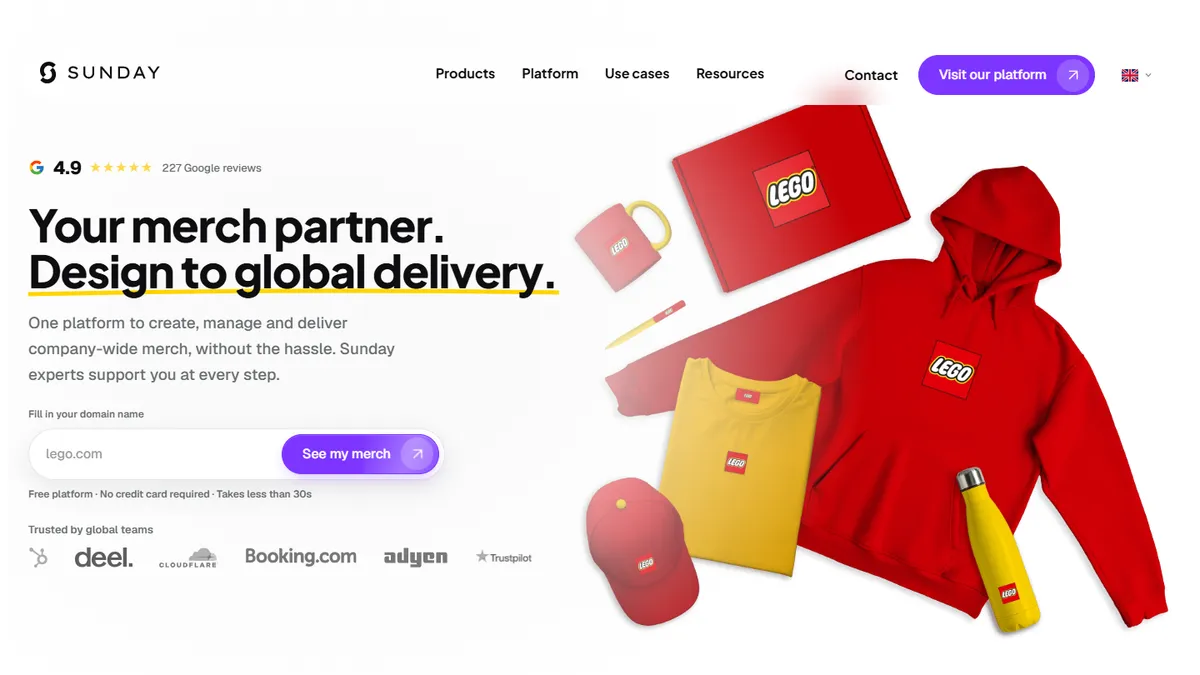
3. Sunday — Best for Self-Serve Multi-Team Merch Programs with Global Delivery
Founded: 2013 | HQ: Roeselare, Belgium | Model: Self-serve platform
Standards: OEKO-TEX materials; Sedex and BSCI supply-chain audits
HR and people-ops teams did not sign up to become shipping coordinators.
Sunday is a merch platform, not a quote-and-wait distributor. Live pricing and one-time brand controls let department leads pick items, choose sizes, and check out. Sunday ships to each address. Nobody packs boxes in a conference room.
For a 300-person remote onboarding drop, setup takes under two hours. Live pricing undercuts distributor quotes on simple drinkware, and direct-to-recipient shipping cuts the internal workflow from six steps to one. Address capture happens at the user level.
PPAI's company-store listings describe stores built to streamline ordering and cut errors; ASI coverage of company stores credits them with repeat sales through automation and reorder triggers.
Sunday is not a sourcing partner and does not negotiate custom factory builds. For recurring internal programs and department reorders, Sunday is excellent — custom molded products or complex multi-SKU kitting fall outside its model. Sunday sits between distributor and sourcing agent: platform first, custom second.
Our take: Use Sunday when standardized merch, live pricing, and self-serve address capture matter most.
4. Staples Promotional Products — Best for Companies Already Buying Through Staples Procurement
Founded: 1946 | HQ: Overland Park, Kansas | Model: Procurement-bundled distributor
Standards: EcoVadis Silver; Green Light responsible sourcing
If procurement already routes office supplies through Staples, adding promo products is the path of least resistance. Same vendor, same payment terms, same approval structure. No new supplier onboarding. No rogue spend debates. This is a procurement play, not a sourcing play.
Unit pricing typically sits above a factory-direct quote, yet procurement can still approve the order in about two days because the vendor is already in the system. Catalog-stocked goods ship to catalog tolerance rather than a bespoke spec sheet — which matters if the brand checks every incoming swatch.
Staples works best when vendor consolidation matters more than unique sourcing — centralizing custom office supplies and custom promotional drinkware under one contract and accepting standard catalog items, skipping deep QC visibility and aggressive landed-cost optimization.
Our take: Use Staples when moving faster through internal purchase orders beats lowering landed cost.
5. Geiger — Best for Long-Term Relationship Buyers Who Value Account Stability
Founded: 1878 | HQ: Lewiston, Maine | Model: Rep-led distributor
Standards: EcoVadis Platinum; LEED Gold headquarters
Enterprise buyers who prioritize rep continuity over platform speed or factory-direct pricing choose Geiger. A long-tenured rep learns the brand's logo specs, past complaints, and stakeholder preferences. They price faster after the first order. Internal teams trust a named owner who stays put.
Geiger reps commonly stay on one account for five or more years. That cuts rebid cycles and brand drift. Service continuity depends on the rep, as it does with any rep-led distributor. The documentation you receive is finished-item QC, not raw-material traceability.
Our take: Choose Geiger for long-run enterprise programs where account stability outweighs cost transparency. Before signing, ask for the assigned rep's tenure and a named backup, so continuity is a contract point rather than a hope.
6. Proforma — Best for a Local Rep Backed by a National Distributor Network
Founded: 1978 | HQ: Cleveland, Ohio | Model: Franchise network
Proforma pairs a local owner with the buying power of a national network. Buyers get face-to-face service and quick local problem solving, plus volume pricing and a broad catalog.
Response times vary by office: owner-run locations tend to reply faster than large regional hubs, typically within four hours to two days. Quality control and sampling speed depend on the local owner — one office may ship a physical proof in three days where another takes nine.
Quotes still follow a manual workflow. Cross-vendor price checks take time.
Best for: buyers who want a named local contact backed by national buying power. Not for: buyers who want factory-direct transparency or self-serve pricing.
Our take: Use Proforma when local service outweighs office-level variance — and call the owner before you sign.
Factory-Direct and Regional Options
The next six are manufacturers and regional suppliers available for direct sourcing, grouped by region. The table is the shortlist; a short profile follows for each.
| Vendor | Best for | Region | Cost & delivery signal |
|---|---|---|---|
| PapaChina | Mixed-SKU China sourcing | China | Bundled multi-category pricing; per-product minimums |
| LOVO Promo | Bulk catalog orders | China | Broad certification coverage; production in 5–20 business days |
| Gemini Industries | U.S. specialty hard goods | USA | Union-made hard goods; 200,000 sq ft US facility |
| Faro Canada | Canadian cross-border orders | Canada | 85% of the line made domestically; CBSA brokerage recovers clearance time |
| The Signal Group | Managed Australian programs | Australia | 99%+ on-time delivery across ID and merchandise programs |
| Dynamic Gift | Australian corporate gifting | Australia | Largest lanyard producer in AU; rush turnaround from 24 hours |
7. PapaChina — Mixed-SKU China Sourcing

PapaChina is a Shenzhen wholesale supplier covering apparel, bags, drinkware, pens, tech, and outdoor goods in one catalog. The company has traded since 2006 and routes orders across its own factory network, so a single PO can span several categories. Minimums are set per product and project, not company-wide, so confirm each item's floor before comparing costs.
Best for: buyers consolidating mixed-SKU China orders through one supplier. Not for: programs needing certified raw-material traceability — no company-level ISO or BSCI statement is published.
8. LOVO Promo — Certified Bulk Supplier

LOVO Promo is a Shenzhen supplier and OEM/ODM manufacturer spanning tech, bags, drinkware, apparel, and headwear, and publishes the broadest certification set in the China group — ISO 9001 and ISO 14001, BSCI and Sedex SMETA audits, plus product-level CE, RoHS, FCC, UN38.3, OEKO-TEX, GRS, FDA, and LFGB. Production runs 5–20 business days and minimums are quoted per product.
Best for: bulk orders where certification coverage matters as much as price. Not for: buyers who need a public minimum up front — none is stated.
9. Gemini Industries — U.S. Specialty Hard Goods

Gemini Industries, founded in 1954 in Roxana, Illinois, custom-fabricates hard goods in-house — key tags, luggage tags, magnets, coasters, can coolers, and signage — across three buildings totalling 200,000 sq ft. The plant is a union shop and part of Arch Promo Group. Minimums and lead times are not published.
Best for: U.S. buyers needing domestic fabrication on specialty hard goods. Not for: buyers who require social-audit certification documents.
10. Faro Canada — Pins, Coins, and Keychains

Faro, founded in 1986 and based near Montreal, manufactures lapel pins, coins, medallions, keychains, and golf items, with 85% of the line produced domestically, sells through authorized distributors, and is rated a five-star supplier by ASI. Minimums run per product, commonly 100–250 units, with production around 10 days to three weeks.
Best for: Canadian cross-border orders of pins, coins, and metal gifts. Not for: buyers wanting to order direct — Faro sells through distributors.
11. The Signal Group — Managed Australian Programs

The Signal Group, established in 2005 and owned by Mulpha Group since 2021, runs staff-identification and branded-merchandise programs from Helensvale, Queensland, with a second Sydney office. Its divisions cover ID media, signage, and neoprene coolers, and the group reports 99%+ on-time delivery. Minimums are not published; turnaround runs three to five days by division.
Best for: Australian buyers needing a managed merchandise program. Not for: buyers who need a fixed minimum in writing — none is published.
12. Dynamic Gift — Australian Corporate Gifting

Dynamic Gift, trading since 2005 from Tuncurry, NSW, manufactures locally and abroad across 10,000+ promo products and describes itself as the country's largest lanyard producer. Per-product minimums start as low as one unit, rush turnaround starts at 24 hours, and gift-set kitting is available. Certifications are not published.
Best for: Australian corporate gifting and lanyard programs at scale. Not for: buyers who need published certifications — none is stated.
How to Vet Any Custom Merchandise Shortlist for Best Value?
Use this framework ahead of comparing the vendors above.
Step 1: Build the RFQ Scorecard
Ask every vendor to price the same five fields:
- Product spec, including material and decoration method
- Logo file, in vector format and PMS colors
- Exact quantity, not just the MOQ
- Delivery address and final-mile requirements
- Requested Incoterm: EXW, FOB, or DDP
Never compare the headline price alone. EXW looks cheap until freight, customs, and clearance risk are added; FOB clears some risk; DDP gives certainty but hides margin. Ask for a line-item landed cost.
Step 2: Run the Risk Checks That Separate Real Factories From Weak Intermediaries
Run six checks prior to committing:
- OEM/ODM capability: Can they develop or modify tooling, or only resell?
- Legal entity and factory address: Do the registration and the production site match?
- ISO 9001 scope: Does it cover your product category?
- Social audit signals: SEDEX or SMETA-style records, not a logo.
- Golden-sample approval: Signed and dated.
- Sampling plan: AQL General Level II with Critical 0, Major 2.5, Minor 4.0 for sewn goods.
Weak intermediaries often pass the first two checks and fail on audit signals; real factories return documents quickly.
Step 3: Map Supplier Type to Product Type and Urgency
Fast-moving office kits center on custom promotional notebooks; pen-led campaigns need a pen manufacturer with fixed refill SKUs.
Electronics orders require RoHS and CE documents plus longer QC windows — see custom electronic products. Sustainability briefs need eco-sustainability campaign sourcing. Award on supplier fit, not the lowest single line.
Need a scored vendor review or sample plan? Contact us.
Our Own Capability
LeelinePromotion publishes the guide and is a one-stop promotional manufacturing partner, so it sits outside the twelve entries above and is not ranked.
Where each model trades something away — a distributor's markup for speed, a single factory's price for coordination work — our role is factory-direct production with the coordination layer kept in-house: factory vetting, AQL inspection, logistics, and one accountable contact from artwork through delivery.
That fits buyers comparing a factory-direct quote against a distributor's, or running custom, multi-SKU builds across several factories.
This is not the right fit for a one-off event order a broad-catalog distributor fills faster, or a self-serve store a platform runs with no sourcing conversation. As the disclosure states, no vendor paid for placement, and our own option is described here rather than inside the ranking.
Frequently Asked Questions about Best Promotional Products Companies for Business
1. What is the difference between a direct manufacturer, a sourcing agent, and a promotional products distributor?
A direct manufacturer owns production and decorating — more control and margin, but more of the order to manage. A sourcing agent finds, audits, and kits multiple factories but owns no floor. A distributor buys finished goods and marks up speed and convenience rather than transparency. The three sit at different points on the control-versus-convenience line.
2. Should I buy factory-direct or use a promo distributor?
The answer depends on order complexity. Factory-direct lowers price when specs are locked and the buyer can manage QC and import. A distributor adds a markup but absorbs service layers such as kitting and final-mile delivery. Use factory-direct for high-volume runs, and a distributor for mixed SKUs or urgent domestic programs.
3. Can I really get low MOQ custom promo items?
Yes, but expect higher unit cost and fewer decoration choices. Many factories list 1,000-piece MOQs, and the January–March off-season often secures 500-piece runs. LeelinePromotion also aggregates lower MOQs for off-the-shelf items with simple logo prints. Ask for per-color and per-decoration floors before quoting.
4. Which compliance and QC documents should I request before placing a bulk order?
Request the signed sample approval, an AQL inspection report at the levels set out in the vetting section above, and product-specific paperwork. For U.S. goods, require CPSIA and Prop 65 as needed. For EU orders, ask for REACH and CE marking. For recycled claims, request GRS or RCS certificates.
5. What lead times should I expect for standard decorated goods versus fully custom overseas production?
Standard decorated goods ship in 15-21 days off distributor stock; fully custom overseas production runs 28-35 days plus ocean transit. Budget an extra 7 days for physical sample approval and 3 days for final dock inspection.