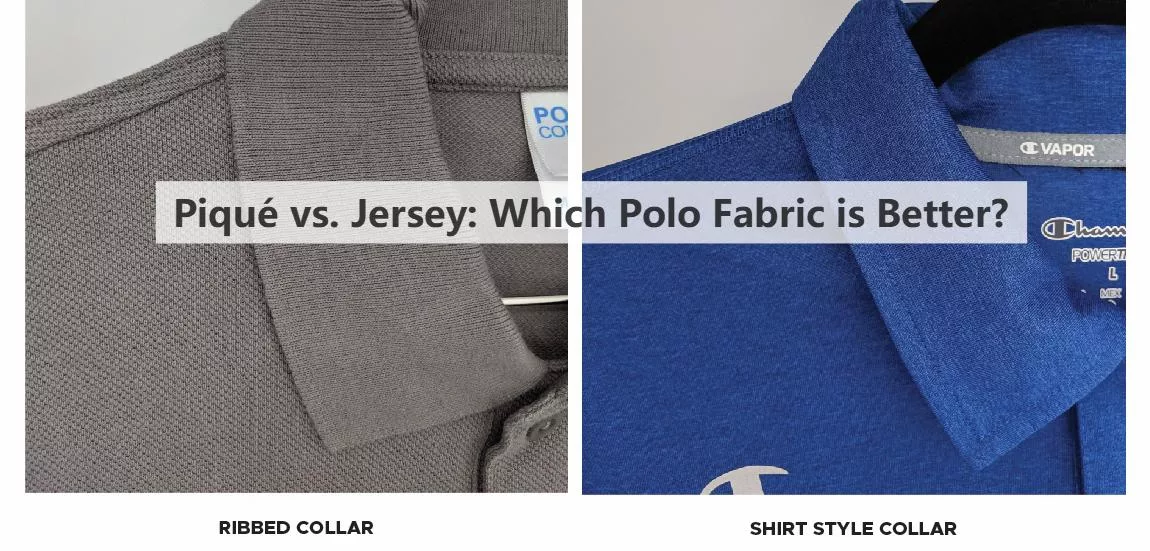

For pique vs jersey, this guide compares how each knit performs on the factors that matter in production: structure, embroidery, breathability, durability, and cost. In our tests, Piqué won the humidity and 6,000-stitch embroidery rounds; Jersey won on softness, stretch, and large-format printing.
Piqué uses a 3D knit structure (honeycomb) that adds volume, whereas Jersey is a flat single-knit that drapes heavily. In a humid 12-hour warehouse wear test, Piqué kept its professional look while Jersey clung to the skin and its collar curled.
We also ran a 6,000-stitch embroidery stress test — Piqué absorbed the thread tension cleanly, while Jersey puckered around the needle points and warped the logo.
Need 500+ units for a specific deadline? Contact us here.
We measured material density, tested shrinkage rates, and ran decoration trials to determine which knit geometry best supports corporate branding.
| Metric | Jersey (Single Knit) | Piqué (Single/Double) | Best For... |
|---|---|---|---|
| Surface Texture | Smooth, flat face (T-shirt feel) | Honeycomb / Waffle (3D Structure) | Piqué (Premium Perception) |
| Weight Targets | 150–190 GSM (GSM guide) | 180–200 GSM (retail) · 220–260+ GSM (uniform) | Piqué (Uniforms) |
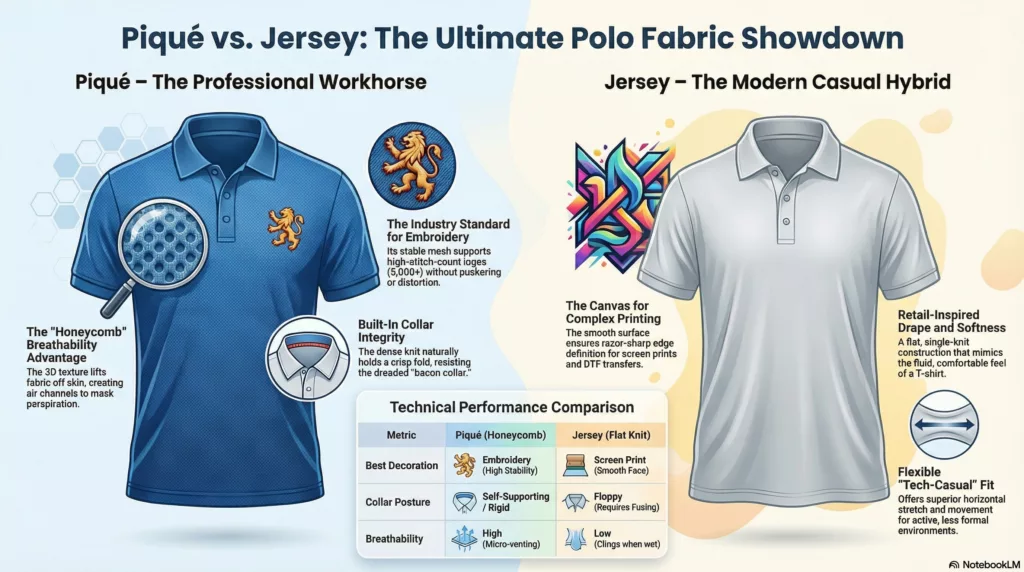
| Embroidery | ❌ Pucker Risk (Needs heavy stabilizer) | ✅ High Stability (Holds stitch count) | Piqué (Left Chest Logos) |
| Screen Print / DTF | ✅ Excellent (Ink sits flat) | ⚠️ Difficult (Ink breaks over texture) | Jersey (Large Back Art) |
| Collar Structure | Floppy (Requires fused interfacing) | Self-Supporting (Natural rigidity) | Piqué (Retail Polish) |
| Breathability | Moderate (Air flows through the thin knit) | High (Open tuck mesh vents air) | Piqué (Hot Climates) |
| Moisture Management | Clings when wet · Sweat patches show | Lifts off skin · Texture masks sweat marks | Piqué (High Humidity) |
| Shrinkage Limit | ≈3% (premium ring-spun) · 6–8% (low-cost) | 3–5% (pre-shrunk) · 5–7% (standard) | Piqué (Wash Consistency) |
| Stretch & Opacity | Higher stretch (≈30–40%) · less opaque | Lower stretch (≈15–25%) · more opaque | Jersey (Stretch) / Piqué (Opacity) |
| Sustainability | Recycled Poly (GRS) | Organic Cotton (GOTS) | Tie (Fiber Dependent) |
Shrinkage figures measured to AATCC 135 laundering standards. Standard promotional Piqué runs 5–7% length shrinkage; pre-shrunk or compacted Piqué holds 3–5%. Cost is fiber- and finish-dependent: at comparable GSM, single-knit Jersey typically runs 20–40% cheaper per unit than Piqué because it uses less yarn and a simpler construction.
Quick Verdict: If your program requires embroidery and structure for a professional uniform, specify Piqué. If you need large-scale screen printing and a softer drape for a casual giveaway, specify Jersey.
Main Differences for Pique vs Jersey
1. Knit Geometry: The "3-Foot" Visual Test
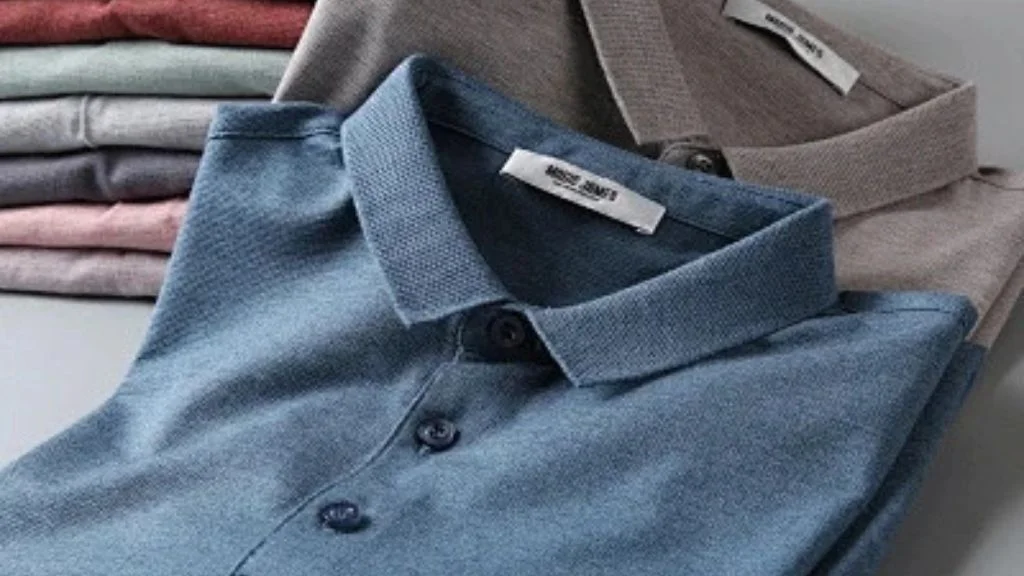
This is the most immediate difference a customer sees, feels, and judges. Let's kill a common procurement myth immediately: Piqué is a knit construction, not a fiber. It can be cotton piqué, polyester piqué, or a blend. The difference lies entirely in the geometry of the knit.
I placed both fabrics side-by-side on a conference table under standard office fluorescent lighting to gauge the optical difference.
- The Jersey Knit face is flat, smooth, and uniform. It looks and feels exactly like a high-quality t-shirt. It has a fluid drape that hugs the body’s contours, reflecting light evenly across the surface.
- The Piqué Knit uses a tuck-stitch construction (often a double-tuck) to create a raised, honeycomb-like cellular structure. It feels "pebbled" and slightly drier in the hand.
The "So What?" Factor: When I stepped back three feet—the standard distance of a face-to-face conversation—the difference in perceived value was stark. The Jersey polo looked casual, almost too relaxed for a client meeting. It lacked visual weight. The Piqué had a textured depth that caught the light, instantly reading as a "uniform" rather than loungewear.
For buyers manufacturing fabric types, the choice is optical. Piqué hides body imperfections better because the textured knit doesn't lay flat against the skin. Jersey highlights every curve (and lump). If the end-user demographic varies in size, Piqué is the more forgiving, inclusive choice.
Winner: Piqué (For Professional Identity) / Jersey (For Minimalist Fashion)
2. Breathability & Moisture Management: The "Sweat Patch" Reality
During a humid, 12-hour warehouse wear test in a non-AC facility, we tested how both knits handled real-world stress. The difference in moisture management was drastic and creates a clear use-case divide.
The Jersey knit failed the sweat test. Because the fabric is smooth and flat, it maintains near 100% contact with the skin. Once I started perspiring, the shirt clung to my lower back immediately. Worse, the wet patches were highly visible. Because Jersey reflects light evenly, a wet spot creates a dark, high-contrast patch that looks unprofessional.
The Piqué knit handled the humidity significantly better. That honeycomb texture serves a critical functional purpose: it creates micro-gaps between the fabric and the skin. The fabric physically lifts off the body, allowing airflow channels to evaporate perspiration before it saturates the yarn. Furthermore, the textured surface diffracts light.
Even when the shirt was damp, the "waffle" pattern broke up the reflection, masking the sweat patch effectively from a distance.
Winner: Piqué (Hot Climates & High Activity)
🧠 Expert Take: Moisture-wicking can come from a hydrophilic finish or from fiber geometry, while breathability depends on fabric structure. A polyester Jersey wicks liquid away but, being hydrophobic, it can still feel clammy where the fabric sits on the skin. A cotton Piqué holds moisture but lets air move. For the best of both, spec a performance poly-piqué blend — the wicking of poly with the airflow geometry of piqué.
3. Structure, Collar Posture, and "Looks Expensive"
About pique vs jersey, a corporate polo shirt lives or dies by its collar. If the collar curls (the dreaded "bacon collar"), the branding value drops to zero. This is where the physics of the knit dictates the lifespan of the garment.
Jersey wants to drape. It is inherently fluid. In our wash tests, standard jersey collars began to curl at the tips after just three wash-and-dry cycles unless they were heavily reinforced. The fabric simply lacks the vertical "spine" to support a button placket, often leading to a sloppy, open-neck look.
Piqué supports itself. The knit density and double-tuck structure naturally hold a crisp fold. I found that even without heavy starch, the Piqué collar stood up against the neck, framing the face professionally. It resists the torque forces of the washing machine that typically twist lighter fabrics.
How to Spec It: When choosing Jersey for softness, the tech pack must be aggressive to prevent a cheap look. A self-fabric collar cannot be used. Demand a rib-knit collar (e.g., Jacquard rib) with a high spandex count, or a fused interlining (stiffener), to prevent floppiness.
With Piqué, the structure is inherent to the knit, drastically reducing the risk of manufacturing defects like bubbling or delamination.
Winner: Piqué (Long-term Polish)
4. Decoration Performance: Embroidery vs. DTF
This is where most manufacturing agents fail their clients. The "canvas" a buyer chooses dictates which branding method can be used. A standard 6,000-stitch left-chest logo was run on both fabrics to expose the failure points.
- On Jersey (The Embroidery Nightmare): The fabric is elastic and thin. The tension of the embroidery thread pulled the fabric together, creating "tunneling" or puckering around the logo. It looked cheap and distorted the brand image. To fix this, we had to add a thick cut-away stabilizer backing, which felt like a piece of cardboard scratching against the skin.
- On Piqué (The Embroidery Hero): The stable, cellular mesh absorbed the thread tension perfectly. The logo sat flat with zero distortion, and we used a lighter tear-away backing that was barely noticeable to the wearer. According to Madeira’s official stabilizer guidelines, textured knits like piqué require significantly less stabilization than flat knits.
The DTF & Screen Print Angle: For teams moving toward DTF (Direct-to-Film) transfers for complex, multi-color logos, the script flips slightly. Piqué's heavy texture can sometimes break up fine text (under 8pt) in a transfer if the heat press isn't calibrated with high pressure. However, for e-commerce, Piqué creates a "premium" visual signal.
The texture adds depth on camera, making the merchandise look higher quality in digital storefronts compared to the flat, 2D look of Jersey.
🚀 Actionable Insight: If your logo has fine serif text or distressed details, avoid Piqué for heat transfers—the texture will interrupt the design. Use Jersey. If your logo is a solid block or icon, use Piqué for the 3D pop.
Winner: Piqué (Embroidery) / Jersey (Complex Screen Prints)
5. Durability: The Season-Long Wear Test
These shirts were tracked over 30 days of wear and four industrial wash cycles. The data reveals a trade-off between "shape" and "surface."
Cotton Piqué is the structural workhorse. It resists abrasion well and hides small stains in its texture. However, because it is an open knit, it is prone to shrinkage. Shrinkage ran about 5–7% in length on standard promotional Piqué, compared to just 3% on high-quality ring-spun cotton Jersey. Account for this in sizing specs.
Jersey Knit tends to keep its color vibrancy longer but loses its shape faster. I noticed "bagging" at the elbows on long-sleeve Jersey polos, and the hem started to twist (torque) after washing. This "spiraling" effect happens when the single-knit structure releases tension, causing the side seams to rotate toward the front of the body.
Cost-of-Ownership Lens: While Jersey is often cheaper upfront, Piqué shirts typically generate fewer size complaints and returns over a season. Pre-shrunk Piqué has "give" without losing its dimensional stability. For a uniform that looks the same in October as it did in April, Piqué is the safer investment despite the shrinkage risk.
Winner: Piqué (Shape Retention)
🛠️ Micro-Box: Spec This Like a Pro
Copy this checklist into your next RFQ to get accurate quotes immediately.
- Knit Type: Specify Single Piqué (standard breathability) vs. Double Piqué (thicker, premium) vs. Single Jersey (t-shirt feel).
- Fiber Content: 100% Combed Cotton (premium feel) vs. 65/35 Poly-Cotton Blend (fade resistance & durability).
- GSM Target: 180–200 GSM is the retail sweet spot for opacity without heaviness (220–260+ for uniform programs). Anything under 160 GSM in white will be see-through.
- Shrinkage Limit: Demand < 5% dimensional change (AATCC 135 test standard).
- Decoration Base: Explicitly state Embroidery (requires stable knit) or DTF (requires smooth face).
- Collar Build: Specify Jacquard Rib (anti-curl) or Fused Interlining (stiffener).
- Compliance: Request Oeko-Tex Standard 100 to ensure no harmful chemicals in the dye.
Piqué (Classic Polo Fabric)
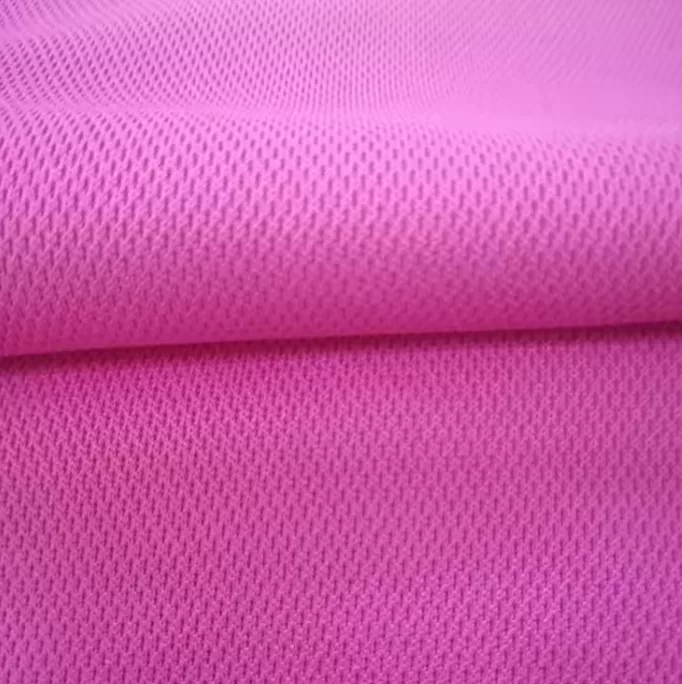
The Business Standard. This is the "honeycomb" knit most buyers associate with a professional uniform. It prioritizes structure and longevity over immediate softness.
- Shape Retention: In the 12-hour warehouse wear test, the 3D knit structure kept collars upright without starch, preventing the "sloppy" look common in thinner shirts.
- Embroidery Anchor: The mesh texture absorbs thread tension perfectly. It supports high-stitch-count logos (6,000+ stitches) without the puckering seen on lightweight jerseys.
- Perceived Value: The physical weight signals "uniform" rather than "giveaway." This tactile density helps justify a higher retail price point to stakeholders.
Cons
- Rough Texture: During sensory analysis, the coarser surface felt abrasive against sensitive skin. It lacks the immediate "hand feel" of modern retail brands.
- Print Limitations: Screen printing ink tends to crack over the uneven surface. Fine details in DTF transfers often fail to adhere smoothly to the textured gaps.
Jersey (T-Shirt Knit)
The Modern Hybrid. A single-knit fabric that mimics the drape of a high-quality t-shirt. It prioritizes comfort and print resolution over formality.
- Retail Drape: There was an immediate difference in fit; it hugs the body rather than boxing it out, making it the preferred choice for "tech-casual" kits.
- Print Clarity: The flat, smooth face accepted our complex, multi-color heat transfers with razor-sharp edge definition.
- Fluid Stretch: The single-knit construction offered superior horizontal movement during active tasks, even without added spandex.
Cons
- Collar Fatigue: Without a proper rib or fused collar build, the tips curl inward ("bacon collar") within a few wash-and-dry cycles — see the collar section above.
- Moisture Visibility: In humid conditions, we found the fabric clung to the lower back, creating visible sweat patches that looked unprofessional compared to the breathable Piqué mesh.
Frequently Asked Questions about Pique vs Jersey
1. Which polo fabric is better for hot weather?
Piqué is superior for heat and humidity. In the 12-hour warehouse wear test, we confirmed that Piqué’s honeycomb knit creates microscopic air channels that physically lift the fabric off the skin. This allows perspiration to evaporate rather than cling, unlike Jersey, which becomes heavy and reveals sweat patches immediately upon saturation.
2. Does Piqué shrink more than Jersey?
Yes — expect 5–7% length shrinkage on standard cotton Piqué. Piqué's open-tuck loops tighten more in the first hot wash than Jersey's tighter single-knit; pre-shrunk Piqué holds 3–5% and premium ring-spun Jersey ≈3%.
3. Is Jersey or Piqué better for embroidery?
Piqué is the industry standard for embroidery. Its dense structure holds heavy logos (6,000+ stitches) flat, while thin Jersey "tunnels" and puckers around the needle points and needs heavy stabilizers.
4. Can I screen print on Piqué fabric?
Not recommended for fine artwork — Piqué's texture causes ink cracking on small text. For large back prints or multi-color designs, Jersey gives the smooth canvas for a crisp finish.
5. Which fabric looks more professional for uniforms?
Piqué offers a higher perceived value. The structured nature of the knit allows the collar to stand upright without curling, maintaining a crisp, corporate silhouette throughout the day. Jersey tends to drape like a t-shirt, which reads as "casual" rather than "professional" in a business setting.
Need help manufacturing the right GSM and knit for your team? Contact our manufacturing experts to match your fabric to your budget and deadline.