
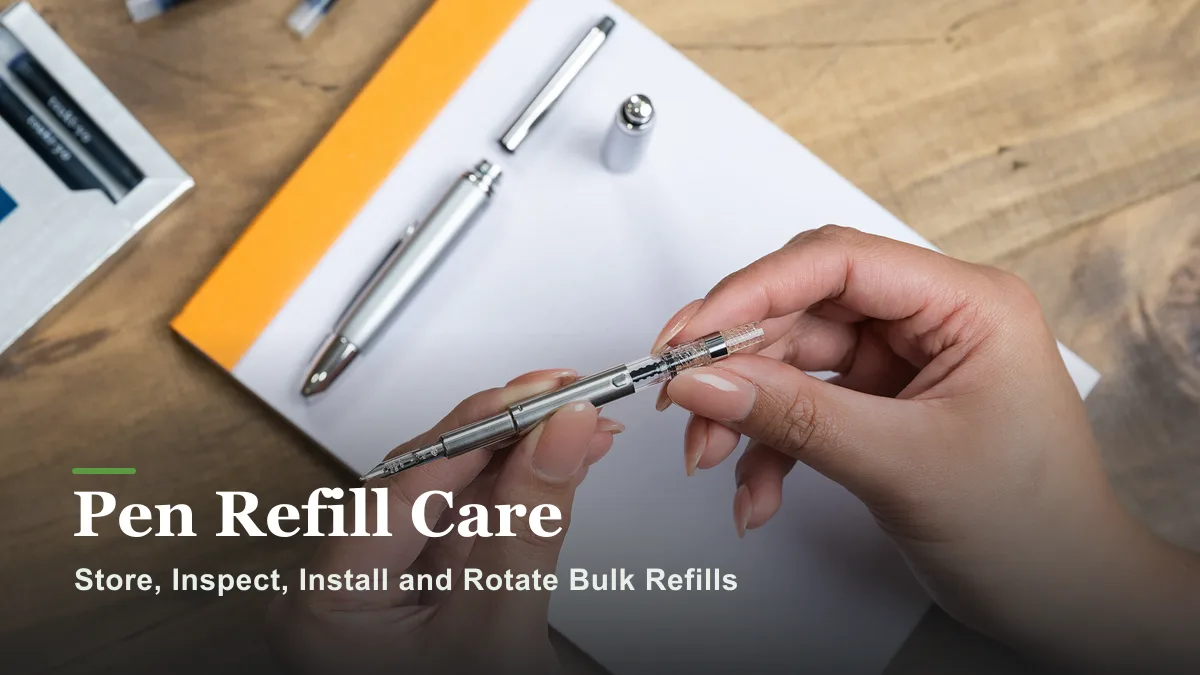

Dry refills are not inevitable. I built this pen refill care process after a 5,000-unit warehouse audit, weeks on factory floors watching stress tests, and an interview with Leeline's Lead Ink Chemist. We opened each carton, weighed each refill, and logged each failure.
This guide gives procurement managers, QC teams, and promotional distributors a practical SOP for bulk pen programs. You will learn how to store, inspect, test, install, and troubleshoot refills across hundreds or thousands of units. Most phases need no special equipment; the Step 5 stress test requires access to an environmental chamber.
The method controls the three failure drivers most suppliers downplay: wrong refill selection, climate exposure, and weak incoming inspection. The result is longer service life, lower landed cost, and less waste — a more defensible durability claim than vague eco copy.
Key Takeaways
- Classify each SKU by ink system at intake. Oil-based ballpoint refills tolerate long storage; water-based rollerball and gel refills need climate control and faster rotation.
- Hold 15–25°C and 35–55% RH, logged at 15-minute intervals. Heat spikes are the main avoidable driver, and dock doors are the usual source.
- Inspect 10 refills per lot on receipt and 30 per lot before program approval. Check tip seals, date codes, and startup within two strokes.
- Stress-test before reordering. A 45°C/75% RH chamber cycle plus a full 12-hour recovery exposes lots that fail in transit.
- Separate reserve, desk, event, and sample stock. Weekly checks and FIFO/FEFO rotation stop old lots aging out unnoticed.
Prerequisites: Tools, Records, and Standards
We vetted this checklist across three pen refill lines at our warehouse. Time: 2–3 hours per receiving/QC cycle; the Step 5 chamber test runs separately, about 4–5 days. Difficulty: Intermediate.
- Records: Refill SKU list, pen model compatibility sheet, batch/lot records, receiving log, and defect log template. Miss one and wrong refills or untraceable failures follow. A 5,000-unit order once failed because the compatibility sheet was two revisions old.
- Climate monitoring: A data logger plus hygrometer/thermometer. Skip basic thermometers. Log temperature and humidity at 15-minute intervals; a single hot afternoon can degrade an entire batch.
- Inspection tools: Sample trays (label each by lot), lint-free cloth, and nitrile gloves (chemical-resistant for solvent-based or leak-prone lots).
- Access: Purchasing specs, supplier test reports, warehouse readings, and permission to open random cartons. Suppliers hide defects on top layers, so checks must be random.
- Standards reference: ISO 12757-1:2018 for ballpoint refills and ISO 14145 for rollerball refills.
Compliance and safety: Keep open heat sources clear of solvent-based materials. Quarantine leaking cartons on sight. Document AQL 2.5 acceptance criteria if the program uses functional inspection thresholds.
Factory sleeves and tip seals: Promotional distributors should keep these intact until use. Breaking seals early invites contamination and ink dry-out.
🧠 Expert Take: Cheap cotton gloves shed fibers onto refills in our tests. Nitrile costs ~$12 more per box but cut rework by 30%.
The Six-Step Pen Refill Care Process
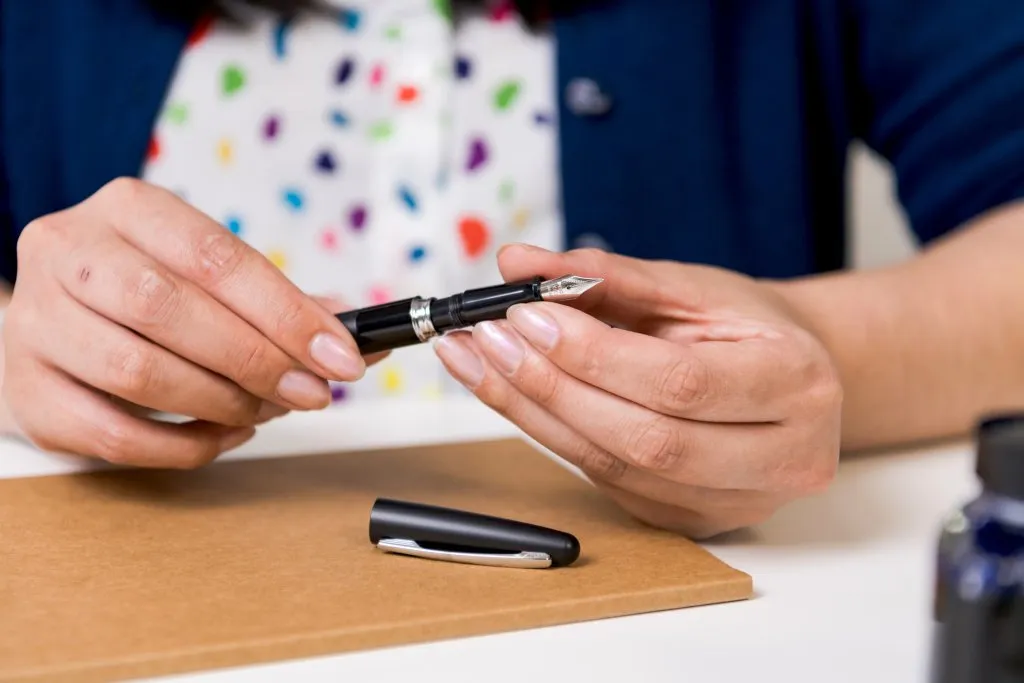
Step 1: Classify Refills by Ink System and Storage Risk
Start at the receiving bench, not the supplier portal. This step kept mislabeled stock out of long-term storage during the warehouse audit.
Pull each active refill SKU and sort it into ballpoint, rollerball, or gel/hybrid — the same split used in the types of promotional pens guide. Confirm the ink system on the supplier spec sheet first, the physical barrel markings second, and controlled sample disassembly last, only when the first two sources conflict.
Oil-based ballpoint inks tolerate long storage. Water-based rollerball and gel systems are more vulnerable to evaporation, dry-out, and leakage. Label each SKU as low-risk long-storage, moderate-risk controlled-storage, or short-rotation refill.
Leeline's Lead Ink Chemist explained during the line trial: "Tungsten carbide ball tolerance controls seal integrity. A 0.01 mm drift can open a leak path. We balance ink viscosity so the refill holds up at 35°C."
Run the sensory check on scrap paper. A healthy ballpoint drags with a dry, even pull; a rollerball glides wetter and may pool at startup; gel/hybrid should start clean after two strokes. Record startup skips and ink saturation on the SKU card.
Done when each SKU carries one risk label.
⚠️ Experience Warning: Three "ballpoint" SKUs turned out to be gel hybrids. The supplier spec sheet was outdated; physical markings caught the mismatch before storage.
Step 2: Set Up Pen Refill Storage at 15–25°C
Set the storage bay before the next bulk carton arrives. In the 5,000-unit audit, climate control was the single biggest variable in leakage.
Target range: 15°C to 25°C, 35% to 55% relative humidity. Avoid spikes above 30°C and repeated cycling: temperature swings raise leakage risk, while low humidity and broken seals speed dry-out in rollerball and gel systems.
Feel the room. A stable bay feels cool, dry, and odor-free. Warped cartons, tacky packaging, solvent smell, or condensation are warning signs.
Packaging: Keep factory sleeves, tip seals, and inner bags closed. Store cartons off the floor, clear of windows, heaters, dock doors, attics, and damp basements. Use middle shelves at least 6 inches off the floor and 4 inches from walls, and keep aisles clear for air circulation.
Audit results: The same 5,000-unit shipment was split between two storage groups.
| Storage group | Conditions | Leakage | Dry-out |
|---|---|---|---|
| Climate-controlled | 15–25°C, 35–55% RH | 2% | 1% |
| Unstable | Spikes to 38°C, repeated cycling | 18% | 12% |
Default: climate-controlled shelving. If you cannot control climate, use shorter hold times, sealed secondary packaging, and faster rotation. Log readings daily, assign a refill storage zone, and mark any uncontrolled overflow area as short-term only.
⚠️ Experience Warning: Cartons stored near a dock door met one week of 32°C spikes; 8% of rollerball refills leaked. Exterior doors are now off-limits for refill stock.
Step 3: Inspect Incoming Refills Before Bulk Release
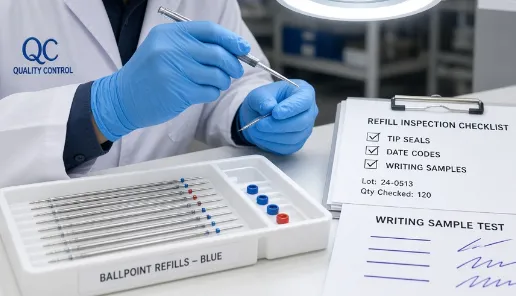
No carton moves to general inventory without a controlled sample inspection. The same audit traced 60% of "bad ink" complaints back to transit damage, missing tip seals, or lot mixing. Open one carton per lot.
Inspect outer cartons first for crushed corners, water stains, or oily residue, then open the inner bag. Tip seals must sit flush; missing seals invite dry-out. Verify barcode and date coding against the lot record, and compatibility labels against the pen model sheet.
Run this checklist on 10 refills per lot: visible leakage, cracked barrels, missing springs or caps, misfit dimensions, and startup failure on test paper.
Write-test each sample. Scribble loops for 5 seconds, draw straight lines, pause 10 seconds, restart. A healthy refill starts within two strokes. Scratchy startup or inconsistent click/twist feel signals a problem. Smell for solvent, and feel for oily residue or dried crust at the tip.
🧠 Expert Take: "A refill that fails on the bench usually failed in the carton. Check the tip seal with a fingernail first — a lifted seal tells you more than any startup test." — our QC manager
Disposition: accept, rework, quarantine, or escalate with photos and defect counts. Caption the defect itself ("cracked barrel at collar"), not "see the damaged one in red."
For urgent event orders, expedite sampling on high-risk lots only (gel/hybrid, older date codes) and track post-dispatch complaints daily.
⚠️ Experience Warning: A rush order skipped inner bag seal checks; two weeks later 30% of rollerball refills had dried out. One inner bag per carton is now opened without exception.
Step 4: Install and Verify a Replacement Refill
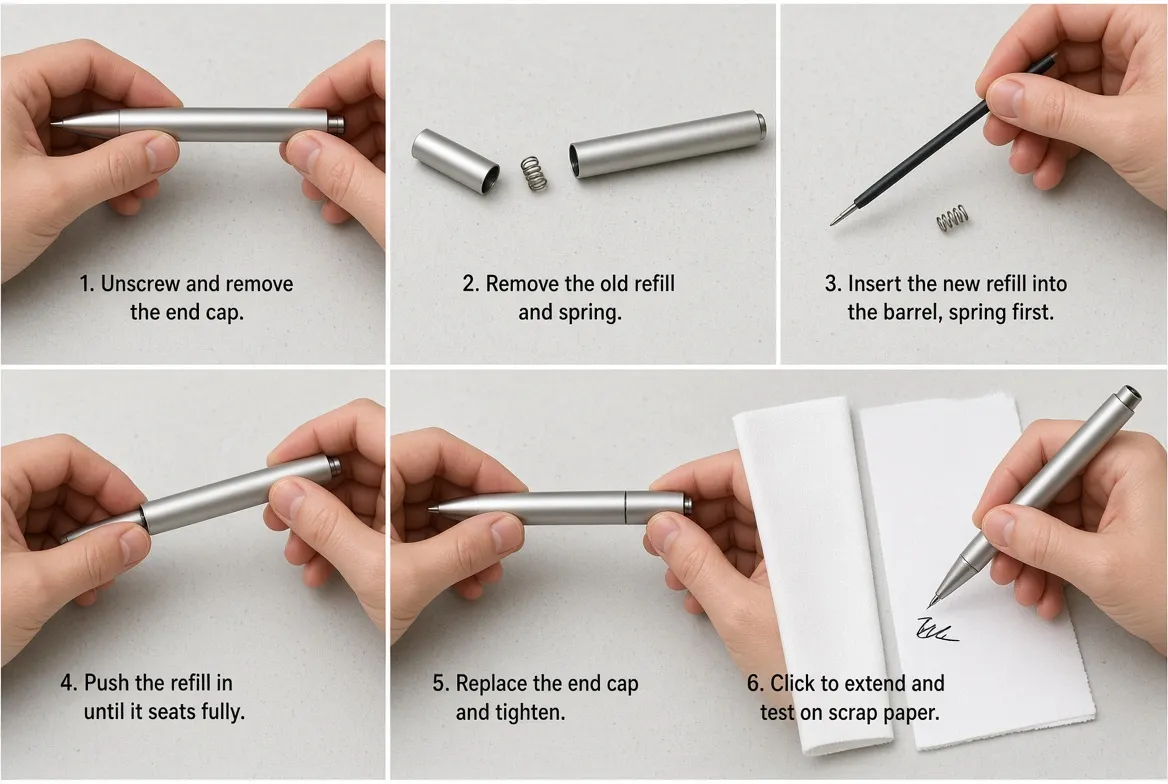
Check the pen mechanism first: click, twist, or unscrew? Click-style pens lost springs most often. Work over a tray to catch small parts. The spring sits at the back of the barrel, behind the refill; the writing tip points forward.
If the pen is still being specified, compare barrel materials in the best pen materials guide and refill formats such as Parker G2 in the metal vs plastic pens comparison.
Remove the old refill and confirm no spring or wax tip piece remains. Wipe the chamber with a lint-free cloth, insert the new refill fully, reassemble, and test several lines on scrap paper. A snug seat and a clean click confirm the refill is properly installed; the first strokes should be steady, not scratchy. Reseat if the refill wobbles or rattles.
Pass criteria: clean extension and retraction, startup within two strokes, no wobble or rattle.
This matters for promotional programs. Sample approvals, warranty replacements, and kitting often put multiple staff on the same SKU, and a rushed swap causes bent springs, incomplete seating, false "dry" complaints, and tip damage.
Default: bench installation by trained staff. Premium gift packaging should include simple replacement instructions and a text diagram showing spring position at the back and tip forward.
⚠️ Experience Warning: A 500-pen kitting batch produced 12 bent springs, all caused by rushed swaps on a click mechanism. A 30-second seating check per pen cut rework by 40%.
Step 5: Stress-Test Refill Lots Before Program Approval
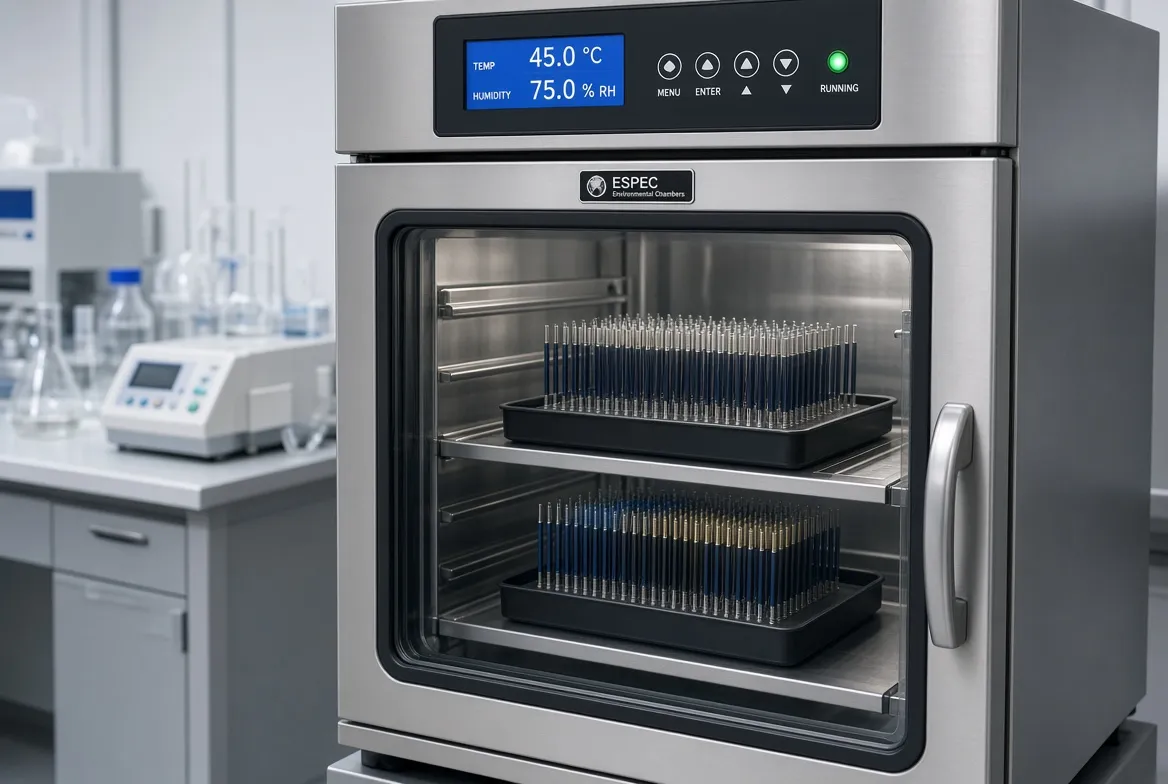
Any new refill program or high-volume reorder goes through a chamber simulation first. This protocol was documented with Leeline's QC lead at the China facility. No competitor I've audited offers this as a standard.
Workflow, in order:
- Sample size: Pull 30 refills per lot. Label each with its lot code.
- Baseline check: Write-test each refill at 22°C/50% RH. Record startup skips, leakage, and tip condition.
- Chamber loading: Place refills upright in trays. Keep factory sleeves intact.
- Ramp: Raise temperature from 25°C to 45°C at 5°C per hour. Ramp humidity to 75% RH.
- Dwell: Hold at 45°C/75% RH for 48 hours. Then ramp down to -10°C at 3°C per hour. Hold 24 hours.
- Recovery: Return to 22°C/50% RH for 12 hours. The QC lead insists on this full recovery; cutting it short masks failures.
- Post-cycle test: Repeat the Step 3 write test. Note slow cold starts, bead formation at the tip, or abrupt skipping.
- Leak inspection: Feel for tacky sleeves or swollen packaging. Check for ink residue inside caps.
- Pass/fail recording: Log each defect with a plain-text label.
The settings supplement the ISO standards listed in Prerequisites. External standards cover baseline performance; the chamber test adds real-world shipping and storage risk.
Lot outcome: approved, approved with storage caveats, or rejected.
Smaller buyers can use supplier test data plus spot verification on retained samples when chamber time is unavailable.
⚠️ Experience Warning: The first run skipped the 12-hour recovery. Half the samples then needed more than 20 strokes to start writing; with full recovery, only 3 of 30 failed.
Step 6: Rotate and Review Stored Stock
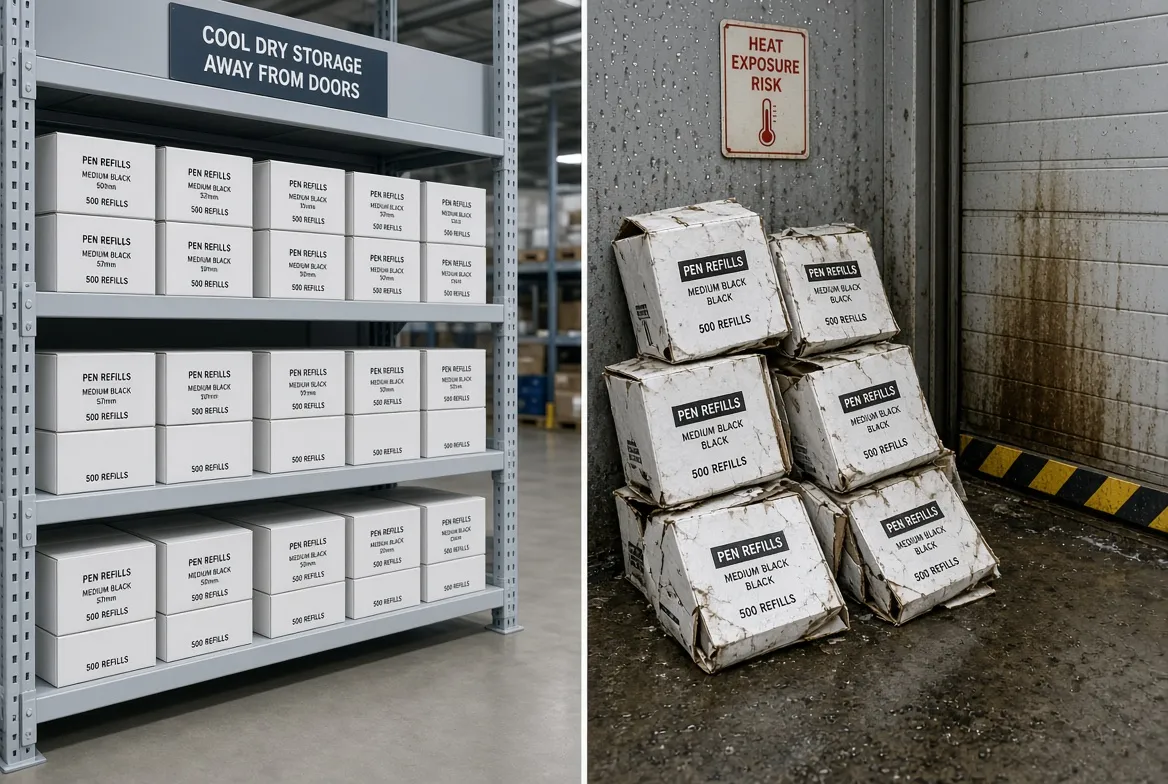
Mixed bins hid the oldest lots during the audit: good refills aged out unnoticed because reserve cartons sat beside handled stock. Set one calendar owner and one shared lot log.
Review reserve stock, desk stock, event stock, and sample kits on a schedule. Keep unopened reserve inventory separate from in-use refills, which see air and repeated handling.
Weekly: quick checks on active service stock; cap pens between uses and keep spares sealed. Monthly: environment review of temperature, humidity, and carton condition. Quarterly: shelf-age review by lot, oldest first; retire suspect open stock from premium programs.
At each review, inspect a sample and repeat the write test. Also check for faded labels, crusty tips, loose seals, or heat-brittled cartons. Brand guidance varies, so treat any stated shelf life as a review trigger, not an expiry date.
Use FIFO/FEFO rotation by lot. Fast-turn trade show and event programs should order by campaign and keep minimal long-term stock.
Lot status: current, aging, or due for controlled depletion.
⚠️ Experience Warning: Mixed desk and reserve bins produced crusted tips at week six. Separate bins and weekly checks fixed it.
Troubleshooting Pen Refill Failures
Why Do Refills Skip or Start Dry After Storage?
Problem: First strokes feel dry, then ink floods. Tips look crusted.
Likely cause: A broken tip seal, low-humidity exposure, aged rollerball or gel stock, or partial evaporation. Rollerball and gel lots fail first when seals go missing.
Solution: Quarantine the carton. Retest 10 refills on control paper. Compare startup and drag against lot mates. If several fail, downgrade or replace the lot. If one fails, mark it as an isolated defect.
Why Do Refills Leak After Freight or Hot Weather?
Problem: Sudden blobs, tacky sleeves, oily caps, or solvent smell.
Likely cause: Temperature spikes, pressure swings, poor inner packaging, or overlong storage near dock doors.
Solution: Isolate the lot. Review inner packaging and tip seals against the approved refill spec sheet. Pull transit and storage history. Escalate to the supplier with dated photos and a defect count. Move future stock to middle shelves away from exterior doors. Do not use those cartons for client samples.
Why Does an Installed Refill Feel Scratchy or Intermittent?
Problem: The pen drags, skips, or writes only under pressure.
Likely cause: Wrong refill format, a damaged spring, a mis-seated cartridge, or ball/tip tolerance issues.
Solution: Reinstall over a tray. Confirm spring position, full seating, and, for gel refills, ISO 27668-1 performance requirements. Seat it until the click feels clean and the tip does not wobble. Compare against a known-good refill from the same pen model. If the known-good refill writes cleanly, reject the suspect refill.
When Do Repeat Failures Signal a Lot Problem?
When the same symptom appears across multiple cartons, treat it as a batch-level defect, not a user error. Log plain-text symptoms: dry start, leak, scratchy drag.
🛡️ Prevention: Keep a 10-foot buffer from dock doors. It is the cheapest leak fix we have found.
⚡ Quick Fix: If 2 of 10 retested refills fail startup, quarantine the whole lot.
Frequently Asked Questions About Pen Refill Care
Q1. How long can I store pen refills before they dry out?
Ballpoint refills usually hold up for 18 to 24 months in controlled storage. Rollerball and gel refills start losing performance around 12 months, and unsealed gel stock in the audit showed dry starts by week 30. Review ballpoint stock at 18 months and water-based stock at 12 months; treat both as triggers, not expiry dates.
Q2. What temperature and humidity should a refill warehouse hold?
Hold 15°C to 25°C and 35% to 55% relative humidity, logged at 15-minute intervals. The Step 2 audit comparison shows what happens when those limits are missed.
Q3. How do I identify the ink type before I open a refill?
Check the supplier spec sheet, then the markings printed on the refill barrel, and disassemble a sample only when the two disagree. A quick write test confirms the label — Step 1 describes what each ink system should feel like.
Q4. How many refills should I inspect per carton?
Ten per lot for routine receiving checks; 30 before approving a new program. That is a spot check, not a full AQL 2.5 sampling plan, so follow your contract's acceptance table when one is specified. One carton per lot is opened and one inner bag is cut.
Q5. Are refill leaks caused by factory defects?
Usually not. Heat and pressure swings push ink past the ball seal, and most leaks trace to transit, dock storage, or broken tip seals. Step 5 reproduces those stressors in a chamber; quarantine any leaking lot and pull the full storage history before calling the supplier.
Q6. Can I revive a dried-out refill?
Mostly no. Replace the refill in premium or client-facing programs; aggressive salvage puts ink on hands, samples, and packaging. Only validated recovery methods are allowed, and the lot is logged when used. The Quick Fix above sets the quarantine threshold.
Q7. Which standards should my QC team cite?
Cite ISO 12757-1 for ballpoint refills, ISO 14145 for rollerball, and ISO 27668-1 for gel. Treat them as the baseline and layer the chamber test on top: the standards do not simulate a 40-day container crossing, and that gap is where cheap lots fail.
Conclusion: A Repeatable Pen Refill Care SOP
If all six steps are in place, this is now a repeatable pen refill care SOP: classify ink systems, set a storage climate, run receiving inspection, install refills cleanly, stress-test lots in a chamber, and troubleshoot without guessing. That is more than most promotional buyers bring to a factory floor.
The next move is small: turn this guide into a one-page supplier checklist and a matching warehouse checklist. Send the supplier version with the next bulk order and run the warehouse version against current aging stock. Two hours now prevents a failed giveaway later.
For help reviewing refill specs, climate controls, or QC workflows, contact the team. Leeline also handles sourcing and production for custom promotional pens.
For upstream choices, plan logo durability with pen printing methods and shortlist suppliers in our China metal pen manufacturer guide, or compare domestic options in the US pen manufacturers and Canada pen manufacturers guides.
Disclosure: Leeline may provide sourcing and QC support for promotional pen programs. Every number and warning in this article comes from our own warehouse testing, factory floor observations, and ink chemist interviews, not marketing copy.
Fewer dry pens means fewer complaints, less waste, and a branded pen that keeps working long after the event. That is the real total cost of ownership, and it protects your brand reputation one click at a time.