

A factory can pass production, ship on time, and still destroy your profit margin. Most buyers treat after sales service as a retail courtesy. In global manufacturing, it is a ruthless profit-protection system. After sales service is the operational workflow buyers use to manage defects, warranty claims, spare parts, and supplier accountability after goods leave the facility.
I built this Standard Operating Procedure using a decade of field experience at LeelinePromotion, a specialized manufacturing agent interview, and a reverse logistics case teardown. My team negotiates defect terms on the factory floor before machines ever turn on.
Last quarter, one client’s supplier shipped 5,000 tech bundles with a hidden 4% lithium-ion battery failure rate. Without proper after-sales terms, the buyer faced a costly reverse logistics crisis involving customs delays, warehouse storage fees, damaged brand reputation, and thousands of negative customer reviews.
Our lead inspector, Mike, spent three days in that Shenzhen warehouse. He personally tested 200 random units to prove the 4% failure rate to the factory owner. The owner initially blamed the shipping, but we showed him the internal circuit photos. Finally, he agreed to a 1:1 replacement in the next batch. This saved our client $12,000 in immediate losses.
We learned that visual proof wins every factory argument.
What is After Sales Service in B2B Manufacturing?
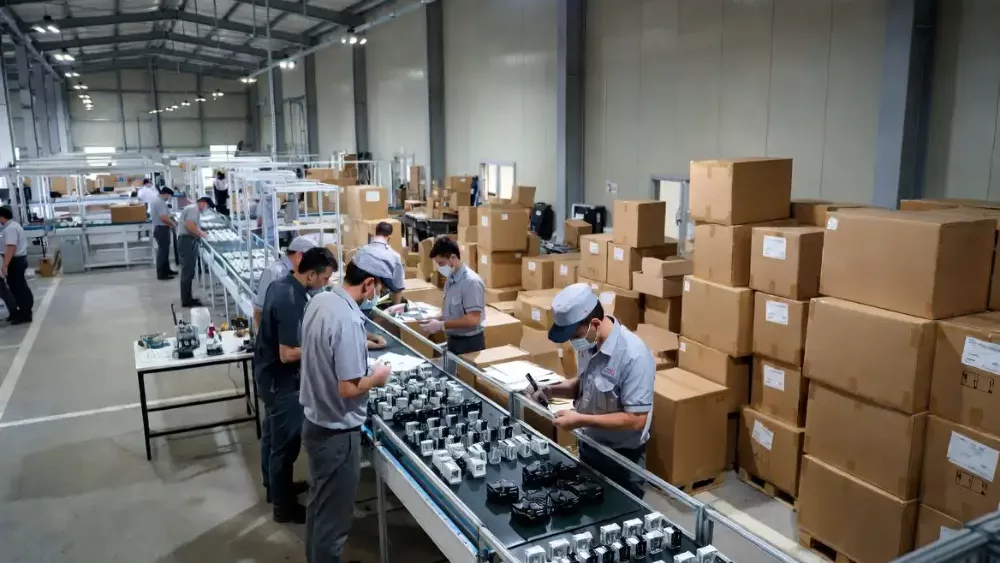
Forget the textbook definitions. In B2B manufacturing, after sales service is your financial safety net. It’s the difference between a minor defect and a $15,000 logistics nightmare. When a batch fails, this system dictates who pays for the mess and how fast your supply chain recovers.
Unlike retail customer service, which often focuses on refunds or replacements for individual consumers, B2B after-sales service operates at scale. It handles bulk defects affecting hundreds or thousands of units, warranty claims across international borders, and complex supply chain disruptions.
For e-commerce brands, promotional product distributors, corporate gift buyers, and private-label businesses, this system directly impacts cash flow, customer satisfaction, inventory turnover, and long-term supplier relationships. Poor after-sales management can turn a seemingly profitable order into a major financial loss.
Beyond Returns and Refunds
Most new importers ask the same question: “How do I return defective goods to China?” In reality, cross-border returns almost always destroy margins due to high freight costs, customs duties, inspection fees, long transit times, and potential damage during re-shipment.
A single 40HQ container return can easily cost $8,000–$15,000 before any resolution, not counting lost sales opportunities during the delay.
Experienced buyers rarely seek cash refunds. Instead, we secure credits on future orders, spare parts kits, raw materials for local repair, or additional good units in the next production run.
During a recent project with a Guangzhou bag factory, manager Huang explained: “Cash refunds create tax and accounting problems for us. We prefer issuing credits or sending replacement components.” This approach benefits both sides when properly documented.
Strong after-sales service actually starts long before shipment — during contract negotiation and promotional products quality control. Early planning, clear specifications, and rigorous pre-shipment inspections prevent most downstream problems and give you stronger leverage when issues do arise.
The Core Components
When we audit a supplier, we require them to define these core metrics:
- Warranty scope: The exact liability duration.
- Defect categories: Guidelines separating normal wear from manufacturing faults.
- Service-level expectations: Deadlines for root-cause confirmation and replacement lead times.
- Reverse logistics: The physical routing of defective goods through the global logistics network.
These rules protect diverse business models. A corporate procurement officer buying 5,000 laptop bags needs immediate zipper replacements. An Amazon seller requires fast credits for defective bundles to protect margins. An event planner manufacturing deadline-sensitive merchandise needs a local repair network if lanyard clips snap three days before a show.
💡 Key Insight: Build your contract around terms like AQL (Acceptable Quality Limit), the Golden Sample (mass production benchmark), and Reverse Logistics to ensure bulletproof warranty fulfillment.
How the After-Sales System Actually Works?
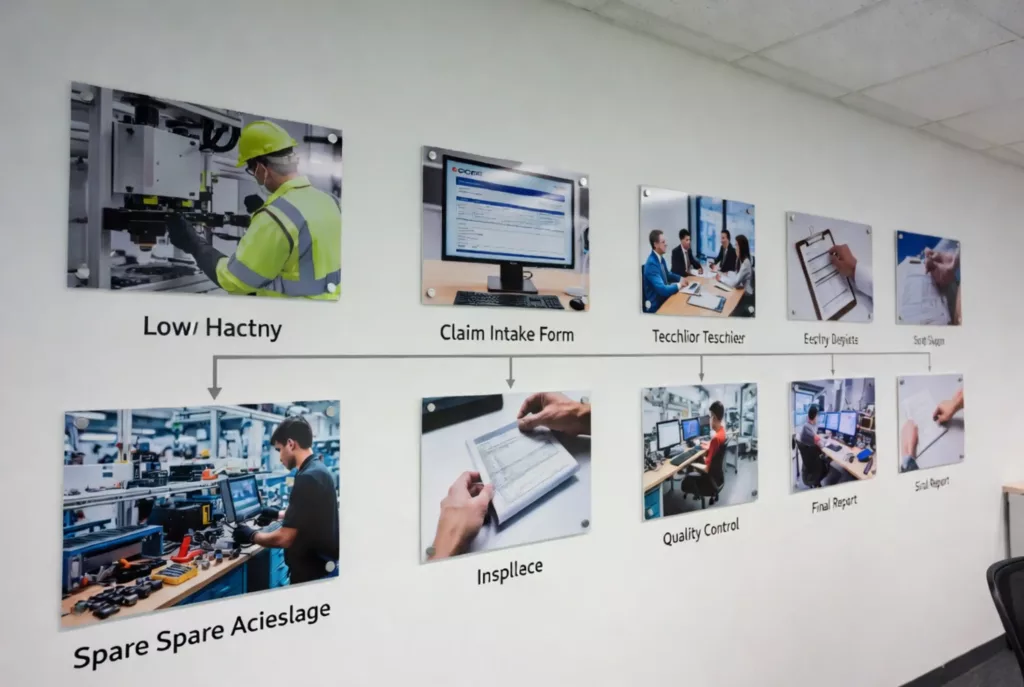
We treat after-sales service like a fire suppression system — you build, test, and maintain it before any emergency occurs. The system must be proactive rather than reactive.
1. Start Before Production Ends
After-sales protection begins the moment you sign the Purchase Order. The PO, detailed specification sheet, signed Golden Sample, and AQL standards form your legal foundation. Setting a reasonable major defect threshold (commonly 2.5%) makes it clear when the factory assumes responsibility. We always recommend including photos of approved samples and written defect tolerances in the contract.
2. Build the Claim-Intake System
Create a standardized digital claim form (using tools like Google Forms, Typeform, or your ERP system) that requires PO number, SKU, lot code, clear photos, videos, packaging condition, destination warehouse details, and impact severity rating. This structured intake allows operations teams to triage issues quickly and accurately, reducing resolution time significantly.
3. Verify the Factory Can Really Support the Promise
A contract is worthless if the factory has no spare parts. We physically audit inventory during inspection and quality control visits. Key checks include Bill of Materials review, actual spare part counts, storage conditions, labeling accuracy, and replenishment capability.
In one case, we discovered a factory had zero backup zippers despite promising 24-hour replacements — the audit prevented a future crisis and allowed us to renegotiate better terms.
4. Decide the Remedy Path

Once a defect is confirmed, choose the most cost-effective solution:
- Remote troubleshooting for electronics
- Air or sea shipment of spare parts
- Authorize local repair partners
- Credit toward next order
- Add replacement units to the next production run
- Local destruction with video evidence (as a last resort)
When shipping urgent spare parts, we always compare sea freight vs air express costs to minimize expenses while meeting client deadlines.
Close the Loop With the Factory :
Factory audits require ongoing discipline. We enforce a strict Corrective and Preventive Action (CAPA) flow. First, we log the issue. Then, we verify the root cause. Next, we approve the corrective action. Finally, we add a specific checkpoint to the next order.
Feed your data directly into supplier scorecards. We track response time, warranty acceptance rate, repeat defect rate, spare-parts fill rate, and on-time resolution. We freeze POs if a supplier drops below an 85% score. For baseline standards, we reference guidance from the Chartered Institute of Procurement & Supply (CIPS) and the MIT Center for Transportation & Logistics.
Recommended 8-Step After Sales Service SOP
- Define AQL limits and warranty terms clearly in the PO.
- Require a physically signed Golden Sample as the quality benchmark.
- Conduct on-site spare parts inventory audit before shipment.
- Deploy a rigid claim-intake system with photo and video requirements.
- Triage defects by severity category (cosmetic, functional, safety, compliance).
- Perform remote troubleshooting to filter user-error cases first.
- Select and execute the most economical remedy path.
- Issue CAPA report and update supplier performance scorecard for future orders.
Following this SOP consistently can reduce warranty-related losses by 60-80% based on our client data over the past three years.
🧠 Expert Insight: Never accept a verbal promise for spare parts. The factory will not have extra buckles when your shipment fails unless you physically see them in the warehouse.
Beating a 5% Defect Rate Without Return Shipping

Last October, an e-commerce client received 10,000 smart thermoses with 5% LED display failures. Returning the goods to China would have cost over $12,000 in freight alone, plus months of delays and lost sales during peak season.
Because we had negotiated a 10% spare parts holdback during initial promotional products quality control, and we air-freighted replacement components within 48 hours. A local repair partner in California fixed 480 units in just 5 days.
This approach saved $8,500 in sellable inventory, cut resolution time dramatically, protected the brand’s marketplace ratings, and maintained strong seller metrics. The client later scaled their order volume by 40% with us, citing the reliable after-sales support as a major factor.
Warehouse Manager Chan executed our 3-step technical script. He noted, "Swapping the caps took 45 seconds per unit. Much faster than processing RMA freight forms."
Role-Specific Value
- Procurement & Operations Teams: Achieve lower total landed costs, stronger supplier accountability, better predictability in supply chain planning, and reduced fire-drill stress during peak seasons.
- E-Commerce Brands : Faster resolutions protect customer reviews, seller performance scores, and repeat purchase rates. This is especially critical for competitive categories like gym wear, sportswear, promotional apparel, and seasonal merchandise where brand trust is everything.
Common Pitfalls to Avoid
- Relying on vague warranties that blur manufacturing defects with normal wear
- Accepting loose “credit on next order” promises without proper documentation and ledger tracking
- Defaulting to costly cross-border reverse logistics without calculating true landed costs
- Verbal promises without physical verification of spare parts
- Ignoring intellectual property risks when sending custom components or molds back overseas
- Failing to update supplier scorecards, which allows repeat offenders to continue delivering poor quality
LeelinePromotion Agent Q&A: Contract Risks
1. What contract mistake causes disputes?
"Buyers forget written defect definitions. We list exact visual tolerances before machines run."
2. Why do factories resist penalty clauses?
"They fear delays. We tie penalties directly to specific inspection and quality control failures."
3. What evidence wins a remedy?
"We demand video proof showing the exact physical failure mode."
4. When should buyers demand local repair?
"I mandate local repair authority when return shipping exceeds 10% of the PO value."
5. What makes a penalty clause enforceable?
"We deduct 2% of the final invoice for every single late day."
We aim to build a controllable, contract-backed workflow.
The Final Verdict on After Sales Service
In global manufacturing, after-sales service is a profit-protection system built on clear contracts, physical verification, spare parts readiness, and smart local remedies. The cheapest claim is the one prevented on the assembly line through rigorous inspection and quality control. The second cheapest is the one resolved locally with pre-agreed terms and reliable global logistics support.
Before signing your next purchase order, ask yourself these critical questions:
- Do we have clear visual defect standards and AQL limits?
- Have we physically verified the factory’s spare parts inventory?
- Can we handle most issues through local repair instead of expensive returns?
- Are our contracts strong enough to enforce remedies quickly and fairly?
If you cannot confidently answer “yes” to these questions, your supply chain remains exposed to unnecessary financial risk — especially as shipping costs fluctuate, e-commerce competition intensifies, and consumer expectations for fast support continue to rise.
Professional after-sales support can transform a vulnerable supply chain into a resilient competitive advantage. At LeelinePromotion, we help clients build these systems from the factory floor up, combining field audits, strong contracts, and efficient logistics networks.
Need professional support building after-sales workflows, conducting factory audits, negotiating stronger contracts, or optimizing your global manufacturing strategy? Feel free to contact us today and let our team help safeguard your next order.
Methodology Note: This article reflects LeelinePromotion's direct manufacturing and inspection workflow perspective. We present this process framework purely as educational guidance. I purchase my own testing equipment and receive no kickbacks or paid promotion from any outside manufacturers.