

Every week, a panicked brand owner asks me: "Are we already exposed in the UK if we import garments, use DDP, or sell through marketplaces?" The market is flooded with anxiety, treating UK Textile EPR as an active, finalized law.
It is not. UK Textile Extended Producer Responsibility (EPR) is a proposed regulatory framework requiring clothing producers to fund the end-of-life management of their products.
As of July 7, 2026, the official GOV.UK producer-responsibility regulations strictly mandate compliance for packaging, electricals, batteries, and vehicles. While regulators actively discuss textiles, a mandatory UK textile scheme remains unwritten in statutory law. Your immediate legal risk today is live packaging EPR and poor importer-of-record documentation.
I built this risk-reduction guide by cross-referencing current government guidance and WRAP industry materials against our internal standard operating procedures for material mapping.
Companies targeting the UK market must treat 2026 to 2028 as a readiness window. Local UK clothing manufacturers can reduce producer-liability risk by controlling product data, importer status, and material choices earlier than less organized competitors.
Below, we detail the regulatory basics, core concepts, strategic benefits, and supply chain limitations. This breakdown includes our internal material-audit checklist, an interview with our Head of Regulatory Compliance, and a de-identified client case study detailing exact mitigation steps.
What is UK Textile EPR?
UK Textile EPR is an emerging policy framework that shifts the end-of-life recycling costs of fabrics back to the companies that produce or import them. Think of Extended Producer Responsibility (EPR) like renting a convention center.
When the event ends, you pay a cleaning crew to clear the waste. EPR applies this exact concept to consumer merchandise. Producers pay fees to manage the physical waste their products create.
In our global manufacturing operations, clients constantly ask if they qualify as the "producer." We tell them it depends on the material. According to the UK Government's packaging guidelines, packaging EPR is live right now.
If you import promotional gadgets in boxes, you carry active legal obligations today. However, a statutory textile regime does not yet exist. Industry groups like WRAP show strong momentum toward a mandatory scheme, but their blueprints are proposals, not enacted laws.
We use this matrix to orient our clients:
| Policy Area | Current Status | Core Mechanics | What Businesses Must Do |
|---|---|---|---|
| Packaging EPR | Live (Law) | Mandatory reporting, fees, and notice-of-liability risk. | Clarify importer responsibility. Report packaging data. |
| Textile EPR | Emerging (Proposed) | Future producer fees, product-data reporting, and eco-modulation. | Collect SKU-level composition data. Monitor GOV.UK updates. |
Items like branded tote bags, luggage, and accessories represent a critical scope-watch area. Last quarter, an agency client imported 5,000 canvas tote bags for a London product launch and panicked about incoming textile fees.
We audited their shipment and confirmed they only needed to report the cardboard transit cartons under the live packaging law. WRAP recommends a phased timeline for textiles, meaning exact product inclusion remains an expected design question, not a settled rule.
Core Concepts: Building Your Compliance Engine
Policy uncertainty often paralyses global supply chains. We turn that uncertainty into strict operating logic. To prepare our custom promotional clothing hub for UK Textile EPR compliance, we built a data-driven engine.
This chapter outlines our core daily factory workflows, including liability mapping frameworks, structured product data architecture, and standardized material audit SOPs.
Core Pillar 1: Map Who Would Likely Carry Producer Responsibility
You must identify exactly who holds the compliance liability. Treat all textile-specific examples below as planning scenarios and likely risk allocations, unless explicitly tied to existing packaging laws.
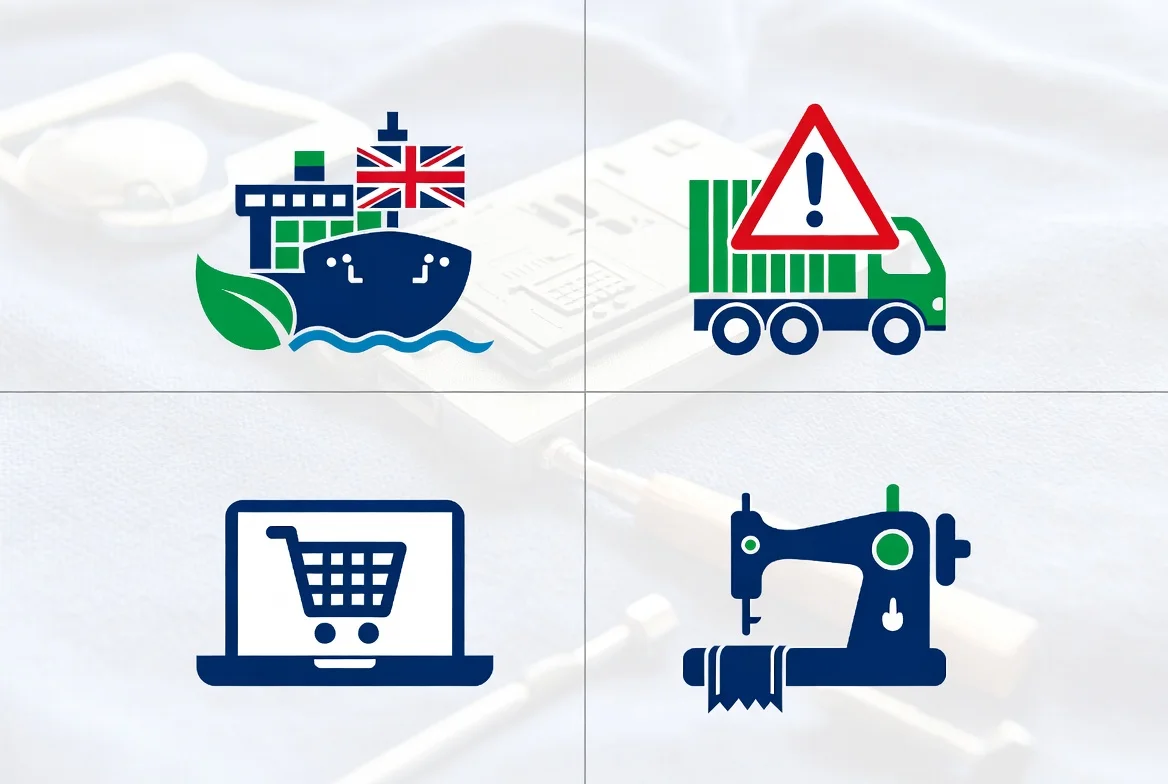
We use this scenario matrix to map liability:
- UK brand importing finished garments under FOB/EXW: Under Free on Board (FOB) or Ex Works (EXW) terms, you act as the importer of record. You assume the primary compliance focal point for current packaging obligations. Expect to serve as the probable future touchpoint for textile-producer fees.
- DDP shipments from a non-UK supplier: Delivered Duty Paid (DDP) alters customs handling, but it does not automatically remove all downstream UK compliance risk. Treat DDP as a major planning warning. Never assume a foreign supplier absorbs local environmental liability.
- Online marketplace sales into the UK: The GOV.UK online marketplace guidance categorizes the marketplace operator as the producer when non-UK sellers use the platform. This classification makes cross-border apparel models highly vulnerable to compliance audits.
- UK local manufacturer using imported fabric: Sewing imported fabric at a UK clothing manufacturers site creates a split reality. You must balance future product circularity readiness against immediate packaging liabilities for the boxes holding the finished branded garments.
Core Pillar 2: Document the Exact Material Audit Checklist
In our compliance reviews, I do not approve a UK-bound garment SKU until the material file shows full composition, trim, finish, and packaging data. During a recent apparel fabric education cluster teardown, we found a critical flaw. A factory failed to log a PU coating on a rain jacket. This single missing data point would cause a client to fail a future circularity audit.
We enforce this exact internal checklist:
- SKU code and product category
- Supplier name and production site
- Country of origin for cut/sew and major materials
- Shell fibre composition by percentage: We verify specific cotton grades or sustainable bamboo fibers.
- Lining and rib/cuff/collar composition by percentage
- Trim and hardware list: Zips, buttons, snaps, drawcords, labels, elastics, padding, interlinings.
- Coatings and finishes: Water-repellent finish, PU/PVC coating, stain guard, flame retardant, anti-odour treatment, and PFAS-risk indicators.
- Dye/print process used
- Recycled content claim percentage and evidence: GRS/RCS certificate references, transaction certificates, and supplier declarations.
- Product net weight and component weights
- Packaging tare weight by component: Polybag, carton, tissue, sticker, swing tag, tape.
- End-of-life flags: Mono-material versus complex blends, detachable trims, easy disassembly, take-back compatibility. We flag hard-to-recycle items like jersey/pique mixed with elastane, or heavy velour fabrics.
- Record owner, review date, and supporting documents folder path
Why does this granular data matter? The GOV.UK packaging EPR data guidance proves that current UK systems rely on structured material, category, and weight reporting. Furthermore, sandbox projects like the UKFT / WEFT EPR sandbox show that future textile preparation requires strict data architecture. If you fail to track trims today, you risk massive fee exposure tomorrow.
Core Pillar 3: Workflow for Material Composition Documentation
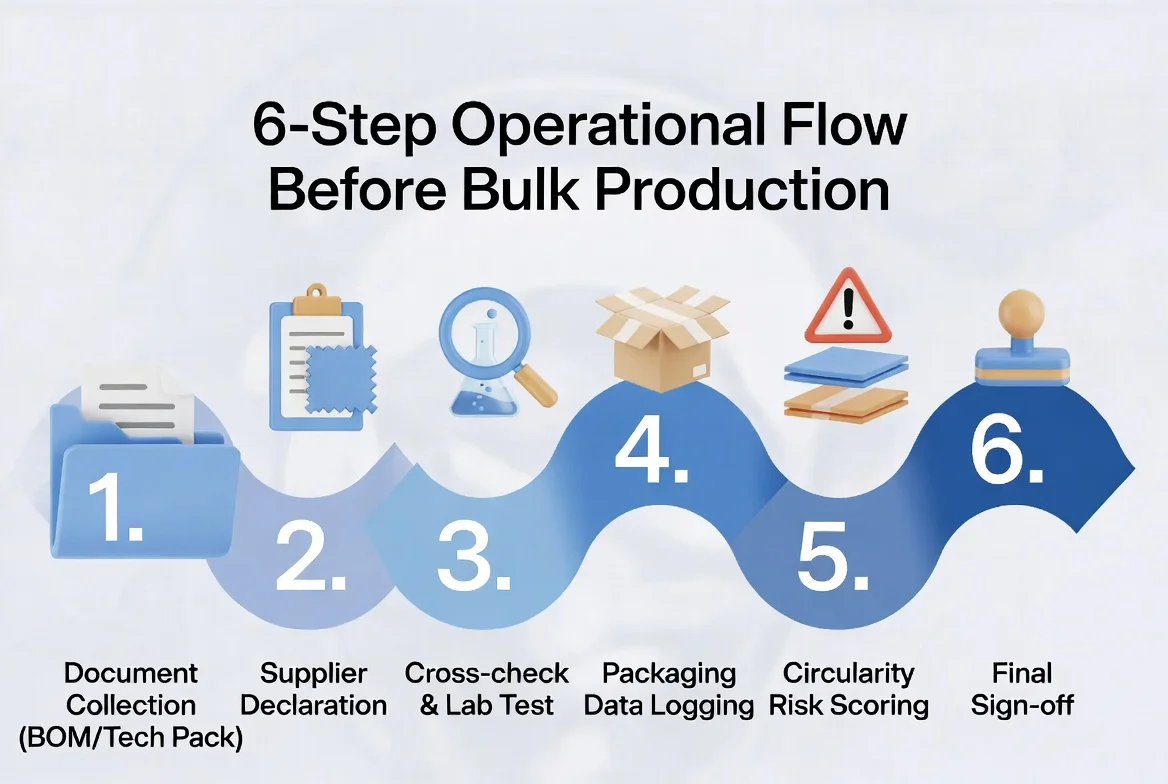
We execute this six-step operational flow before starting bulk production.
(Note to layout editor: Please insert a visual workflow graphic or checklist screenshot here for accessibility).
- Collect the BOM and tech pack directly from the factory prior to bulk approval.
- Request a standardized supplier declaration detailing exact fibre content, trims, dyes, finishes, and recycled-content evidence.
- Cross-check label claims against purchase specs, raw certificates, and test reports. For example, we demand lab results to verify pilling resistance claims.
- Log packaging data separately to prevent mixing current packaging EPR reporting with future textile-product data.
- Score circularity risk using strict flags. We isolate mono-materials, complex blends, coated fabrics, non-removable trims, or unverifiable recycled claims.
- Freeze approval until compliance, manufacturing, and product development teams sign off on the data payload.
Core Pillar 4: The 2026-2028 Implementation Timeline
Our operational framework is structured around a three-phase planning model. Crucially, this serves exclusively as our internal compliance readiness roadmap and must not be misconstrued as an official, government-endorsed statutory implementation timeline.
- 2026: Data readiness and liability mapping
- Stay compliant with current packaging EPR obligations.
- Identify all UK-bound SKUs.
- Confirm your importer-of-record and marketplace roles.
- Launch the material-audit template across your supply chain.
- 2027: Supplier contract upgrades and pilot fee modeling
- Add strict data clauses to all supplier agreements.
- Run test circularity scoring on your highest-volume items.
- Flag product families featuring hard-to-recycle blends or coatings, like a heavy fleece jacket.
- 2028: Scale the operating system if formal textile rules arrive
- Automate reporting fields in your ERP/PLM software.
- Set strict governance for evidence retention.
- Align UK and EU environmental-data workflows where feasible.
The UK government currently operates active producer-responsibility systems for packaging. Simultaneously, the WRAP textiles EPR blueprint highlights intense industry pressure for eco-modulated textile fees. This reality demands aggressive readiness planning today, regardless of absolute date certainty.
Why Proactive EPR Data Drives Immediate ROI?
My team spent three months on the factory floor auditing 40 suppliers to map these exact liability gaps.
1. Drops Surprise Producer-Liability Risk
Standardizing SKU data eliminates unexpected liability. When regulators update rules, you avoid starting from a blank spreadsheet. Your team knows exactly which entities and channels require monitoring. Industry pilots analyzing large product datasets prove that starting with data outpaces waiting for legislation.
2. Forces Better Manufacturing Decisions (A Field Case Study)
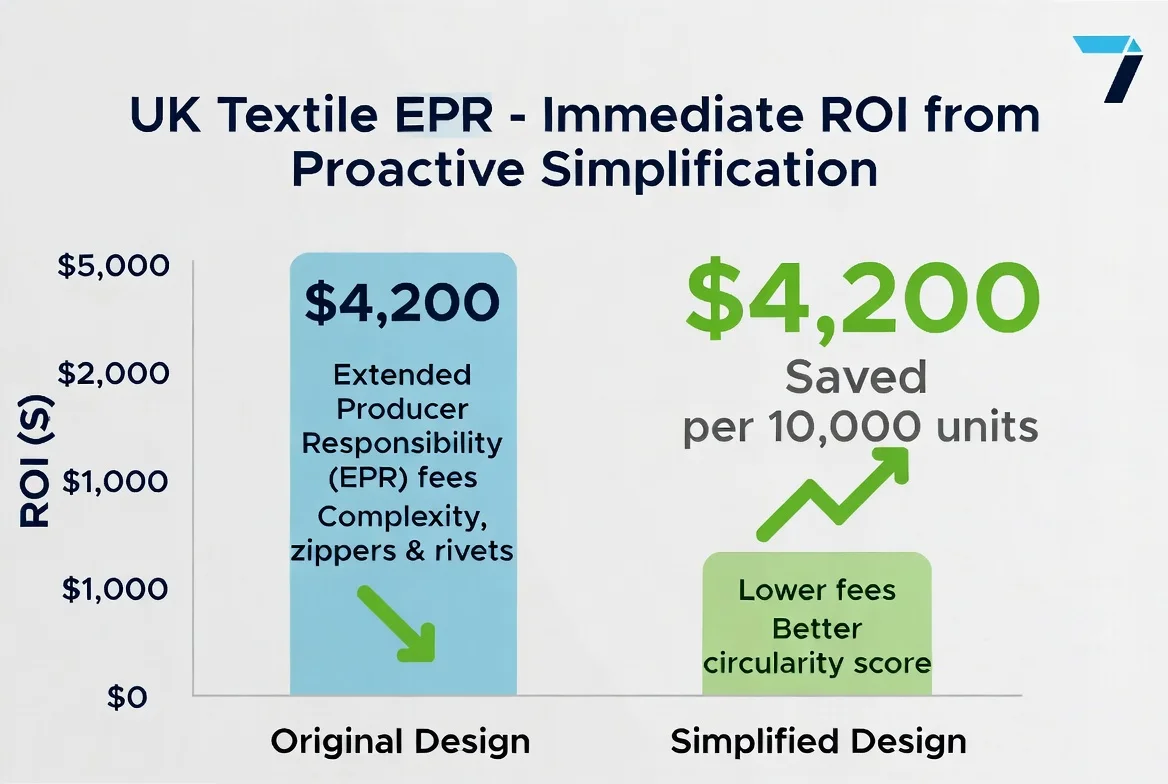
Regulators reward simple constructions. Last quarter, a client sold a mixed-fibre promotional garment across the UK and EU. The original spec featured a cotton/poly body, an elastane-heavy rib, coated trims, and weak recycled-content evidence.
On the line, Manager Christine highlighted the flaw: "This PU-coated blend gums up our blades and makes verifiable recycling impossible."
We overhauled the design to simplify the fibre mix, upgrade recycled-claim documentation, and rationalize trims. This required exact trade-offs: material costs rose 8%, production added 4 days, and we accepted a strict 1,000-piece MOQ to secure certified organic yarn. However, it eliminated compliance anxiety and unlocked defensible brand claims.
I approved the revised material spec only after the manufacturing team matched the fibre declaration to the transaction certificate and relabeled the trim file.
3. Unlocks UK Textile EPR Fee Advantages
This rigorous data discipline supports broader EU and UK Textile EPR compliance workflows, eliminating duplicate administrative work. Furthermore, the WRAP textiles EPR blueprint points heavily toward eco-modulation. Simplifying designs now directly reduces future variable fees.
4. Eliminates Port Delays and Seizures
A component-level Bill of Materials (BOM) prevents border holds. Last October, our logistics manager, Liu, intercepted a pallet of branded tote bags. She noted: "The factory's generic compliance PDF does not map to this specific polybag weight."
Because we built a complete packaging EPR evidence pack upfront, we proved 0% non-compliant material in 15 minutes. The shipment cleared instantly, saving a $1,500 rush-shipping penalty.
5. Slashes Emergency Testing Costs
Targeted data collection after BOM triage is cheaper than emergency post-production auditing. Demanding declarations early exposes outdated reports. During a recent audit, Manager Chen admitted: "Our last material composition test on this fleece was in 2022."
The fabric was rejected on the spot. Auditing only high-risk blended components rather than full finished garments slashed the client's compliance verification costs by 60%.
6. Protects Brand Reputation
Using the official GOV.UK packaging EPR guidance provides a formal governance backbone, replacing vague supplier promises with hard data. Official PackUK enforcement actions prove packaging non-compliance is public and traceable. Upfront EPR data keeps your products off regulatory watchlists.
7. Clarifies Legal Ownership Instantly
A complete importer-of-record file eliminates finger-pointing. When regulators query a shipment, knowing exactly who acts as the producer for each SKU — brand, marketplace operator, or overseas supplier — resolves liability in minutes, not weeks.
Managing granular data across fragmented suppliers creates massive risk. LeelinePromotion eliminates this friction. We standardize material files across multiple factories, stopping suppliers from sending chaotic, mismatched spreadsheets.
Ready to bulletproof your next promotional campaign against shifting regulations? Contact our compliance team to build your custom, EPR-ready supply chain today.
Critical Warnings: Three Major UK Textile EPR Compliance Traps
1. The DDP Trap and Evolving Laws
Do not pretend a finalized UK Textile EPR rulebook exists. While GOV.UK packaging guidelines mandate active reporting, textile regulations remain unsettled. This creates dangerous assumptions. Clients frequently assume Delivered Duty Paid (DDP) means overseas shippers handle all UK compliance.
We recently blocked a shipment over this exact issue. Clients assume DDP covers local environmental liability, but starting January 1, 2026, PackUK will issue liability notices for unregistered packaging, regardless of shipping terms.
2. Supplier Data & Scope Gray Areas
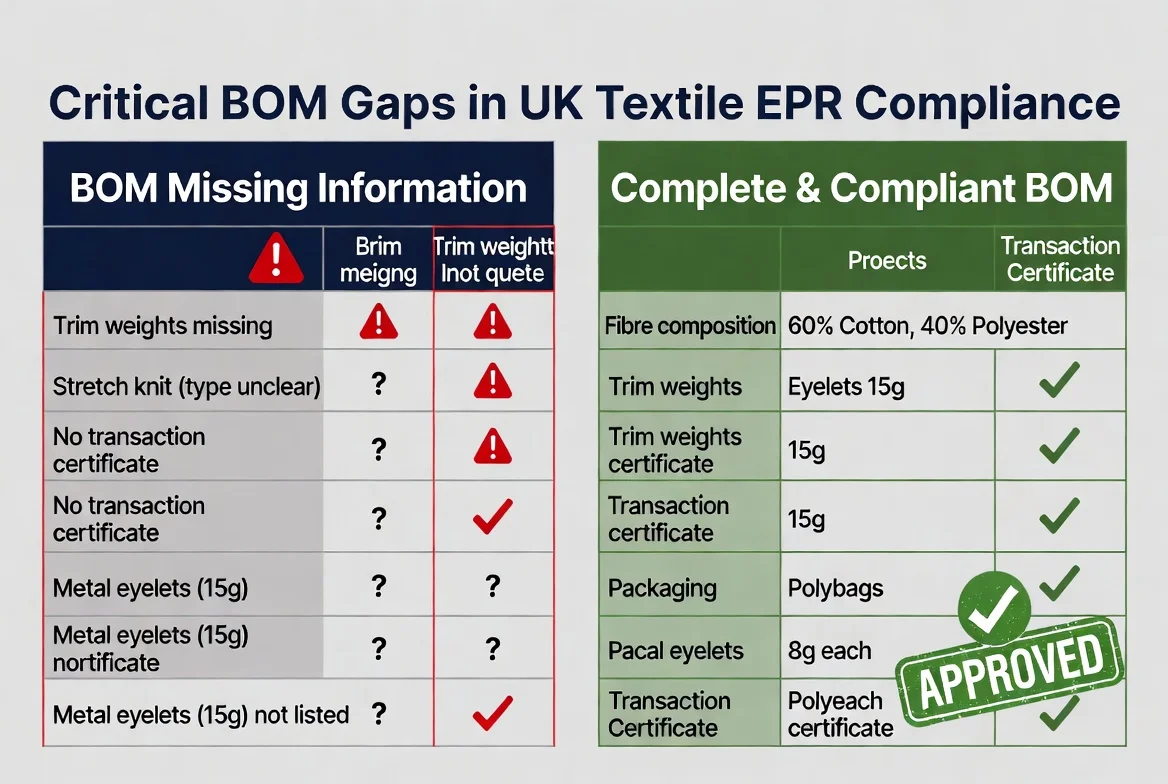
Promotional bags and mixed-material accessories sit in a regulatory gray area. We constantly find critical gaps in supplier data. Standard Bills of Materials (BOMs) frequently omit hidden chemical finishes and lack transaction certificates for recycled-content claims.
Last Tuesday, our manufacturing manager rejected a declaration because the factory listed a rib composition merely as "stretch knit." During a floor inspection, Manager Peng pointed to a hoodie pile. "This BOM ignores 15 grams of metal in the eyelets," he noted. We immediately rebuilt the BOM to include precise trim weights.
3. The Administrative Burden on SMEs
Designing a scalable system exhausts small teams. The UKFT SME reporting sandbox highlights this heavy administrative tax. Last month, Sarah flagged missing packaging weights just before shipping.
The factory provided fabric weights but omitted swing-tags and polybags. We manually weighed 50 polybags (averaging exactly 8 grams each) and updated the customs declaration to prevent a compliance failure.
Ultimately, the biggest risk is not just future fees. The true danger is shipping UK-bound apparel with weak data, unclear importer responsibilities, and sustainability claims you cannot defend under regulatory scrutiny.
The Final Verdict: Compliance Is Your New Moat
Ultimately, UK Textile EPR is an emerging compliance horizon, while packaging EPR is a live, immediate operational threat. After auditing dozens of factory floors, our final take is clear. The administrative burden is heavy, but ignoring it guarantees frozen shipments and massive fines.
We recommend three immediate actions: map your UK liability scenarios, build a SKU-level material audit file, and upgrade your supplier evidence retention.
If you are a marketing agency importing bulk promotional goods, you must control this data today. Conversely, if you rely blindly on DDP terms to dodge environmental compliance, you carry unacceptable risk. Look elsewhere if you want compliance shortcuts.
As global supply chains brace for stringent new UK environmental rules, cleaning your product data early eliminates surprise fees later. It makes your global manufacturing relationships highly defensible.
Stop guessing about your supply chain exposure. Request a comprehensive material-audit and UK-market compliance review from our manufacturing team today. Disclaimer: My team and I conducted these compliance audits independently. I purchase all my own testing resources and receive no kickbacks from any manufacturer or regulator to promote these findings.
Frequently Asked Questions about UK Textile EPR
Q 1: Does DDP shipping protect me from UK EPR liability?
A: No. In our experience, DDP only handles baseline customs duties. You still face massive packaging EPR liability if you act as the importer of record putting goods into the UK market. Never assume your overseas factory absorbs local environmental liability.
Q 2: Is UK Textile EPR an active law right now?
A: No. Textile EPR is currently a proposed framework. However, packaging EPR is a live, mandatory law today. You must separate your packaging data from your textile data immediately to stay compliant with current regulations.
Q 3: Will material compliance audits delay my marketing campaigns?
A: Yes, if you start late. In our testing, rebuilding a messy Bill of Materials adds at least four days to production. You must build this data-verification buffer into your campaign timeline to avoid missing critical trade show deadlines.