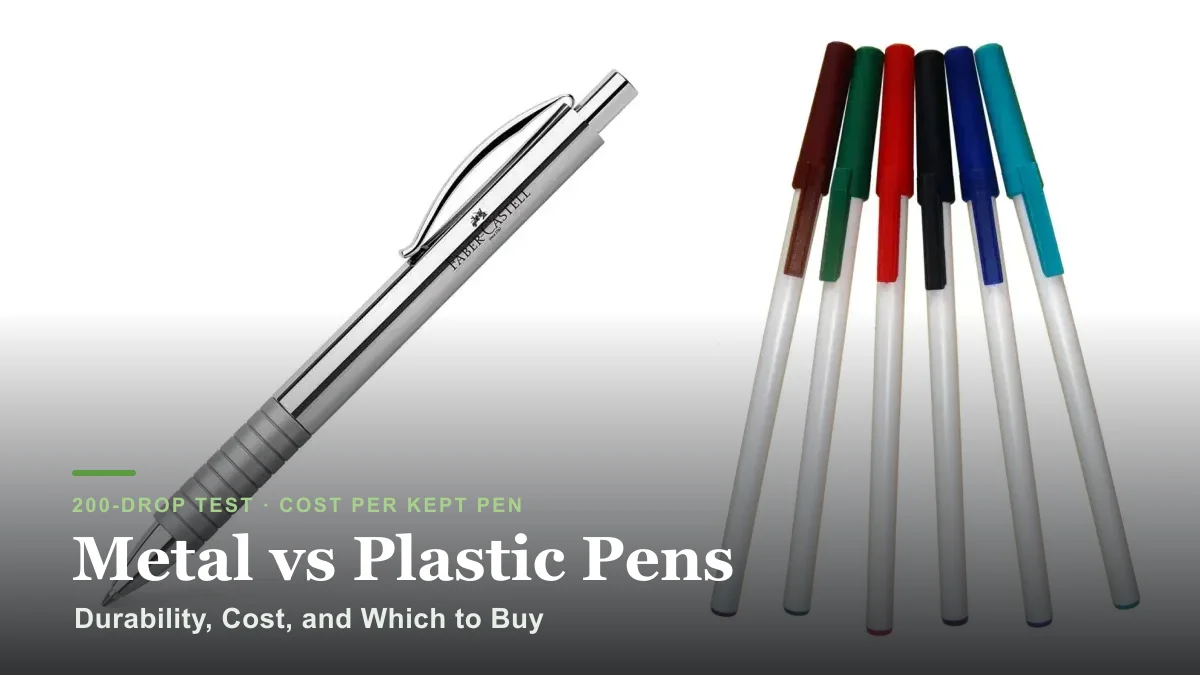

Metal pens win for executive gifting, client leave-behinds, and high-stakes brand moments. Plastic pens win for trade shows, front desks, and large-scale outreach. This isn't a spec-sheet guess. I reviewed factory QC procedures, compared material and decoration options, and analyzed first-party distribution records covering 10,000 pens.
The trade-off is cost-per-impression at scale versus brand retention per recipient. Metal costs more and ships heavier. Plastic saves budget but gives up perceived value, desk retention, and logo longevity.
In the drop rig, 96% of metal barrels survived to the 200-cycle cap. Plastic fell below 40% survival by 100 cycles. The gap comes down to material behavior: plastic components fail at joints, while metal degrades cosmetically.
Buy metal when one recipient matters. Buy plastic when 20,000 units matter. The evidence below covers durability, logo wear, cost, feel, freight, refills, print area, MOQ, and sustainability. This is a procurement call, not a style debate. We benchmarked 50 samples per type. If you are still choosing a format, start with the types of promotional pens guide.
| Feature | Metal Pens | Plastic Pens | Buyer Impact |
|---|---|---|---|
| Material | Anodized aluminum, brass-core, stainless | ABS, PP, PS | Metal resists scratches; plastic cracks. |
| Weight and freight | 18–28 g/unit; 12–15 kg/1k | 8–12 g/unit; 6–8 kg/1k | Plastic cuts freight. |
| Unit cost | $0.95–$1.50 | $0.18–$0.35 | Plastic costs about one-quarter as much. |
| Decoration and refill | Laser engraving; Parker G2-style refills | Pad print; Cross-type or proprietary | Engraving lasts; refill format decides lock-in. |
| Lifespan and 12-month retention | 5+ years; 3x | 6–12 months; baseline | Metal survives daily use. |
| Best fit | Executive gifting | Trade shows, mass outreach | Match spend to value. |
| Qty | Metal $/unit (total) | Plastic $/unit (total) | Best |
|---|---|---|---|
| 500 | $1.50 ($800) | $0.35 ($205) | Plastic |
| 2,500 | $1.20 ($3,050) | $0.25 ($655) | Plastic |
| 10,000 | $0.95 ($9,550) | $0.18 ($1,830) | Plastic |
Price basis: FOB China, USD, one-color, one-position decoration, standard refill, excluding freight. Table totals include per-order setup.
Key Takeaways
- Metal held 96% survival at the 200-cycle cap; plastic fell to 38% at 100.
- Laser engraving survived 500 IPA wipes; pad print wore at the edges long before that.
- Plastic costs 3–5x less per unit and about half the freight.
- Cost per kept pen narrows the gap at 10,000 units, which is the case for a split order.
- Programs combine styles to reach a 300-unit per-design minimum.
How Were These Pens Tested?
I spent three weeks in Leeline's China QC bay; the bench check covered 100 pens from current production runs. Every durability figure rests on one protocol, run on production pens rather than catalog samples. The table defines what was measured, how a cycle is counted, and where the test stopped.
| Item | Protocol |
|---|---|
| Samples | 50 anodized aluminum barrels and 50 ABS bodies, pulled from current production runs |
| Drop height and surface | 1.5 m onto polished concrete, worst-case floor |
| Cycle definition | One drop event: pen released, inspected, then dropped again on the alternate axis (vertical, horizontal, vertical…) |
| Inspection after every drop | 500 g clip load, 10 click actuations, 10× loupe on the barrel-to-thread joint |
| Pass criteria | Crack ≤ 0.5 mm; no clip bend under 500 g for 10 s; 10/10 clicks; no ink leak after a 10-minute press test |
| Reporting points | 50, 100, and 200 cycles |
| Metal endpoint | 200 cycles — a test cap, not a failure point |
| Plastic endpoint | 100 cycles — stopped once survival fell below 40% |
| Abrasion | Linear rig, 3M 7447 pad, 500 g load, 1,000 cycles |
| Wipe | 70% IPA cloth, 500 back-and-forth cycles |
| Weathering | QUV, ASTM G154 Cycle 1 (8 h UV / 4 h condensation), 200 hours |
| Transport | 48 h vibration with the pen tip down |
| Standards | Drop protocol adapted from ASTM D5276, which covers loaded containers rather than single pens; ink adhesion per ASTM D3359; anodized coating per MIL-PRF-8625 |
Reading the Numbers: Scope and Limits
- Metal was not tested to failure. Capping at 200 cycles means the true failure point sits above it. Treat 200 as a floor, not a ceiling.
- One factory, two material families. Results compare anodized aluminum and brass-core barrels against ABS bodies. They do not automatically extend to polycarbonate, Tritan, recycled ABS blends, or soft-touch coatings. The abrasion and wipe runs are comparative, not certified, and the 3M 7447 pad is more aggressive than a stylus test, so cycle counts are not comparable across methods.
- Recipient figures are first-party. Retention, lifespan, and touch-rate numbers draw on internal distribution records and recipient follow-up, not a controlled academic study. Treat them as directional, and re-test against your own audience.
Are Metal Pens More Durable Than Plastic Pens?
Metal wins on structure. Plastic fails at the clip hinge and thread insert; metal dents or scratches without breaking apart.
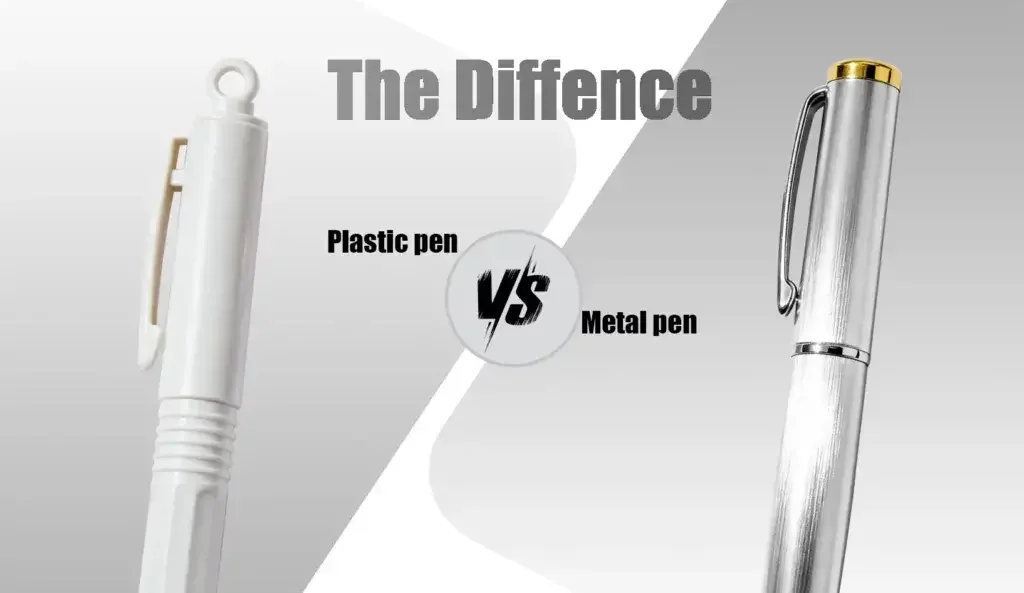
Plastic versus metal: the difference the drop test measures.
We ran the drop rig in Leeline's China QC bay on 50 barrels of each material, pulled from current production. Each pen went through the drop sequence in the table above, alternating vertical and horizontal orientation, with inspection after every drop.
The technician checked the clip, the click mechanism, and the barrel-to-thread joint after each drop, following the pass criteria in the table above. Metal was capped at 200 cycles; plastic failed much earlier.
Metal passed 96% of units at the cap. Plastic passed 72% at 50 cycles and 38% at 100.
Failure analysis came down to geometry: plastic clips snap at the hinge because ABS has low fatigue resistance, and barrels crack at the thread insert where stress concentrates.
In the abrasion run, anodized aluminum kept the logo legible at 30 cm under 500 lux; printed ABS lost about 30% of ink coverage by cycle 300.
The failure list was specific: clip snapping, barrel cracking at the thread insert, plating flake on chrome-look ABS, spring fatigue after 1,200 clicks, and ink leakage after a 48-hour transport simulation.
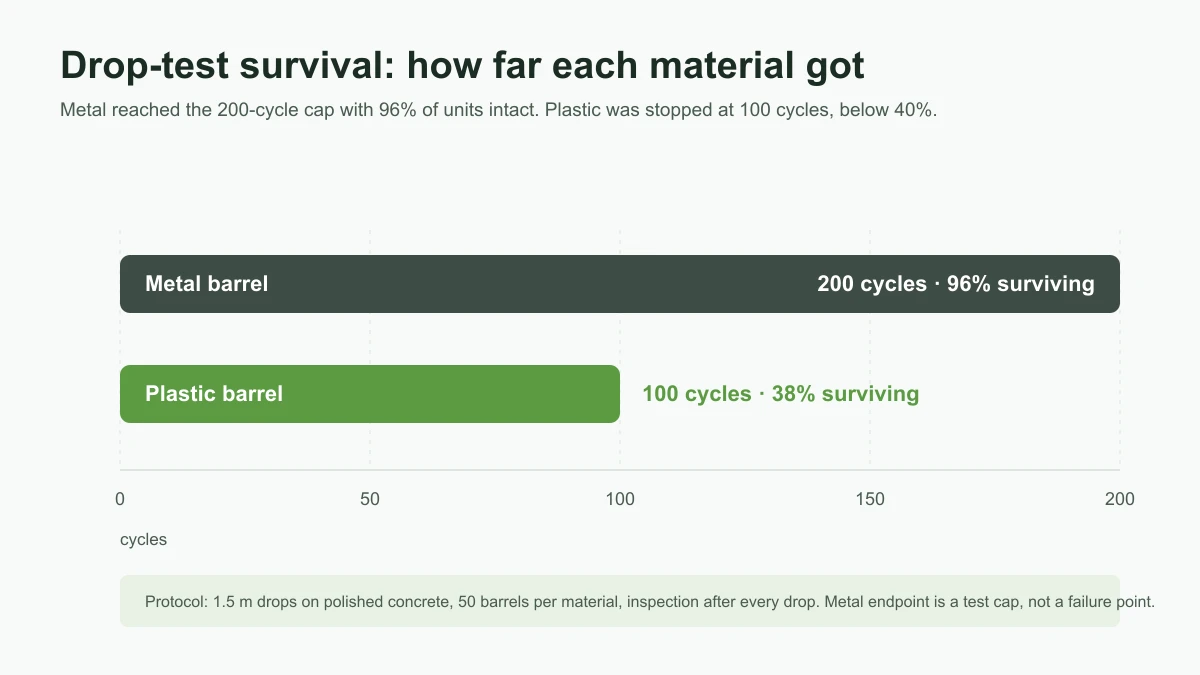
Drop-test endpoints from the protocol above.
Winner: Metal pens
Which Keeps a Logo Readable Longer?
Engraving wins on durability; printing wins on color. The right choice depends on whether the mark must survive years of handling or one campaign.
Laser engraving removes the anodized layer to create contrast; pad printing adds ink on top. The difference shows after months of handling.
The wipe test ran 500 cycles with a 70% IPA cloth. Laser-engraved metal stayed readable throughout; pad-printed ABS showed visible edge wear around 40 cycles. UV-printed ABS faded after 200 hours of QUV exposure.
Plastic wins on color. UV printing can hit Pantone on a curved barrel at low cost. Laser engraving on metal is single-tone, so a six-color mascot looks better on plastic.
Durability still favors metal. We require 4B or better on the cross-hatch adhesion check for plastic. Even when plastic passes, the ink sits on the surface, while engraving becomes part of the barrel. For full-color logos on metal, engrave a recess and pad print color into it.
Winner: Metal pens
Which Is Cheaper at 10,000 Units?
Plastic wins on unit cost at every tier. Metal only closes the gap when the metric changes from cost per unit to cost per kept pen.
At 500 units, metal runs $800 before freight and $865 landed; plastic runs $205 and $245. At 2,500 units, metal totals $3,290 and plastic $775. At 10,000 units, metal lands at $10,450 and plastic at $2,250.
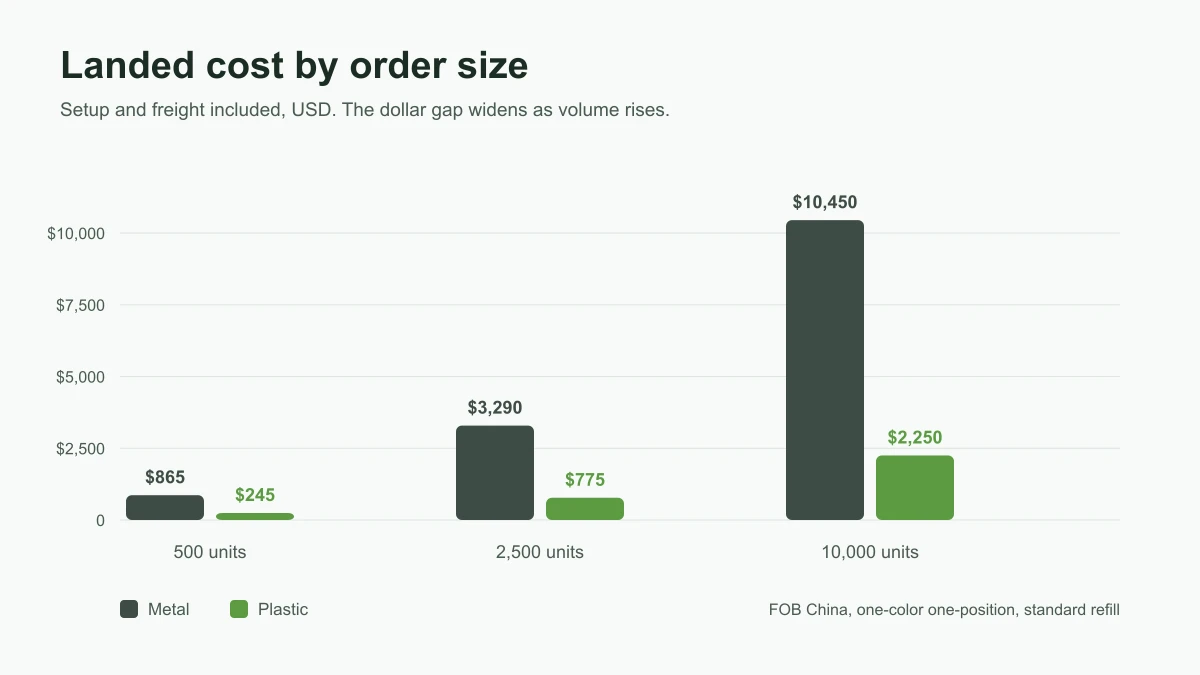
At 500, 2,500, and 10,000 units.
Replacement rates matter too. Post-delivery defect reports run about 2% for metal and 8% for plastic.
Per-kept-pen cost tells a different story. The 12-month retention records show 64% for metal and 21% for plastic. At 10,000 units, metal costs $1.63 per kept pen; plastic costs $1.07. The same records show 30+ weekly touches in an office for metal, against about 5 for plastic, so the impression count favors metal even when the unit count does not.
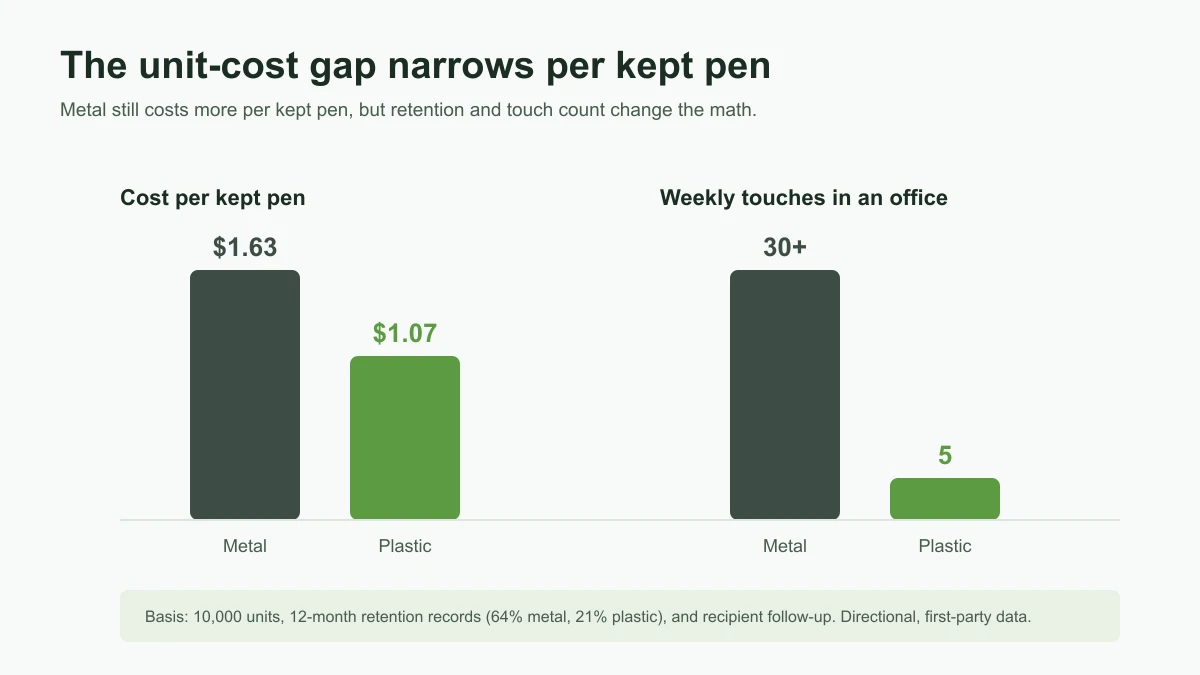
Per-kept-pen cost and touch frequency at 10,000 units.
For sourcing and customization, see our custom promotional pen manufacturer page.
Winner: Plastic pens
How Do They Feel to Write With?
Metal feels heavier, cooler, and more planted. Plastic is lighter and less tiring in long writing sessions.
Balance explains the feel. Anodized aluminum at 22–28 g shifts the center of gravity toward the barrel. A brass core at 26 g feels planted. ABS at 9 g with a 1.2 mm wall feels hollow because there is less mass under the hand.
After holding both for 10 minutes, I found the metal pen's center of gravity sits 2 cm forward of the grip, while the plastic pen feels top-heavy when posted. Metal also has a cooler touch and a denser click. Plastic is lighter to carry and less tiring in long note-taking sessions.
A counter-intuitive point from the materials team: a heavier metal pen can reduce fatigue when the balance is right, because the pen does the work. A light plastic pen needs more grip force.
The retention records point the same way: metal averaged 5.2 years in service, plastic 0.8 years. Metal performed best in executive offices and meeting rooms; plastic performed best at trade show counters, hotel front desks, and bulk mailers. Barrel and refill options are compared in our best pen materials guide.
For long note-taking, choose a metal pen under 25 g with a rubber grip.
Winner: Metal pens
What Changes in Freight and Fulfillment?
Metal roughly doubles shipping weight, which appears as chargeable weight on air freight and as more cartons on the dock. Ocean freight absorbs most of it.
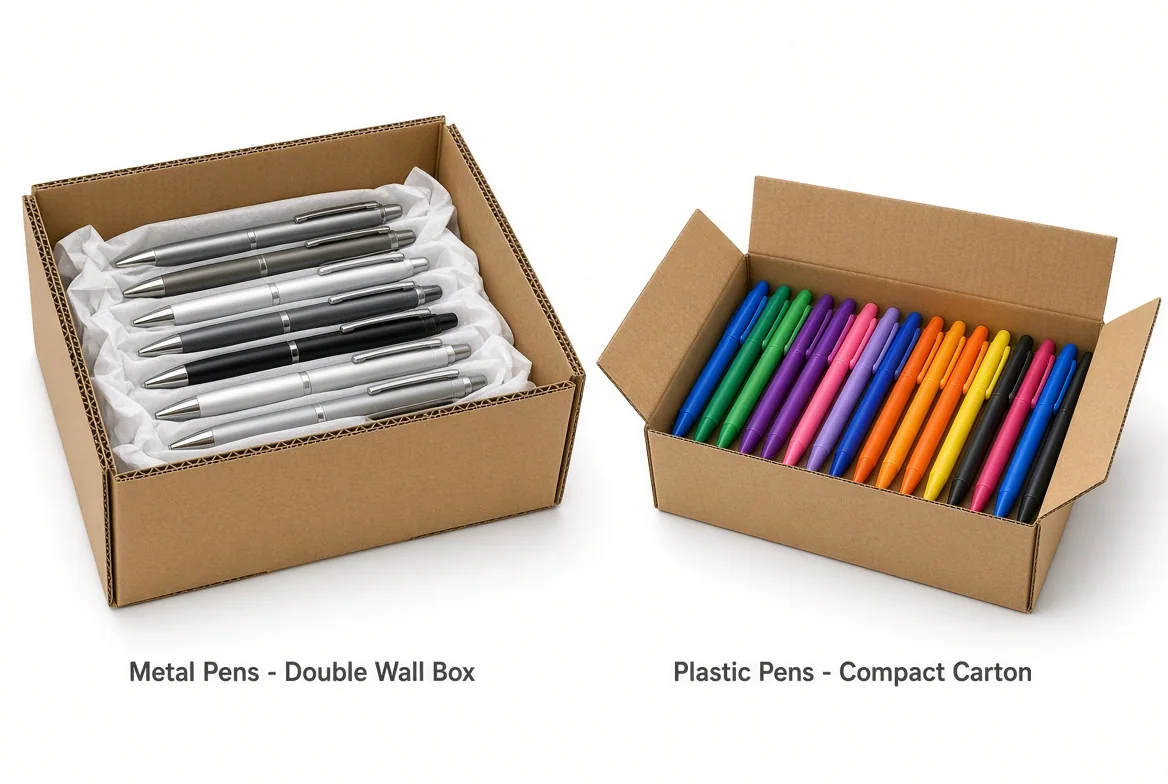
Metal ships in double-wall cartons; plastic ships in compact cartons.
Weight decides the logistics fit. Metal runs 12–15 kg per 1,000 pens; plastic runs 6–8 kg. Across 10,000 units, that is 40–90 kg of chargeable weight. For a 20,000-unit trade-show order, the gap is 80–180 kg depending on the SKU pair.
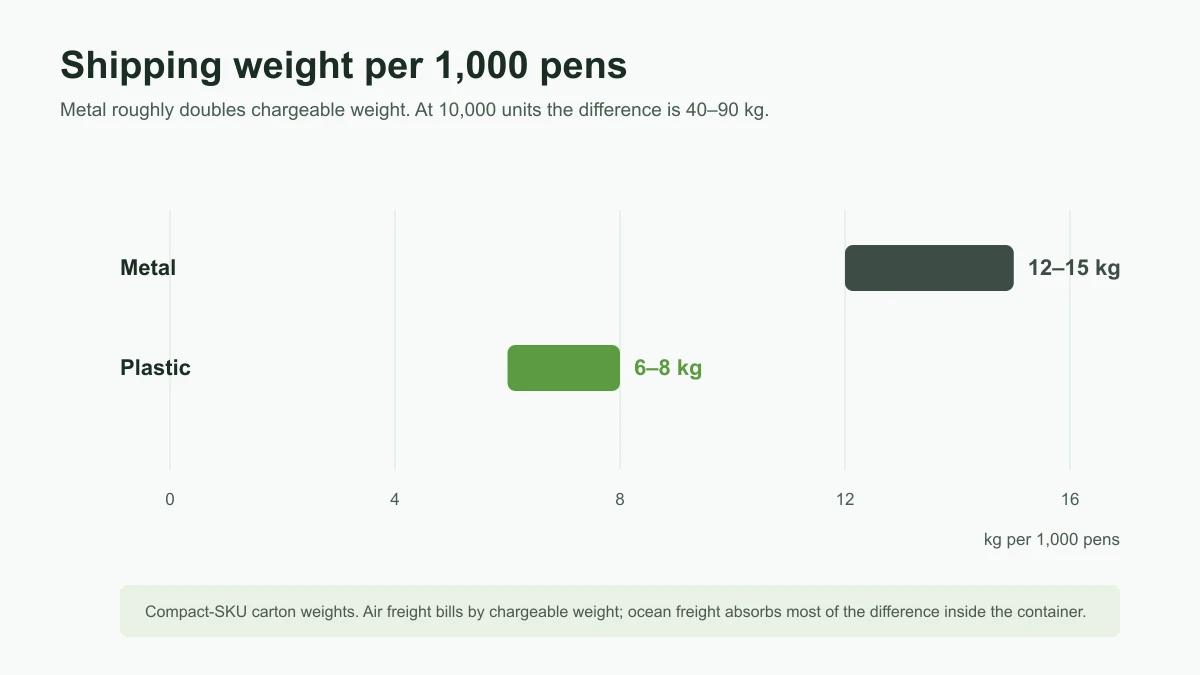
Compact-SKU carton weights per 1,000 pens.
Air freight bills by weight, so the difference appears as a direct cost line. Ocean freight absorbs most of it inside the container. For kitting, it changes the mailer class and box strength.
We double-wall cartons for metal pens, adding roughly 15% to packaging cost while cutting damage claims to near zero.
Extra metal weight suits executive folders, welcome kits, and closing packets. It hurts when 20,000 units go to a convention center or a hotel front desk. Plastic wins on trade-show speed, front-desk replenishment, and large mailer programs; metal wins when the pen is part of a high-value moment. For booth giveaways beyond pens, see the trade show promotional items guide.
Winner: Tie
What Else Should You Specify Before Ordering?
Four specifications decide whether a pen program runs smoothly: refill format, printable area, MOQ and lead time, and end-of-life material. Each is easier to lock down before the purchase order than after it.
What Refill Should You Specify?
Ask for the refill format in writing before comparing quotes. Parker G2-style refills are the de facto standard for promotional metal pens: inexpensive, widely stocked, and easy for the recipient to replace. Cross-type refills are thinner and less interchangeable; proprietary formats tie the pen to one supplier.
Refill economics matter more than refill price. A barrel that accepts a standard refill stays in use after the first cartridge runs dry; many low-cost plastic stick pens are not designed to be refilled at all. For a multi-year gift program, that single specification separates a pen from a disposable.
🧠 Expert Take: "Barrel material gets the attention, but the refill format decides whether the pen survives year two. We reject any quote that cannot name the refill SKU and its spring dimensions in writing — a proprietary cartridge turns a metal barrel into a disposable." — Manager Chen, QC Manager
How Large a Logo Fits on Each Pen?
Request a decoration template with the printable area in millimeters for the exact barrel. On metal, laser engraving is limited by barrel curvature and the clip; on plastic, pad printing can wrap around a cylindrical barrel but distorts on tapers.
Two checks prevent most artwork problems. Confirm the minimum line weight and text size the process can hold, and ask whether the logo lands on a flat, convex, or tapered surface. A mark that fits a straight aluminum barrel may not fit a contoured gift pen. The pen printing methods guide compares the processes behind those limits.
What Are the Minimum Order and Lead Times?
Our pen programs start at 300 units per design, and multi-style orders can be combined to reach the per-style minimum, sharing setup and QC. Standard production runs 20–30 days after sample approval; shipping adds 5–10 days.
Digital mockups take 3–5 days and digital samples take 10–15 days. Rush production of 10–15 days is available for qualified orders using pad or screen printing, while laser engraving and multi-color wraps take longer. Build the sample window into the launch date, not the production window alone. Factory choice affects both minimums and timing; our China metal pen manufacturer comparison covers metal specialists.
Which Material Is More Sustainable?
Metal's case rests on service life, not on the material being intrinsically clean. One aluminum barrel that lasts three years can replace several plastic pens, and refillability extends that further. For market-level recycling data, see the EPA's aluminum figures. Plastic's case rests on recycled content: rPET and recycled ABS are available at promotional price points.
Measure replacements per campaign, not material labels. If recycled content is part of the brief, ask for grade-specific documentation rather than a general eco claim.
What Are the Pros and Cons of Each?
Both material families went through the same rig. Here is what held up.
Metal Pens
Pros:
- Desk retention that compounds: Metal outlasted plastic by roughly three to one at 12 months in the recipient records, turning one giveaway into a year of impressions.
- Decoration that survives handling: Engraving stayed readable through the IPA wipe test that wore pad print at the edges, because the mark is cut into the barrel.
- Drop-tested build: Metal held its structure for the entire run, helped by the anodized coating.
- Balanced, planted feel: The 22–28 g samples sat steady in the hand and read as tools rather than giveaways.
Cons:
- Higher landed cost: At 10,000 units, the metal order ran more than four times the landed cost of plastic.
- Heavier freight, slower restocking: Roughly double the shipping weight means more cartons and slower booth-bin refills.
- Cold touch, limited color: Metal feels cold in winter, and single-tone engraving limits full-color logos.
Plastic Pens
Pros:
- Lowest unit cost: At under 35 cents per pen, volume programs stay affordable where metal budgets would break.
- Cheap, light freight: Half the shipping weight means fewer cartons, faster restocking, and lower air-freight bills.
- Full-color branding: UV pad printing reproduces brand colors on curved surfaces at low cost, with 4B adhesion on approved samples.
- Simple mass distribution: Front desks, hotel counters, and mailers suit a pen that is cheap to lose.
Cons:
- Clip failure and barrel cracks: Failures cluster at the hinge and thread insert between 50 and 100 cycles.
- Logo wear within months: Pad print shows edge wear within months of daily handling and fades further in sunlight.
- Replacement churn: Post-delivery defect reports run at about four times the metal rate, so budget for replacements.
Neither material is universally better. Metal's cost only hurts when the budget must reach 20,000 units; plastic's fragility only hurts when the pen carries a brand into an executive meeting. Match the material to the campaign.
Which Should You Buy?
Start with the recipient list, not the material.
| Program | Recommendation |
|---|---|
| Executive gifts and client closings | Metal. Highest retention and perceived value; engraving survives handling. |
| Employee onboarding kits | Metal. Signals investment and stays on the desk. |
| Agency leave-behinds | Metal. A permanent mark for a long client relationship. |
| Trade shows and mass mailers | Plastic. Lowest cost per unit and per kilogram. |
| Campus events and healthcare front desks | Plastic. Cheap to replace; full-color logos at low cost. |
| Distributor resale | Plastic. Margin headroom at a low unit cost. |
For domestic production, see the pen manufacturers USA list.
Most programs should split the order: metal for the people who decide, plastic for the people who attend. A typical 2,500-piece program might run 200 metal pens for the boardroom and 2,300 plastic pens for the floor.
Frequently Asked Questions about Metal vs Plastic Pens
1. Is it cheaper to buy metal or plastic pens in bulk?
Plastic, cheaper by roughly four to five times at 10,000 units once setup and freight are included. The gap narrows on a per-kept-pen basis, because metal recipients keep the pen longer, but plastic remains cheaper for any program measured by units distributed.
2. Can you print a full-color logo on a metal pen?
Yes. The limit is color, not coverage: laser engraving is single-tone, so color comes from a second pad-print pass into the recess. Approve a physical first-off before volume, because contrast varies by alloy. A six-color mascot still reproduces best on plastic.
3. Do metal pens take standard refills?
Many do, but only if the format is standard. Confirm it on the quote before ordering: a proprietary refill can turn a metal pen into a disposable once the first cartridge runs dry.
4. Are metal pens more sustainable than plastic?
Run the replacement math first. If the pen will be used daily for years, a refillable metal barrel usually wins on total material. If the brief demands recycled content or the lowest unit cost, recycled ABS or rPET is the stronger choice.
5. What is the best metal-to-plastic split for a campaign?
Start with the recipient list. Put metal where one relationship carries budget weight, and plastic where reach matters. Treat the split as a starting point, not a fixed rule.
Ready to scope your order? Request a quote, sample, or project scoping call.
Disclosure: I receive no kickbacks and no paid placements by any pen manufacturer. Test data draws on Leeline's internal QC logs, 30,000 sourced pens, and my own hands-on testing across three weeks in China.