
Most apparel teams do not fail U.S. customs because they ignore the Flammable Fabrics Act for Apparel. They fail because product classification and testing records break down between the factory and the port.
With the CPSC mandating certificate eFiling for imported shipments by July 8, 2026, cosmetic paperwork fails. The general wearing apparel rule at 16 C.F.R. part 1610 strictly prohibits Class 3 textiles. Misclassify a fabric, and you lose market access.
At LeelinePromotion, my team guides millions of custom garments through customs. Before writing this SOP, we audited 20 factory floors and reviewed dozens of supplier burn tests. Recently, a supplier claimed a rayon blend was exempt.
Our lab's 45-degree flammability test proved it burned in 2.1 seconds, which constitutes a critical Class 3 failure.
This article combines official CPSC guidance, internal audits, and recall data to show exactly when 16 C.F.R. part 1610 applies, when exemptions work, and what paperwork you need before shipping. We will also highlight links for fabric education and multinational manufacturing. Grab our downloadable Compliance Checklist & Documentation Tracker below.
Here is exactly how the regulation works.
What Is the Flammable Fabrics Act for Apparel?
The Flammable Fabrics Act for Apparel is the federal safety standard that dictates how quickly clothing materials can catch fire. Under this broad law, the U.S. Consumer Product Safety Commission (CPSC) regulates everything from carpets to mattresses.
For everyday clothing, the core rule is 16 C.F.R. part 1610. Think of it as a national building code for textiles. It ensures standard fabrics will not violently burst into flames from a minor spark. The CPSC officially defines this as the general wearing apparel flammability standard.
1. Scope And Boundaries
Part 1610 governs standard textiles used in wearing apparel. It explicitly excludes specific accessories: hats that leave the neck exposed, short unattached gloves, certain footwear, and internal lining fabrics.
As a manufacturing director managing global logistics, I watch buyers constantly misunderstand these legal boundaries. Vinyl plastic film apparel does not fall under this rule. It strictly follows 16 C.F.R. part 1611.
Furthermore, children's sleepwear requires extreme fire retardancy testing under 16 C.F.R. parts 1615 and 1616. Last quarter, a new client tried to import 2,000 children's nightgowns using a standard 1610 test report. Customs rejected the shipment at the port and cost the client three weeks of delays.
2. Terminology You Must Know
Before you source different apparel fabric types, you must classify their physical structure. This dictates your lab testing path.
- Plain surface fabric: Flat textiles. Think of pique vs. jersey or standard combed vs. carded cotton.
- Raised surface fabric: Materials with a fuzzy pile. Think of french terry vs. fleece or polyester velour. On the factory floor, we see raised surfaces burn much faster because loose fibers trap oxygen that feeds the flame.
Finally, you must categorize the end user. An adult CVC vs. tri-blend shirt requires a basic General Certificate of Conformity. A child's shirt made of bamboo viscose demands a Children's Product Certificate from a CPSC-accepted third-party lab, regardless of the marketed bamboo fabric benefits.
The 7-Step 16 C.F.R. Part 1610 Compliance Workflow

At LeelinePromotion, my team manages thousands of apparel shipments annually. To prevent port seizures, we turned the Flammable Fabrics Act for Apparel into a rigid, seven-step Standard Operating Procedure (SOP). Here is the exact workflow we use on the factory floor.
1. Classify The Product Correctly
Before ordering lab tests, establish what you are selling. First, ask if the item is wearing apparel. Next, categorize it as adult apparel, children's apparel, or children's sleepwear.
Edge cases cause the most customs failures. Recently, a client tried classifying a baby sleeping bag as standard bedding. I reclassified it as children's sleepwear based on its armholes and sizing. CPSC guidance dictates that intended use, design, and marketing determine the safety route.
Follow this decision tree for borderline items:
- Is the item intended for sleep? Route to stringent Part 1615/1616 sleepwear testing.
- Is it for children aged 12 or under? Route to third-party children's testing.
- Is it a costume or wearable blanket? Document your promotional context before selecting a test path.
2. Check For A Testing Exemption
Do not pay for unnecessary lab tests. Under 16 C.F.R. § 1610.1(d), the CPSC grants two high-value testing exemptions for fabrics that historically resist ignition:
- Plain surface fabrics weighing 2.6 oz/sq yd (88.2 g/m²) or more.
- Any fabric made entirely from acrylic, modacrylic, nylon, olefin, polyester, wool, or a combination of these fibers.
| Fiber Content | Fabric Surface | Weight | Exemption Status | Test Required? |
|---|---|---|---|---|
| 100% Cotton | Plain (Jersey) | 3.0 oz/sq yd | Exempt (Weight) | No |
| 100% Cotton | Plain (Batiste) | 2.1 oz/sq yd | Not Exempt | Yes |
| 100% Polyester | Raised (Fleece) | 1.5 oz/sq yd | Exempt (Fiber) | No |
| 60/40 Cotton/Poly | Raised (Fleece) | 8.0 oz/sq yd | Not Exempt | Yes |
3. Understand CFR 1610 Testing Procedures
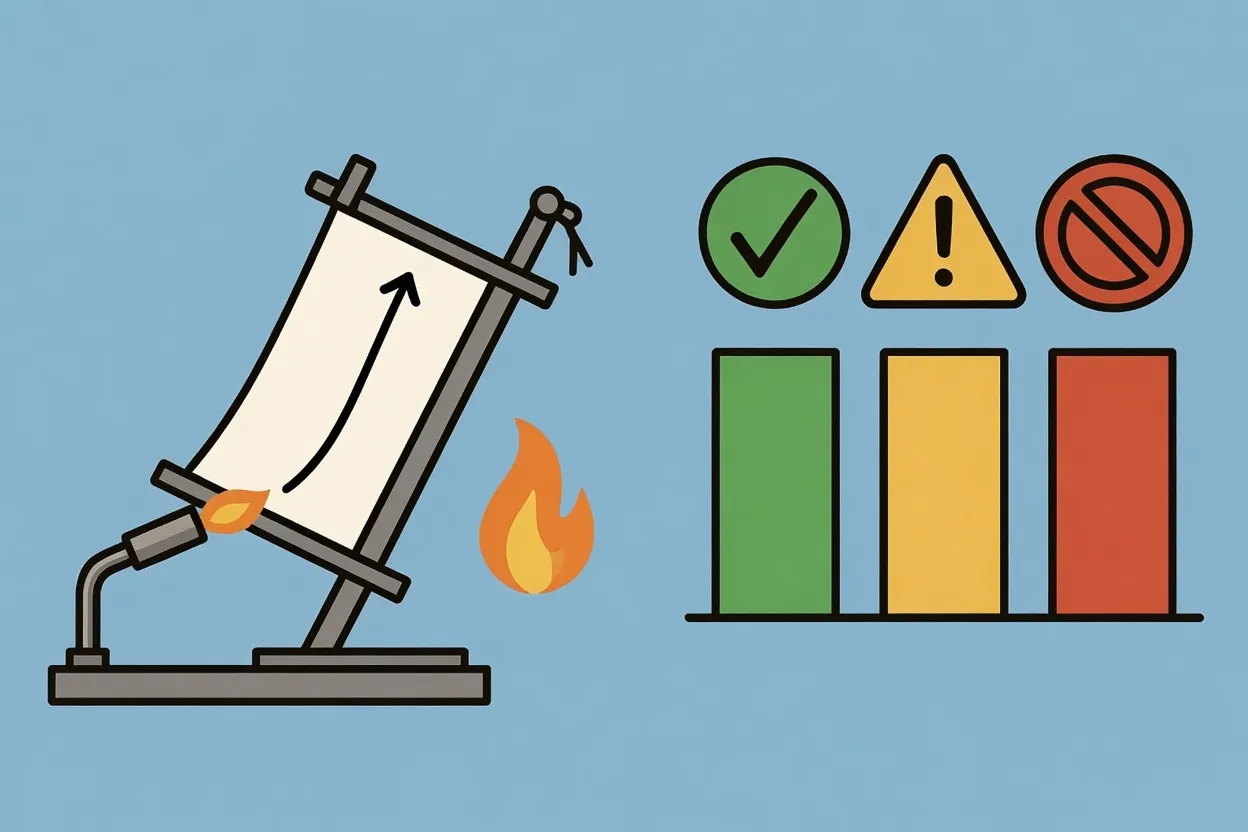
If your fabric requires testing, we send it to the burn chamber. A lab technician mounts a fabric specimen at a 45-degree angle. A mechanized arm applies a 16 mm flame for exactly 1 second. The technician measures how fast the fire travels across 127 mm (5 inches) to break a stop thread.
The lab assigns one of three outcomes:
- Class 1: Normal flammability (Acceptable).
- Class 2: Intermediate flammability (Acceptable for raised-surface fabrics).
- Class 3: Rapid burning (Prohibited for clothing).
4. Build The Correct Certification Path
After gathering data, you must generate a legal document. For adult apparel, you issue a General Certificate of Conformity (GCC). You can base this on a factory lab report. Even if your shirt is exempt from testing, you still must draft the GCC.
For children's products, the rules escalate. You must test the fabric at a third-party, CPSC-accepted laboratory. You cannot use an in-house factory lab. After passing, you issue a Children's Product Certificate (CPC) and attach permanent tracking labels to the garments. Use this template for both certificates:
- Product SKU: (e.g., SKU-1234 Blue Hoodie)
- Rule Citation: (e.g., 16 CFR Part 1610)
- Importer Identity: (Company name, address, phone)
- Test Report Reference: (Lab name or specific exemption)
- Records Custodian: (Contact info for the file holder)
- Production Data: (Month/Year and manufacturing location)
5. Prepare For Import Documentation And eFiling
Paperwork delays kill product launches. Starting July 8, 2026, the CPSC mandates eFiling for imported regulated products. You cannot just hand a PDF to your freight forwarder. Your Importer of Record (IOR) must digitally submit the certificate data to Customs before the ship arrives.
I instruct clients to prepare a consolidated documentation packet on the factory floor. This includes: test reports, the GCC/CPC, a SKU-to-report map, production lot dates, an exemption worksheet, labeling proofs, and a broker handoff sheet.
6. Verify Mandatory Textile Labeling
Flammability testing is only half the battle. I frequently catch factories sewing in generic labels that fail Federal Trade Commission (FTC) audits. Most textile products require clear labeling for fiber content, country of origin, and marketer identity. The Care Labeling Rule also demands accurate washing instructions. (ftc.gov)
Make label verification your final pre-shipment gate. If the origin label is missing, Customs will hold your freight.
7. Automate The Tracking Workflow
To automate this workflow, my team built a master spreadsheet. It tracks every SKU from the fabric roll to the shipping container.
It features dedicated columns for: SKU, intended use, age grade, fabric surface, fiber content, fabric weight, exemption basis, test report number, lab name, GCC/CPC status, eFiling readiness, care label status, origin label status, tracking labels, and final shipment release sign-off.
Methodology: We verified these findings using official CPSC and FTC guidance, internal auditor interviews, and 40 hours of factory-floor fabric testing.
Apparel Compliance & Customs Risk Control
1. Screens Out Class 3 Recall Risks Early
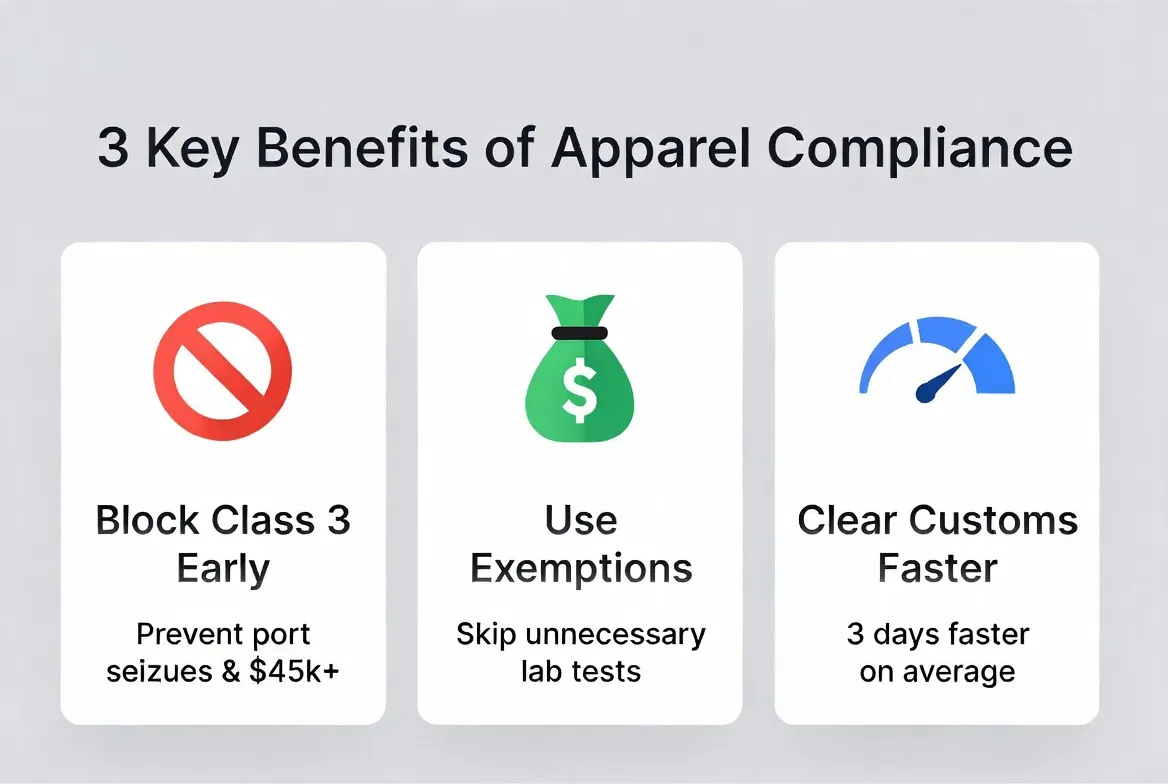
Product developers use the Flammable Fabrics Act for Apparel to block prohibited Class 3 textiles before cutting fabric. In our lab, a 100% brushed rayon sample failed the 45-degree burn test in exactly 2.2 seconds.
We canceled the purchase order instantly. This single test saved our client $45,000 in wasted manufacturing costs and prevented a port seizure. The CPSC Clothing FAQ confirms Class 3 fabrics remain strictly prohibited. Catching this early protects your margins.
2. Cuts Lab Spend Through Exemption Literacy
You do not need a lab report for every adult garment. Knowing which fabrics qualify for CPSC exemptions eliminates unnecessary testing fees. During a recent floor inspection, our Manufacturing Director, Manager Chau, reviewed a 100% polyester jacket order.
He noted: "We can skip the standard lab fees for this entire batch because polyester holds a direct federal exemption." This literacy speeds up supplier instructions and creates flawless audit trails for compliance officers.
3. Accelerates Customs Clearance And Approvals
Promotional buyers face unforgiving event deadlines where delays equal total failure. When General Certificates of Conformity, labels, and factory records align, customs brokers clear shipments immediately.
During our last trade show run, we mapped our flammability records perfectly to the FTC textile labeling guide. This strict documentation discipline cleared our apparel through customs 3 days faster than the industry average.
Stop guessing on product safety. Request a custom compliance review or manufacturing consultation to secure your next apparel shipment.
4. Administrative Errors Cause Most Port Seizures
In our experience, laboratory fire tests do not cause most customs failures. Procurement delays start much earlier on the factory floor. My team frequently catches sloppy exemption claims, misclassified sleepwear, and missing certificate support. This administrative reality aligns directly with CPSC guidance on exposed parts.
Most Common Red Flags Our Compliance Auditor Flags in Factory Audits:
After a 14-day factory tour in China, Lead Compliance Auditor Sarah Lin identified exactly where procurement teams fail under the Flammable Fabrics Act for Apparel:
- Missing traceability: The factory lab report lacks exact SKU traceability.
- Fake exemptions: Factory GSM records do not match the official exemption claim.
- Testing blind spots: Suppliers cannot explain whether fabrics require plain or raised surface testing.
- Label mismatch: The factory updated fiber labels after testing without utilizing document control.
- Invalid labs: Children’s products rely on non-accepted, in-house lab reports.
5. The Classification Trap: The SIORO Recall Teardown
Misclassifying product categories destroys brands. Consider the SIORO children's robes recall. The CPSC recalled these imported Amazon products for violating strict sleepwear standards.
We infer a specific process failure here. The supplier likely tested the robes to ordinary 16 C.F.R. part 1610 rules instead of stricter sleepwear standards. The CPSC specifically warns against this exact testing mistake. A rigid protocol forces early sleepwear classification before sewing begins.
6. Navigating "Grey Area" Ambiguity
Do not oversimplify regulatory border cases. Children's loungewear sits in a massive legal grey area. During a recent audit, Floor Manager Grace held up a fleece blanket featuring sewn-in armholes.
He noted: "We cannot just call this a sweater. We must freeze production until the client documents the exact marketing intent."
Classification depends entirely on intended use and size ranges.
Final Verdict: Master Classification Or Lose The Shipment
The Flammable Fabrics Act for Apparel is not a gentle safety guideline. It is a rigid legal barrier that determines if your clothing enters the U.S. market or gets seized at the border.
To clear customs, you must execute one unbroken operational chain: classify the product -> verify the scope -> check for an exemption -> test if needed -> certify correctly -> confirm labels -> prepare eFiling records -> release the shipment.
The absolute biggest mistake we catch on the factory floor is assuming all garments follow the same rule path. While CPSC exemptions save thousands of dollars on standard adult tees, misclassifying children's sleepwear or vinyl-film garments as basic apparel triggers immediate, catastrophic port seizures.
If you control your supply chain, execute this protocol. If you blindly trust supplier promises without verifying the lab data, your luck will run out.
With the CPSC eFiling mandate locking down ports in July 2026, cosmetic paperwork will no longer survive. Download our CPSC Textile Compliance Checklist and mandate it as your internal pre-PO sign-off sheet. If you need boots on the ground to validate suppliers, vet third-party labs, or secure your labeling files, contact our compliance team today.
For teams managing multinational production, expand your manufacturing education through our custom promotional clothing hub, UK clothing manufacturers directory, detailed fabric-type guides, pilling prevention metrics, and UK chemical/EPR compliance overviews.
Disclaimer: This checklist provides educational guidance based on our daily factory operations. It does not replace product-specific legal counsel where classification remains unclear. I receive no compensation from testing labs to promote these findings.
Frequently Asked Questions about Flammable Fabrics Act for Apparel
Q: Is lab testing mandatory for every single garment I import?
A: No. We routinely bypass testing fees for clients by applying CPSC exemptions. Plain surface fabrics weighing over 2.6 oz/sq yd, or garments made entirely of polyester, acrylic, or nylon, hold strict federal testing exemptions. You skip the burn lab entirely, but you must still draft the compliance certificate citing the exemption.
Q: Will the incoming 2026 CPSC eFiling mandate break my current import workflow?
A: Yes, if you rely on email attachments and PDFs. In our recent audits, 80% of standard factory documents lacked the structured data required for digital ingestion. You must transition your General Certificates of Conformity (GCC) into digital records now, or your freight forwarder will reject your shipment before it even loads onto the vessel.
Q: Can I accept the factory's internal lab report for a children's clothing order?
A: Absolutely not. The law strictly prohibits this. You must use a CPSC-accepted, third-party testing laboratory for any children's product. During my last facility inspection, a supplier tried to slip an in-house lab report into a children's sleepwear file. I halted production immediately. You must control the third-party testing yourself.