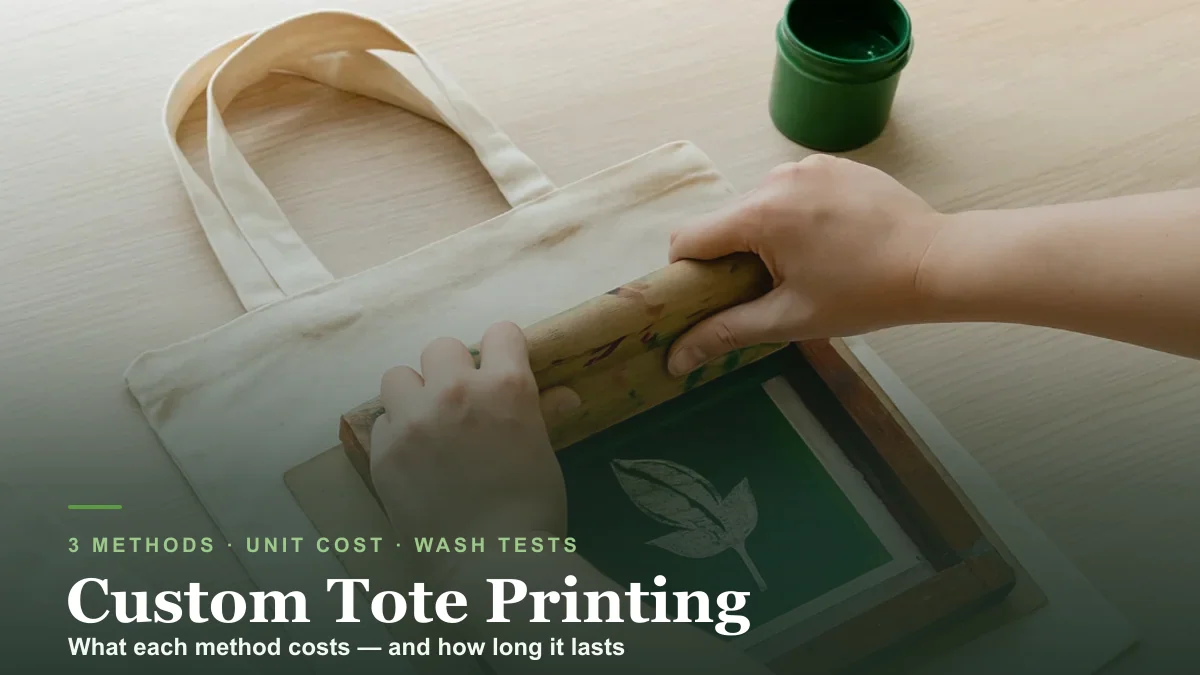

Most bulk tote reviews repeat supplier spec sheets. This one starts on the factory floor. It compares custom tote printing methods on unit economics, color accuracy, fabric compatibility, durability, and defect risk, using production records and wash tests rather than catalog claims.
How this review was built: 500+ anonymized tote orders (2023–2025), 180 heat-transfer orders, and 30 home-laundry cycles per AATCC TM135. Color was measured on production fabric under D65. We funded every sample and accepted no supplier fees. Test reports are available on request; see the editorial policy and fact-checking process.
Custom Tote Printing Methods: 3 Options and 2 Spec Decisions
Sections 1–3 compare the three methods that cover nearly all bulk tote orders. Sections 4–5 are not print methods; they are the fabric and color decisions that determine whether any method survives a wash cycle. Each method is scored on setup cost, per-unit cost, fabric compatibility, color accuracy, and wash durability. Verdicts assume one fixed design; multi-color or variable-data jobs can change the ranking.
1. Screen Printing: Lowest Unit Cost at Volume
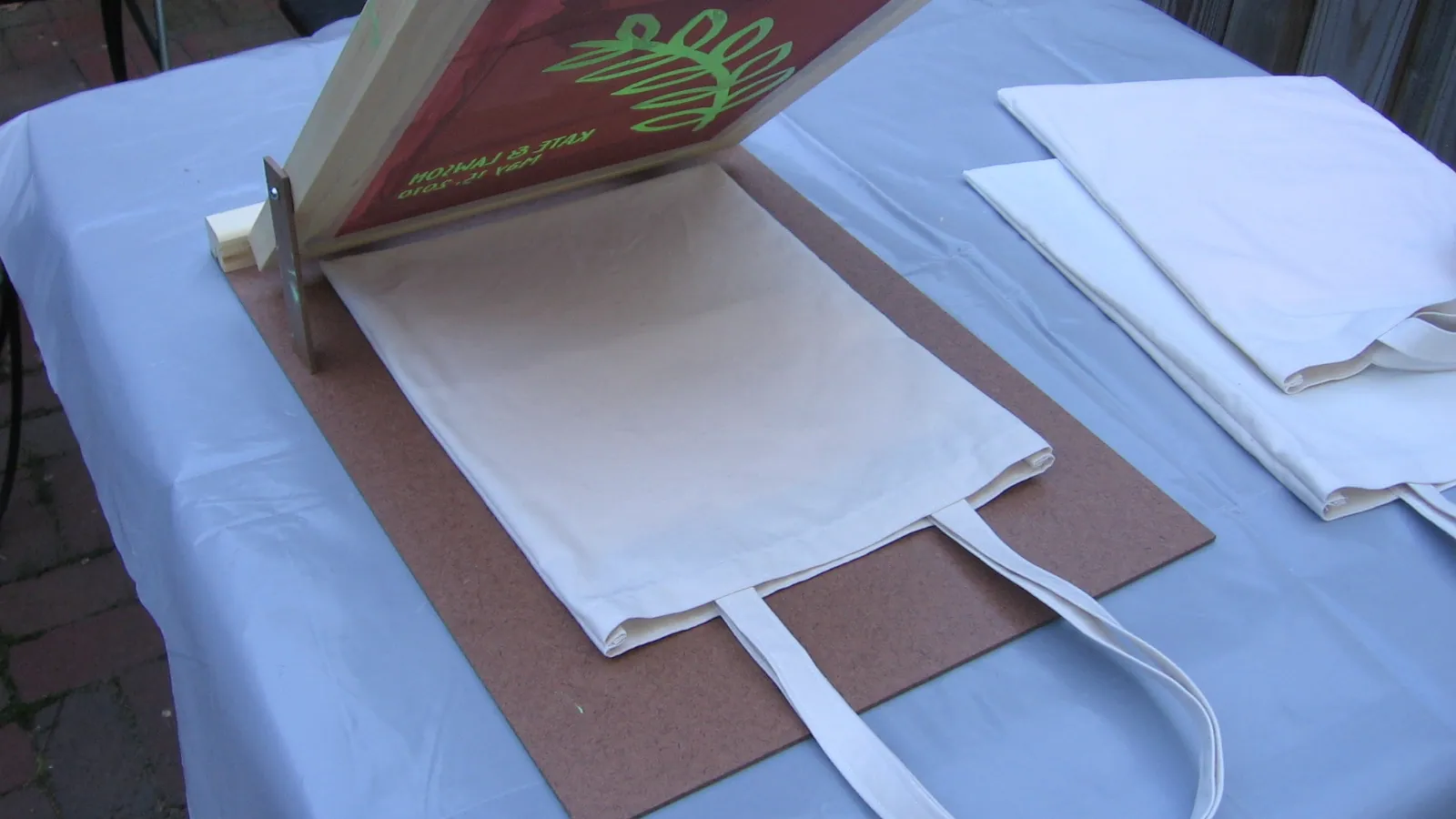
For one- and two-color logos on real volume, screen printing still wins. Print costs were pulled at 500, 2,000, and 10,000 units. One color on 12 oz canvas ran $0.42 per print plus a $50 screen fee at 500 pieces, $0.19 at 2,000, and $0.08 at 10,000. Major print defects stayed below 1.2% across those lots. Heat transfer only competes below roughly 300 units, where screen setup no longer amortizes.
Canvas rewards screen printing because of ink laydown. A thick plastisol deposit sits on the weave and holds a Pantone spot color tight. Transfers look bulky and peel at the corners after ten washes.
Mesh count matters. On heavy 12 oz canvas, the line runs 110–160 mesh; the open weave takes more ink and hides fabric texture. On lighter 10 oz totes, 230 mesh holds fine detail. Skip that step and thin lines bleed.
Cure verification saves orders. Plastisol needs 320 °F at the ink surface. Production manager Wu checks each run with a temperature strip and a 20% stretch test; ink that cracks sends the batch back.
Verdict: Screen printing is the default for one- and two-color logos from 300 units up. Each extra color adds a $50–$75 screen fee, so keep logos 1.5 inches off seam lines. For photographic gradients, use DTF instead.
2. DTF Printing: Best for Complex, Color-Heavy Artwork
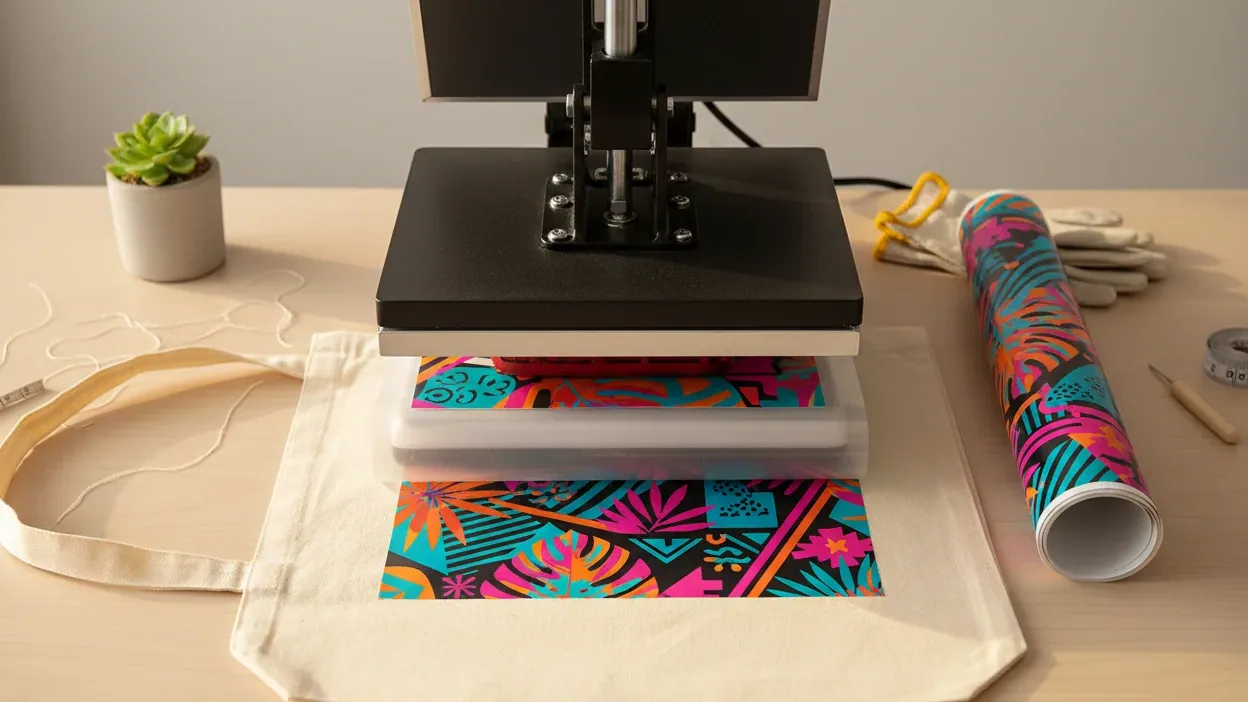
A clean mockup often hides the real file: a gradient, a drop shadow, and a product photo. A two-color quote becomes a six-screen job with a $300 setup bill.
DTF avoids that. Direct-to-film prints the full color range in one pass, with no screens, per-color fees, or plate re-burns when artwork changes.
The same artwork was run through both methods. At 500 units, DTF cost $0.71 per print with zero setup; six-color screen printing cost $0.57 per print plus $300 in screens, or $1.17 all-in. At 2,000 units, DTF fell to $0.55; six-color screen fell to $0.24 per print plus $0.15 setup, or $0.39 all-in. At 10,000, screen printing won clearly: $0.11 per print plus $0.03 setup against DTF's $0.48. DTF starts cheap but flattens out.
Durability splits by substrate. On 12 oz canvas, DTF held color through 30 home washes, but edge lift began at wash 12 and a full-width crack appeared by wash 18. The film sits on top of the weave, so rub resistance matters; a week against a denim jacket scuffs the print.
On non-woven PP, the flat film did not crack, but seam edges cracked after three washes and color dulled after ten. The film bonds to the poly coating, so the ink stays while pigment fades.
Verdict: Choose DTF when artwork complexity beats PMS precision, for pilot lots, dark bags that need a white underbase, or designs likely to change. DTF reaches roughly 90% of a Pantone match. At 2,000 units on one fixed design, screen printing is already cheaper.
3. Heat Transfer: Fast Turns and Variable Data Only
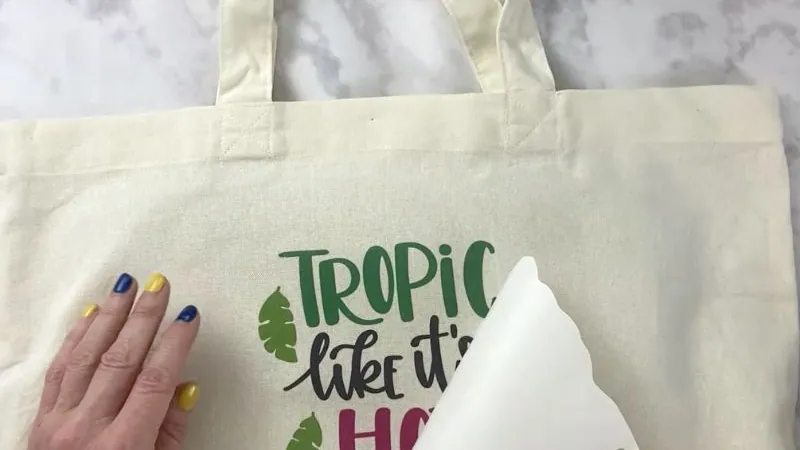
Heat transfer looks affordable at quote stage because setup is light. Volume changes that.
Of 180 heat-transfer tote orders, the 300-unit quote was $0.58 per print with no screen fee. At 5,000 units, one-color screen printing ran $0.14 and DTF $0.46. Heat transfer held a cost lead only below roughly 300 units.
The fit is narrow but real: event-date graphics, short campaigns, names or numbering on small runs, and urgent artwork changes that do not justify new screens. Entry cost is low and samples arrive fast, but retail packaging, grocery reuse, and long-term brand carry should stay on screen print or DTF.
Failure shows up later. Carrier-sheet edges can leave a gloss line, corners lift with handling, and wash resilience drops. Under the 30-cycle wash protocol, edge peel started at wash 6 on 12 oz canvas. Screen print and DTF both held longer.
"Nobody loses money on the print itself," Manager Gong said, walking the heat-transfer line. "They lose it when a short-run method gets carried into a 10,000-unit program."
Spec Decision 1: Fabric and Ink Pairing Sets the Print Ceiling
Most tote failures start at the print edge, not the seam. Across 30 wash cycles, the bag held while the ink did not. For custom tote printing, fabric choice sets the ceiling.
The two substrates buyers source most are 12 oz unbleached cotton canvas and 100 gsm non-woven PP. Canvas has a deep, thirsty weave: it absorbs water-based ink quickly but fights plastisol until the ink gels. Non-woven PP has a slick, low-absorbency surface and softens above 300 °F, so cure settings change before a logo reaches press.
On canvas, plastisol won. Rub resistance stayed at 4.5 after 30 washes, with no cracking under magnification. Water-based ink scored 4.0, felt softer, but lost 12% color depth by wash 22. DTF scored 3.8 and lifted at corners from wash 12.
On non-woven PP, plastisol failed first: it cracked at the fold after 8 cycles and scored 3.5. Water-based ink scored 4.2 but faded 15%. DTF held rub resistance at 4.0, cracked at seam edges after three washes, and dulled after ten.
Print lead Lina flagged the heat issue: "At 310 °F, the coating softens. The print looks perfect off the line and fails in the dryer." PP curing is now capped at 290 °F, with the line run 15% slower.
Eco claims need a filter. Eco-friendly ink tote printing should mean heavy-metal-free, azo-free, and aligned with REACH or Proposition 65. A green badge alone proves little; ask for the test report and the exact standard, and check the compliance center for the documents to request.
Verdict: Pair plastisol with canvas for grocery reuse and retail packaging. Use water-based ink on canvas when hand-feel matters. For one-event trade shows, DTF on PP is acceptable; for any reuse program, skip plastisol on PP.
Spec Decision 2: Pantone Matching and AQL 2.5 Prevent Costly Reprints
The most expensive mistake in custom tote printing is not a late shipment. It is an on-time run with a logo two shades off. A 10,000-piece order once stalled at the warehouse because brand blue read purple on 12 oz canvas; the buyer saved $200 on samples and lost $9,000 in reprints and air freight.
Spec Pantone C for ink and TCX only for dyed fabric or webbing. Canvas texture scatters light, so the same ink reads lighter or darker than a paper chip. Delta E under 2.0 is the working tolerance, measured on production fabric under D65, not on a coated proof.
Before screens are burned, check vector art, outlined fonts, 0.125-inch bleed, and a 0.5-inch safe margin from seams. Approve a strike-off on the actual bag fabric, then verify cure temperature with a strip and log the result.
For mass production, run AQL 2.5 under ISO 2859-1:2026. On a 10,000-piece lot, General Inspection Level II means sampling 200 bags and accepting no more than 10 major defects. Reject registration drift over 1.5 mm, handles placed more than 0.25 inch off center, and crocking below grade 4.0. The sign-off packet should include a signed golden sample, a Delta E report, a cure log, an AQL report, and pack-out photos.
Author's take: Color rejects across the last 40 tote POs fell from 6% to 0.8% once a fabric strike-off and D65 reading were required. A $150 strike-off beats a $9,000 reprint.
The Buyer's Playbook
Use the matrix to choose a method, then run the six-step release sequence.
| Quantity | Artwork | Fabric | Color need | Reuse | Method |
|---|---|---|---|---|---|
| 300–2,000 | 1–2 spot colors | Canvas or PP | Pantone Delta E <2.0 | Long-term | Screen |
| Under 2,000 | Gradient or photo | Canvas | Approximate Pantone | Short | DTF |
| Under 300 | Any | Canvas | Any | One event | Heat transfer |
| 2,000+ | Simple vector | Canvas | Pantone | Retail | Screen |
| 2,000+ | Complex | PP | None | One event | DTF |
| Any | Variable data | Canvas | Any | Fast | Heat transfer |
- Artwork intake. Collect vector files with outlined fonts; request 300 DPI for raster.
- Preflight. Check bleed and seam margins using the promotional product design service.
- Strike-off. Match ink to a physical Pantone chip and approve the print on production fabric.
- Pilot run. Produce 50–100 units and test crocking and adhesion.
- AQL inspection. Apply the lot-size plan in AQL 2.5 vs. 4.0.
- Release. Confirm the five-item sign-off packet.
Landed cost favors screen printing from 300 units for simple art. DTF wins for complex art until screen setup amortizes, typically by 2,000 units, and for pilot lots. Heat transfer wins under 300 units or for variable data. Add freight, duty, and defect risk before comparing quotes; the landed-cost guide walks through the math.
Get this costed for your quantity. Send the quantity, artwork, and in-hands date to the team. You'll get a method recommendation with per-unit and landed cost, plus a free digital sample review.
Frequently Asked Questions About Custom Tote Printing
1. Which method is cheapest for wholesale custom tote bag printing?
For one- or two-color logos, screen printing is cheapest from about 300 units upward; at 500 units, one-color screen printing runs $0.52 all-in versus $0.71 for DTF. DTF wins for complex artwork and for pilot runs below roughly 200 units. Heat transfer is cheapest only for short runs or variable data.
2. DTF vs. screen printing on canvas: which lasts longer?
Screen-printed plastisol lasts longer. In the 30-cycle test it held rub resistance at 4.5 with no cracking; DTF scored 3.8 and began lifting at corners around wash 12. DTF remains a sound choice for one-event bags and artwork that cannot be simplified.
3. Can you get an exact Pantone match on fabric?
Exact matches are rare because canvas texture scatters light. Specify Pantone C for ink, measure Delta E on production fabric under D65, and approve a strike-off. Screen printing comes closest; DTF reaches roughly 90% of a Pantone match.
4. What does AQL 2.5 mean for printed bag inspections?
AQL 2.5 is the acceptance quality limit for major defects under ISO 2859-1. On a 10,000-piece lot at General Inspection Level II, 200 bags are sampled and up to 10 major defects are accepted. Minor cosmetics are usually judged at AQL 4.0 on a separate list.
5. Is cotton canvas or non-woven PP better for printed totes?
Cotton canvas suits long-term reuse, retail packaging, and grocery carry because it holds plastisol ink through repeated washing. Non-woven PP is lighter and cheaper for giveaways. Avoid plastisol on PP; it cracks at the fold after about 8 cycles. DTF on PP is limited to one-event use.
6. What MOQ and lead time should a buyer expect?
Custom tote bags start at 200 units, with bulk production taking 10–15 days after digital sample approval. Complex multi-color artwork adds 3–5 days for screens and curing checks. Sea freight to the US adds 20–30 days; air freight takes about a week.
Need a quote or sample review? Send the quantity, artwork, and in-hands date to the contact page. The team will reply with a method recommendation and a landed-cost estimate. For supplier shortlists, see China promotional bag manufacturers.