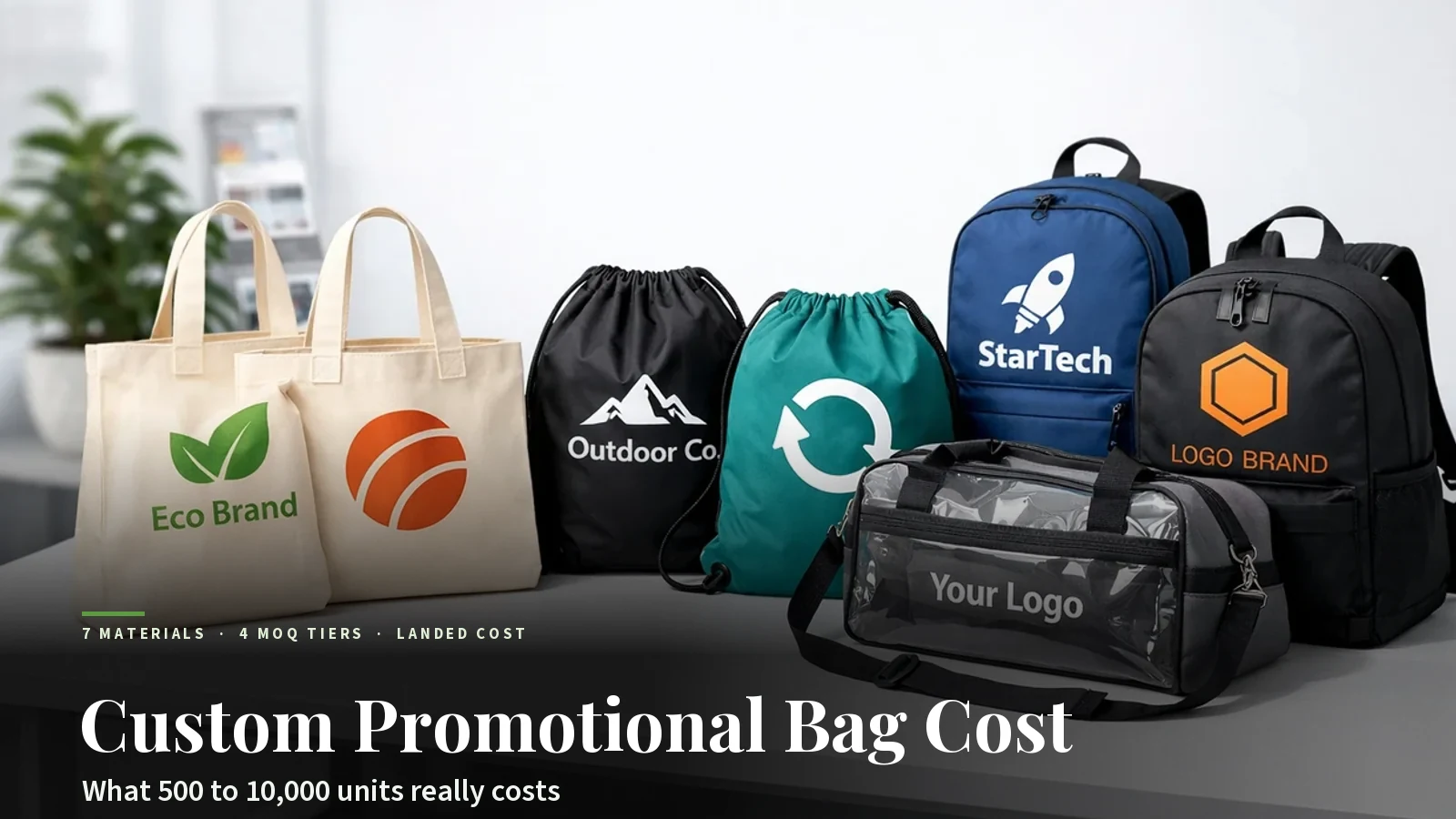

A custom promotional bag costs $0.60–$5.90 per unit at the factory gate (FOB China, 1–2 color print) across 500 to 10,000 units. At 2,000 units a plain 100gsm non-woven tote runs about $0.75 FOB, while a lined GRS rPET or laminated retail tote lands at $5.80–$6.05 after freight and duty.
Unit price is rarely where these orders fail. They fail on line items buyers never see: setup fees, testing adders, carton volume, and a duty classification nobody checked.
This custom promotional bag cost guide is written for B2B buyers sourcing 500 to 10,000+ units in China. It runs through a benchmark matrix by MOQ, a line-by-line BOM, the landed-cost formula, and a side-by-side teardown of two real 2,000-unit orders.
How this guide was built: 300+ anonymized LeelinePromotion order files (2024–2026), two 2,000-unit quote teardowns, and interviews with the senior costing engineer. All prices are USD, FOB China, and include 1–2 color print unless the spec line says otherwise.
Order data is anonymized before it enters a benchmark: buyer names, logos, and PO numbers are removed; material, quantity, and quote-structure fields are kept. See the fact-checking process for how claims are verified. The editorial policy explains how corrections are handled.
Prerequisites
Vetted against live LeelinePromotion quote files and the costing team.
Time: 30 to 45 minutes. Difficulty: Intermediate.
Have these in hand or on-screen:
- Order-volume spreadsheet: quantity tiers (500 / 1,000 / 3,000 / 10,000), target margin, budget ceiling.
- Tech pack PDF: front/back views, gusset depth, handle length, fabric GSM, lining, zipper gauge, print method, carton assumptions, label requirements.
- Material swatches or Pantone references for specified colors.
- Destination country and port, plus an Incoterm target (FOB or DDP). This changes the quote structure.
- Packaging format: polybag, hangtag, retail box, or kitting.
- Sign-off authority: procurement approval plus finance confirmation on your landed-cost ceiling.
- Past order files, if available. Factories price faster against a reference.
⚠️ Compliance warning: Never approve on price alone. If the project needs GRS transaction certificates, REACH or Prop 65 testing, or retailer packaging rules, confirm documentation before signing. Classify HTS early, and verify any eco certification before accepting a recycled claim.
Turning concept art into a production-ready brief? See the promotional product design page.
Step 1: Set the Landed-Cost Ceiling Before Requesting a Quote
Suppliers quote FOB first, because it is the number that looks best. Duty and freight arrive later and rewrite the budget.
Start with the commercial endpoint. Define the bag's job: giveaway, retail resale, or employee kit. Name the target channel. Set the maximum acceptable landed cost per unit. Split demand into four comparison tiers: 500, 1,000, 3,000, and 10,000 units.
Now separate the spec list. Put must-haves first: material family, capacity, closure, print colors, lining, hangtag, insert card, and retail packaging. Mark non-critical items as negotiable. In recent quotes, moving hangtag and insert card onto the negotiable list cut first-round FOB prices by 6% to 9%.
Use reverse costing. Write your program budget or target selling budget per unit. Subtract internal margin needs, domestic handling, and contingency. That gives the target landed cost. Then subtract duty, freight, insurance, and port fees. The result is the maximum FOB goal.
Target landed cost = budget per unit - margin - handling - contingency
Max FOB goal = target landed cost - duty - freight - insurance - port fees
If past order files exist, use them as a bottom-up sanity check.
Contrast two bags. A corporate event tote at 1,000 units may carry a $3.80 landed ceiling and a $2.20 FOB goal. A retail-quality DTC bag at 3,000 units may support an $8.50 landed ceiling and a $5.40 FOB goal. Same shape. Different commercial job. Different cost ceiling.
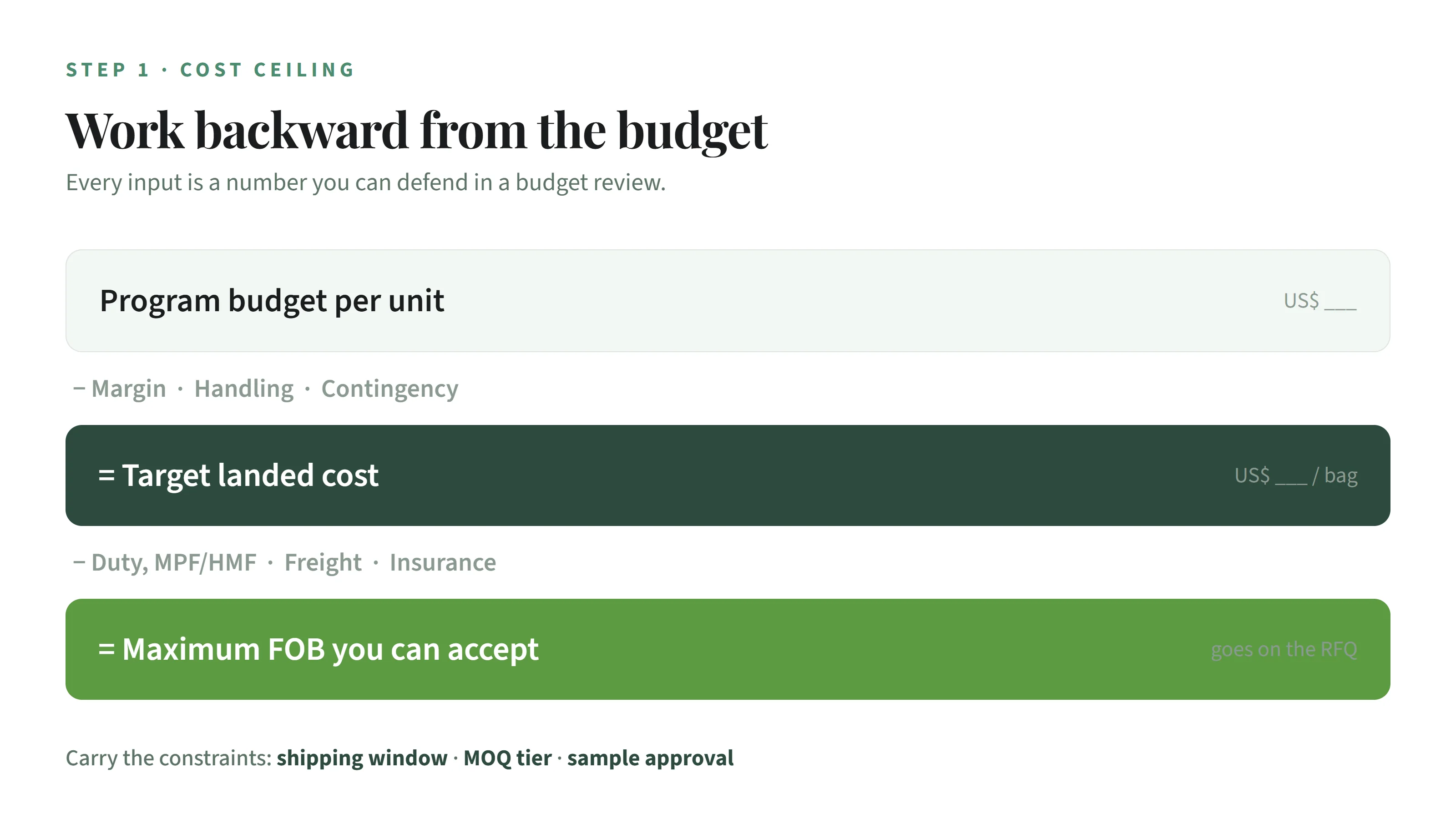
Before moving on, state four numbers out loud: one target landed cost, one target FOB, one shipping window, one acceptable MOQ tier.
Step 2: Build a Factory-Style BOM to See Where the Money Goes
In a teardown of two 2,000-unit quote files, Senior Costing Engineer Li Wei walked through the cost buckets. He handed over a swatch of 100gsm non-woven PP — stiff, almost papery — then 12oz cotton canvas, noticeably heavier with a rough hand. The rPET swatch had a slicker face. "Feel the zipper pull," he said. "That's a cost multiplier."
Start with the quote buckets. In my experience, direct materials eat 45–60% of FOB. Direct labor takes 20–30%. Factory overhead and profit sit at 15–25%. Ask the supplier for a line-by-line BOM.
Build the BOM framework with these lines: outer fabric, lining, interlining, webbing/handles, zipper or closure, print/embroidery, labels, packaging, labor, and overhead. Per-unit print cost alone swings with method, so compare custom tote printing options before locking a decoration line.
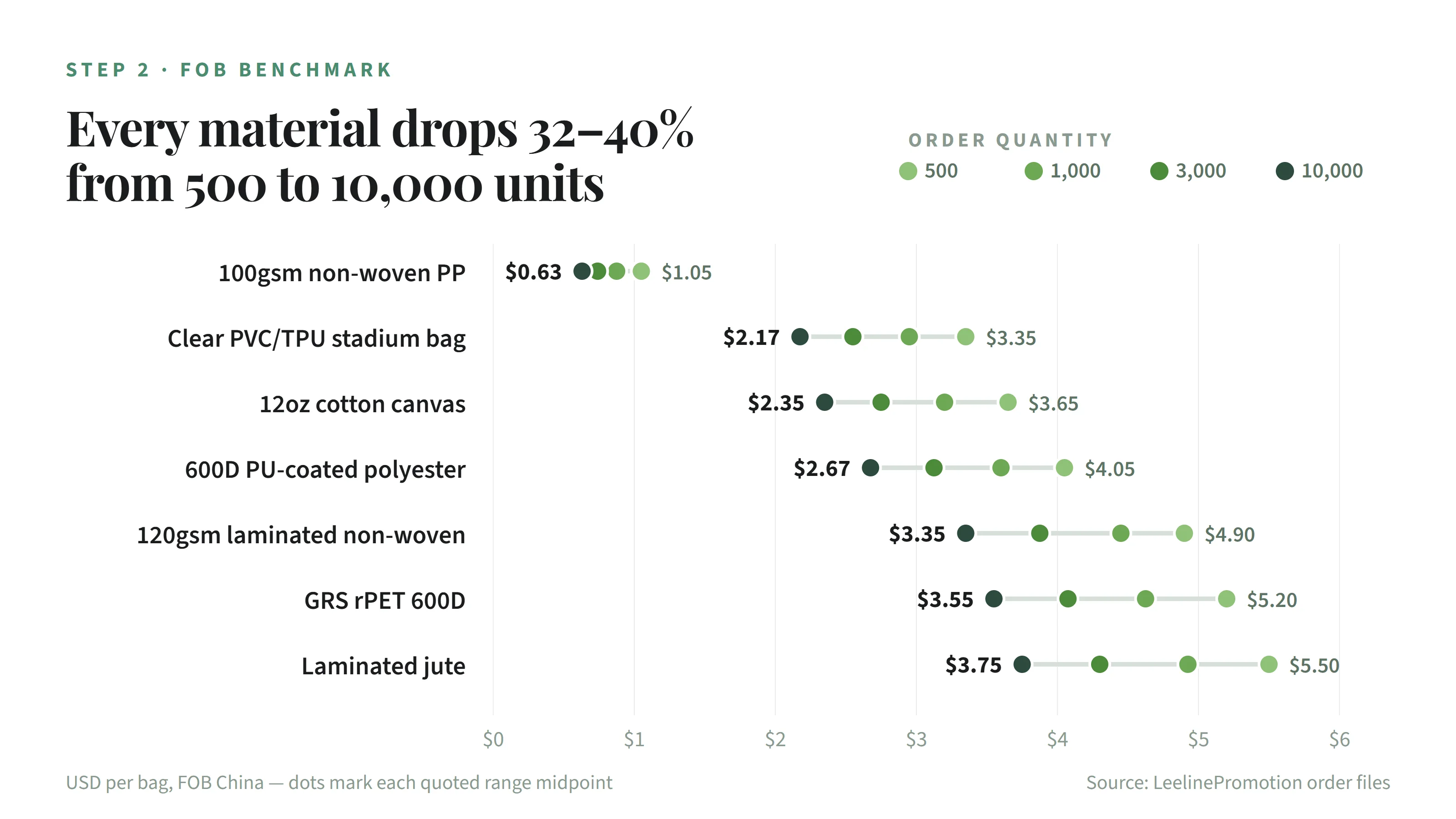
The seven core materials in this brief — 12oz cotton canvas, 100gsm non-woven PP, 120gsm laminated non-woven, GRS rPET, 600D polyester, laminated jute, and clear PVC/TPU stadium bags (built to the NFL/NBA 12×6×12 clear-bag rule) — form the benchmark matrix below.
FOB price per unit, USD, Q4 2026, based on LeelinePromotion order files. Standard polybag packing. "Retail-ready" adds lining, reinforced handle stitching, and a hangtag.
| Material and spec | 500 | 1,000 | 3,000 | 10,000 |
|---|---|---|---|---|
| 100gsm non-woven PP, 1-color, no lamination | $0.95–$1.15 | $0.80–$0.95 | $0.68–$0.80 | $0.58–$0.68 |
| 120gsm laminated non-woven, 2-color, lined, retail-ready | $4.55–$5.25 | $4.20–$4.70 | $3.70–$4.05 | $3.15–$3.55 |
| 12oz cotton canvas, 1-color screen print, bar-tacked handles | $3.35–$3.95 | $2.95–$3.45 | $2.55–$2.95 | $2.15–$2.55 |
| GRS rPET 600D, 1-color, lined, hangtag | $4.85–$5.55 | $4.35–$4.90 | $3.85–$4.30 | $3.35–$3.75 |
| Laminated jute, 1-color, cotton webbing handles | $5.10–$5.90 | $4.60–$5.25 | $4.05–$4.55 | $3.55–$3.95 |
| 600D PU-coated polyester, 1-color, lined | $3.75–$4.35 | $3.35–$3.85 | $2.90–$3.35 | $2.45–$2.90 |
| Clear PVC/TPU stadium bag, 1-color | $3.05–$3.65 | $2.70–$3.20 | $2.35–$2.75 | $2.00–$2.35 |
Two bags a buyer would both call "a non-woven tote" can differ tenfold, and the quote line rarely says which one arrived.
Seven levers sit behind that gap: 100gsm versus 120gsm (+15–20%), single-layer versus laminated (+15–25%), no lining versus full lining, one print color versus four, plain handle versus reinforced webbing, polybag versus retail box, and stock color versus Pantone dyeing. Put all seven on one RFQ line before comparing anything.
The tote bag material breakdown covers how each fabric choice affects load rating and reuse.
Compare cotton canvas vs rPET tote cost. The design looks simple. But recycled claims add paperwork. GRS certification requires transaction certificates and audits, which adds cost even when the fabric itself prices close. See the GRS official standard before accepting a recycled claim.
Finally, operationalize labor multipliers. Gussets, inside pockets, zipper panels, reinforced handles, color count, and packaging all add minutes. Ask the costing engineer to list minutes per operation. "Most buyers assume fabric is the whole story," Li Wei said. "It's not."
Success check: After this section you should be able to name the 2–3 BOM lines that explain most quote variance.
Step 3: Collect Comparable Factory Quotes with a Standardized RFQ
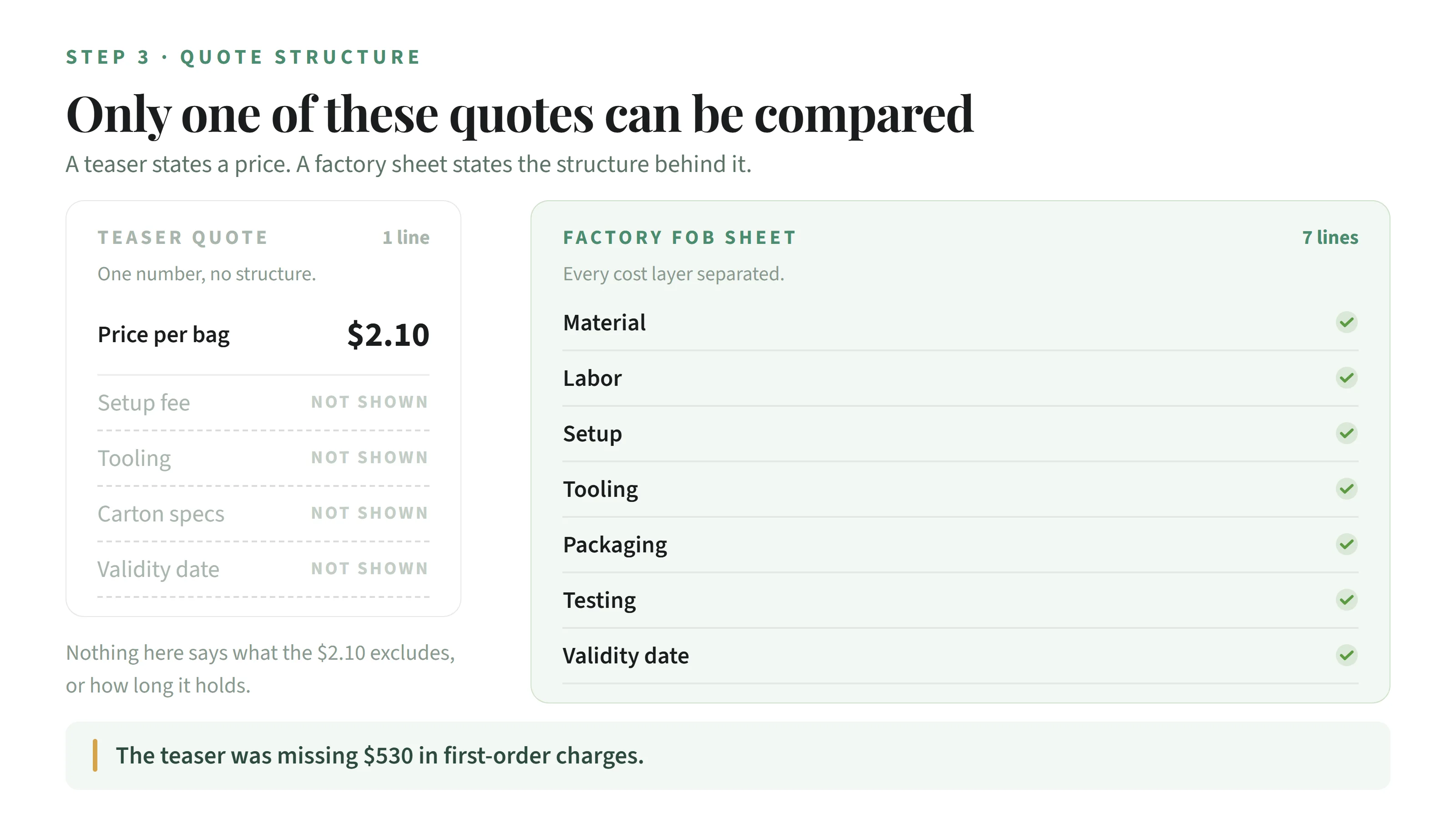
Different spec sheets sent to different suppliers produce garbage quotes. I watched the costing team compare two quote files in October 2026. One was a one-line teaser: $2.10 per bag, no validity date, no carton specs. The other was a factory-direct FOB sheet with seven cost rows.
The teaser was missing $530 in first-order charges. Getting the factory list right matters as much as the spec sheet — see sourcing promotional bags in China.
"Every buyer negotiates the unit price," Manager Gong said, flipping between the two sheets. "The margin is decided on the carton line and the HTS code. Most RFQs never ask for either."
Build one RFQ pack. Include a spec sheet with dimensions, fabric weight (GSM), lining, print method, artwork colors (Pantone numbers), packaging format, sample cost, tooling, testing requirements, and the target Incoterm — the guide to FOB vs EXW vs CIF explains which option puts freight risk on the buyer.
Send that exact sheet to at least three factories. Request pricing at 500, 1,000, 3,000, and 10,000 units. Each supplier returns the sheet with the quote. No exceptions.
Now demand a hidden-charge checklist: screen or setup fees, mold fees for custom hardware, sample courier fees, custom dyeing penalties, and recycled-material documentation fees.
The order files show how these fixed costs amortize. At 500 units, a $400 screen setup adds $0.80 per bag. At 10,000 units, it adds $0.04. The biggest price drop usually lands between 1,000 and 3,000 units, because setup spreads out.
For sub-3,000-unit orders, ask for stock-color and open-mold alternatives. Custom Pantone dyeing often triggers a 500-yard minimum and a $200 penalty. Open molds avoid $800–$1,500 in tooling fees. Take stock colors on first runs and save custom tooling for reorders. The promotional product MOQ guide explains where each material's floor actually sits.
Success check: By now you should hold at least two comparable FOB quotes on the same spec sheet. For each price delta, write one sentence explaining why (e.g., "Supplier A is $0.12 higher because the lining is 20gsm heavier").
A spreadsheet, ERP sourcing module, or procurement template works, as long as the fields are normalized. If sharing screenshots, label columns by function (e.g., "Material cost," "Setup fee") rather than by color.
Step 4: Calculate the True Landed Cost and Validate Compliance Assumptions
That $2.10 FOB quote looked safe until the carton dimensions hit the forwarder's desk. Duty, MPF/HMF, brokerage, and oversized cartons can turn a small FOB gap into a budget problem. The general guide to calculating landed cost covers this formula for any product; this section applies it to bags.
Landed cost per unit =
  (PO cost + freight + insurance + duties/taxes
   + brokerage/port fees + inland delivery) / units
Build the cost layers in order. Start with FOB or ex-works, export handling, and freight mode. Add insurance, import duty, MPF, and HMF for ocean. Finish with brokerage, drayage, inland trucking, and destination fulfillment prep. Make suppliers quote every layer. Missing layers are not savings. They are future invoices.
US importers can confirm the current fee schedule in the CBP import/export guidance.
Then validate classification. Bag duty depends on correct Chapter 4202 classification and outer-surface material. Never copy an HTS code off a prior order. Li Wei caught this in the files: one tote assumed 4202.92, but the coated outer surface pushed it to 4202.12. The broker added $0.09 per bag. Confirm classification in the official HTS database.
Here is the 2,000-unit comparison. Both bags are 2,000 units at retail-ready spec (lined, reinforced handles, hangtag, 2-color print):
| Cost line | Order A: GRS rPET | Order B: laminated non-woven |
|---|---|---|
| FOB | $4.18 | $3.92 |
| GRS transaction certificate | $0.20 | $0.00 |
| REACH/Prop 65 testing | $0.12 | $0.05 |
| Freight | $0.61 | $0.94 |
| Duty | $0.53 | $0.47 |
| MPF/HMF | $0.13 | $0.13 |
| Brokerage/drayage/inland | $0.27 | $0.30 |
| Landed per bag | $6.04 | $5.81 |
| 2,000-unit cash-out | $12,080 | $11,620 |
Bridging the two columns: Order B is $0.26 cheaper at FOB, $0.20 cheaper because a laminated non-woven bag needs no GRS transaction certificate, and $0.07 cheaper on testing. That is a $0.53 advantage before logistics. Freight takes $0.33 back on bulkier cartons and brokerage takes $0.03; cheaper duty returns $0.06. Net saving: $0.23 per bag, or 88% of the FOB gap.
Carton efficiency: Flat-pack versus bulky packing can erase factory savings. In one packing test, dropping carton CBM to 0.061 m³ (from 0.083) cut ocean freight by $0.28 per bag, to $0.61. Always quote carton dimensions, units per carton, and gross weight.
FOB vs DDP: DDP simplifies project management when the supplier gives a line-item breakdown: product, freight, duty, brokerage, and carton CBM. DDP hides margin when those lines disappear. Trust DDP only after seeing the math.
Success check: You should now have the landed cost per unit, the total cash-out number, and a written list of assumptions for broker or supplier confirmation.
Step 5: Cut Cost Without Cutting Quality
Run cost reduction as a controlled five-phase review, not a blind price cut. The costing team uses this SOP.
First review the use case: a giveaway tote and a retail resale bag carry different risk. Then simplify construction — change gusset construction only if seams stay firm; improve fabric nesting yield by rotating panels and tightening the marker, never by skewing grain.
Reduce decoration complexity next: consolidate print colors before artwork detail, and keep print edges sharp and legible. Substitute open-mold hardware only after a fit check. Optimize packaging and logistics through carton cube improvement, not thinner protection.
Guard the quality floor. Keep AQL 2.5 acceptance. Maintain 300+ load-cycle durability. Protect print legibility and compliance requirements.
At sample review, tug the gusset for seam firmness, pull the zipper through full travel, load the bag and hold the handles for 60 seconds, check print edge sharpness under raking light, then pack the bag fully and watch how it sits.
In Q3 2026, a glued-gusset spec looked $0.14 cheaper per bag. Seam failures rose in the pilot. Li Wei switched to stitched and bar-tacked corners. Rework dropped, and the saving held.
Lock the approval workflow: revised quote, revised sample if needed, inspection plan, payment terms, mass production release. For factory-side validation, send the revised BOM to the quote team.
Factory Price vs US Distributor Price: Where Does the 5x Figure Come From?
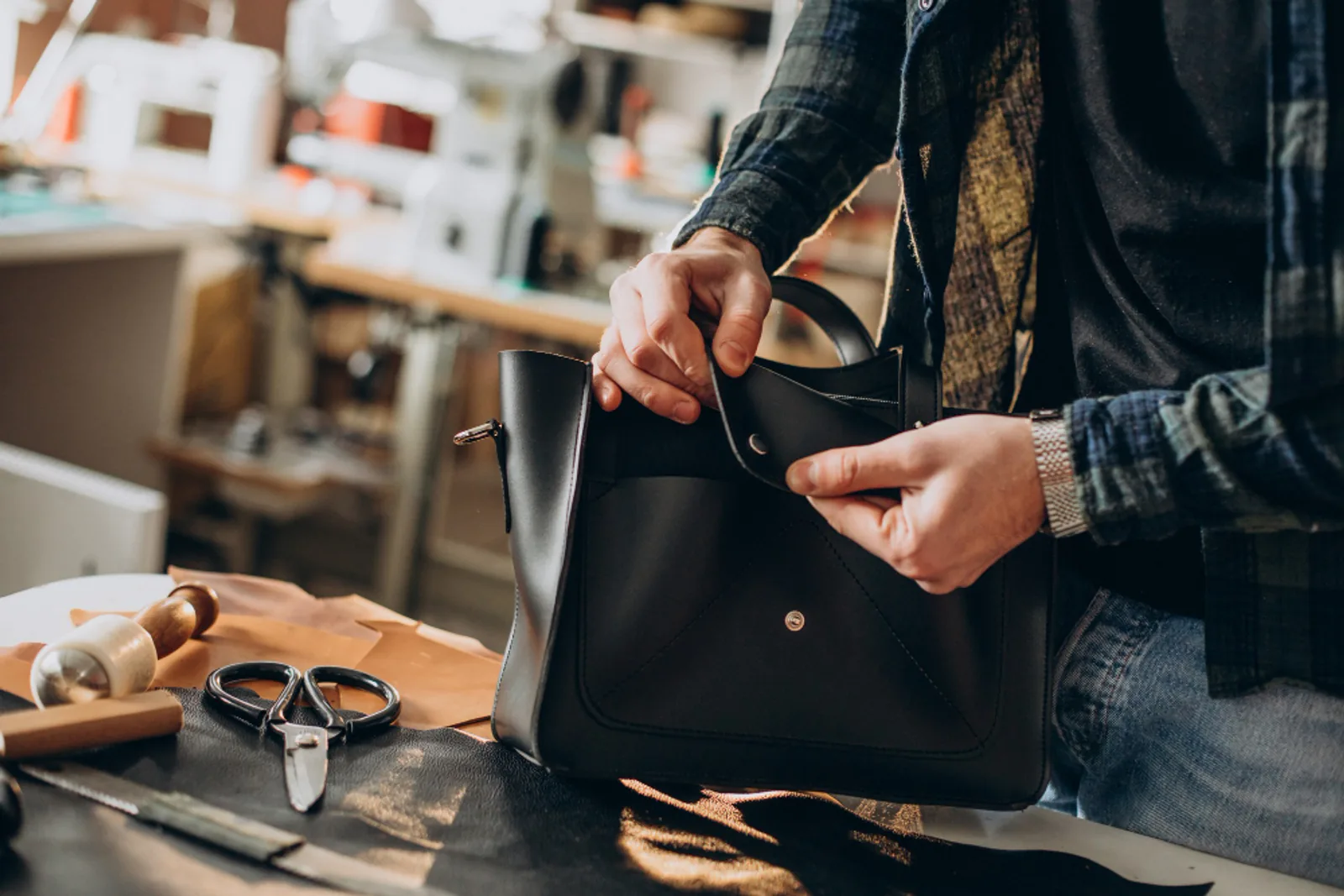
A search for a custom promotional bag returns two price universes. A Chinese factory quotes a 100gsm non-woven bag at $0.60–$0.95. A US distributor quotes a printed tote at $4–$8. Read as one market, that is a 5–10x markup. Read as two markets, it is a spec difference plus a service bundle, and most of the headline evaporates.
Put the identical bag on both sides — 2,000 units, laminated non-woven, lined, reinforced handles, two-color print, hangtag:
| Line item | Factory-direct, China | US distributor |
|---|---|---|
| Product (FOB) | $3.92 | bundled |
| Testing | $0.05 | bundled |
| Ocean freight | $0.94 | n/a — domestic |
| Duty, MPF/HMF, brokerage | $0.90 | bundled |
| Inland delivery | included above | included |
| Total per bag | $5.81 landed | $7.50–$9.00 delivered |
Same spec, same volume, and the gap is 29–55%, not 500%. The premium buys real things:
- MOQ 6–100 instead of 500–1,000. Twelve bags is a valid order.
- 5–10 day turnaround instead of 45–75. Stock blanks are already in the country, decorated to order.
- No import work. No broker, no HTS classification, no forwarder, no customs bond, no ISF filing.
- Inventory risk sits with the distributor. Nobody warehouses 2,000 bags for a 200-person event.
- Decoration is their problem. A design change on Tuesday still ships on Thursday.
Where the 5–10x number actually comes from. It compares a bare 100gsm non-woven bag at $0.60 against a decorated, retail-packaged tote at $4.00+. Different grammage, different lamination, different print, different packaging.
Put both figures in one spreadsheet without a spec column and the sheet concludes China is seven times cheaper, when the real gap on equal spec is closer to 1.3–1.5x. That single error sits behind most "these bags cost too much" conversations.
The break-even sits around 300 to 500 units. At 300 units, sampling ($50–$150), a freight minimum, and a broker fee that does not shrink with volume add roughly $1.50–$2.50 per bag. That usually erases the FOB advantage. At roughly 500 units with a locked design, the factory route wins on identical spec. Below that, the distributor is not overcharging you — you are paying for flexibility.
Pay the domestic premium when the event is three weeks out, the run is under 300 units, the design is unvalidated, variable data is needed, or twelve samples are required before a 10,000-unit commitment. That premium is a convenience fee, and sometimes convenience is the cheapest line in the budget.
💡 Pro Tip: A quote that is too round, too fast, missing carton data, or silent on testing is a warning sign. Ask for the line-item version. It usually takes two days.
Frequently Asked Questions About Custom Promotional Bag Cost
The cheapest quote is the least useful if it cannot survive a landed-cost audit.
1. Why is Supplier A 18% cheaper than the others?
An 18% discount is almost always a missing cost layer, not a tighter factory. Normalize every spec and Incoterm, request a line-item BOM, and force the supplier to separate setup, testing, and packaging charges. In my experience the low quote buries a $400 screen fee or a $0.20 GRS certificate. A round number that arrives fast is a placeholder.
2. Why did my landed cost jump after approval?
Landed cost jumps when the quote priced the bag, not the shipment. Late additions come from GRS transaction certificates, REACH/Prop 65 testing, brokerage, and carton-volume inefficiency. Audit all four before signing, get testing costs in writing, and confirm carton CBM.
3. Why did my duty and freight estimate change at the last minute?
A last-minute change usually means a wrong HTS code or a CBM figure taken off a sample instead of the packing plan. Confirm classification by material and bag type, collect the import compliance documents before booking, validate ocean versus air, and recalculate CBM off the actual carton plan.
4. Why is my MOQ too low for custom color or hardware?
Custom color and custom hardware carry their own minimums: Pantone dyeing typically needs 500 yards, and a new mold runs $800–$1,500. Below those thresholds, switch to stock fabrics, open molds, or a simplified print plan, and hold custom tooling for the reorder.
Conclusion
This guide now covers concept bag, target FOB, and landed-cost reality. The RFQ file should be complete, the target FOB written down, and the supplier comparison controlled rather than fuzzy.
Three actions today: lock the RFQ pack, get the HTS and duty assumption in writing, and request matched quotes against the 500, 1,000, 3,000, and 10,000 unit benchmark tiers.
Need hands-on validation? Contact the LeelinePromotion team. Final disclosure: these benchmarks come from anonymized LeelinePromotion order files, 2024–2026. The math is shown transparently, and the commercial relationship is not hidden.