
Custom keychain cost starts at roughly $0.08 per unit for 2D PVC at 20,000 pieces and climbs past $3.50 for leather-and-metal designs at 500 pieces. On top sits a one-time mold fee of $50–$300. At 1,000 pieces, a standard zinc alloy keychain usually runs $0.45–$0.85 per unit including tooling, before freight.
Those are factory-level numbers. Your invoice will be higher. Packaging, inspection, freight, duty, and broker fees can add 25–60% to a small keychain order, which is why two suppliers can quote the same FOB price and produce very different landed costs.
This guide breaks down the six cost drivers, shows how unit price falls from 500 to 20,000 pieces, and builds a line-by-line landed cost model for 1,000 metal keychains. Use it to benchmark custom promotional keychains quotes and to brief suppliers properly.
Quick answer — the numbers most buyers need:
- Factory unit cost: $0.08–$3.50 per piece, depending on material, decoration, and quantity.
- Mold fee: $50–$300 one-time; it adds $0.24 per unit at 500 pieces but only $0.006 at 20,000.
- MOQ: 100–2,000 pieces for China factory production; US/UK digital short-runs can go to 1–25 pieces.
- Landed cost: usually 1.5–3.3× FOB; at 1,000 pieces, freight, duty, and fees often add 40–60% to the product cost.
How these numbers were built (November 2026): Compiled by Roy Huang, Manufacturing Director, from FOB Shenzhen/Ningbo quotes and published supplier price lists. USD, single-sided decoration, standard split ring, polybag packaging. Ranges are directional benchmarks, not a statistical sample or a binding quote. They exclude US/UK short-run retail pricing, which is compared separately below. FX: 7.1 CNY/USD.
At a Glance: Cost Ranges by Material
Material choice sets both the unit price and the minimum order quantity. If you are still choosing a format, compare types of keychains before comparing prices. The table below reflects China factory FOB pricing for 2026, single-sided decoration, standard hardware, and polybag packaging.
| Material | Best for | Mold / setup fee | Unit price at 500–1,000 pcs | Unit price at 5,000 pcs | Typical China MOQ |
|---|---|---|---|---|---|
| Soft PVC (2D) | High-volume giveaways, mascots, full-color shapes | $50–$100 | $0.08–$0.42 | $0.07–$0.30 | 100–500 |
| Zinc alloy (die-cast + enamel) | Corporate logos, premium events, retail merch | $80–$300 | $0.20–$0.80 | $0.12–$0.50 | 500–2,000 |
| Acrylic (laser-cut + UV print) | Detailed artwork, fan merch, low-volume runs | $0–$100 | $1.20–$1.70 | $0.80–$1.10 | 100–1,000 |
| Leather + metal plate | Executive gifts, VIP kits, long-life merchandise | $90–$150 | $2.50–$3.50 | $1.80–$2.40 | 200–500 |
Ranges reflect artwork complexity, decoration method, and hardware weight. US/UK short-run prices are 2–5× higher; see the channel comparison below.
MOQ is not arbitrary. A PVC mold is cheap to cut and runs in small batches, so 100–500 pieces is viable. Die-cast zinc needs a steel mold, plating rack space, and a full material melt, which pushes the floor to 500–2,000 pieces. Acrylic is laser-cut from sheet, so the constraint is print setup rather than tooling — which is why Chinese acrylic factories often start at 100 pieces while US digital suppliers can produce one. Leather is cut and stitched by hand, which sets a practical floor around 200–500 pieces.

Factory FOB vs US Retail: Why the Numbers Differ
Search results show two very different price worlds. US short-run suppliers quote $0.80–$15 per piece because they cut, print, and ship domestically in tiny batches. Chinese factories quote $0.08–$3.50 because they amortize tooling across thousands of units and ship FOB. Neither number is wrong; they describe different channels.
| Channel | Published example | Typical MOQ | What the price includes |
|---|---|---|---|
| China factory FOB (this guide) | $0.08–$3.50 per unit | 100–2,000 | Ex-works; freight, duty, and testing extra |
| US short-run digital | CustomKeyChainNow: $0.80–$1.69 acrylic (25–2,000 pcs) | 25 | US production and shipping; no import clearance |
| US promotional distributor | Budgetkeychains: $0.44–$1.09, product and quantity vary | 100+ | US stock or quote; higher unit, faster delivery |
| UK/EU short-run | Zap Creatives: from $1.13 at 100 pcs | 10 | Local/import mix; VAT may apply |
| US made-to-order | The Studio: from $1.89 PVC, 1 pc | 1 | US labor; premium unit cost |
Published list prices accessed November 2026. Verify current pricing and inclusions before ordering.
A $0.40 Chinese FOB quote and a $1.49 US short-run quote are not the same product. Add freight, duty, and your own labor to the FOB quote; add import complexity and longer lead time to the US quote. The correct comparison is landed cost per usable piece, not the headline unit price. For US supplier benchmarks, see our acrylic keychain manufacturer list.
The 6 Cost Drivers
Six inputs decide most of a keychain quote. Two come from your design, one is paid once, and three scale with the order.
Material Cost per Unit
Raw material typically accounts for 20–40% of the factory unit price. Zinc alloy tracks the London Metal Exchange zinc price; soft PVC tracks resin and plasticizer costs; acrylic tracks cast sheet pricing; leather depends on hide grade and thickness.
Size and weight matter more than most buyers expect. A 40mm keychain uses roughly half the metal of a 60mm design, and that difference shows up twice — once in the unit price and again in freight. Hardware is a separate line: a standard split ring may cost $0.01–$0.03, while a swivel hook or lobster clasp can add $0.03–$0.10.
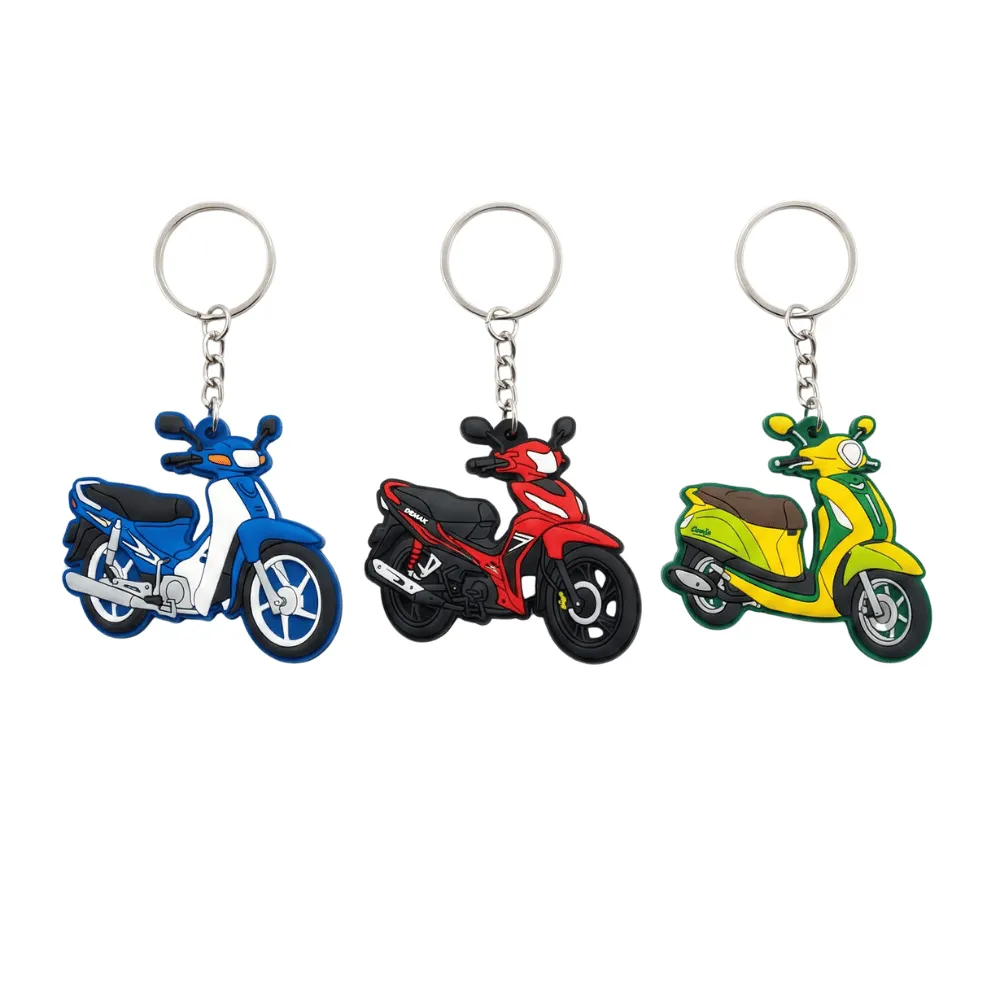
For a full material comparison, see keychain materials.
Mold & Tooling Fees
A mold fee is a one-time charge for cutting the cavity that forms your keychain. It is not a deposit, and you do not automatically own the tool unless the contract says so.
Expect $50–$100 for a 2D PVC mold, $80–$150 for a flat die-cast zinc mold, and $150–$300+ for a sculpted 3D mold. Acrylic usually needs no mold — only a laser setup and print file — but suppliers may charge a $0–$100 setup fee. Leather embossing dies typically run $90–$150.
The fee only hurts at low volume. At 500 pieces, a $120 mold adds $0.24 per unit. At 5,000 pieces, it adds $0.024. At 20,000, it is $0.006. That is why the same design can look expensive in a 500-piece quote and cheap in a 5,000-piece quote.
Decoration & Plating
Decoration is where quotes diverge most. Two factories can use the same material and still differ by 30% because one is hand-filling six enamel colors and the other is laser-engraving a single logo.
The add-ons below are per unit at 5,000 pieces, over a baseline of nickel plating and single-sided soft enamel:
- Soft enamel: $0.01–$0.03 per color, for logos with 2–6 solid colors.
- Hard enamel: $0.05–$0.15, for premium retail and executive gifts.
- Laser engraving: $0.02–$0.08, for one-color metal logos.
- UV printing: $0.03–$0.10, for full-color acrylic or flat metal.
- Electroplating (gold, antique brass): $0.02–$0.10, for premium metal finishes.
- Epoxy dome: $0.03–$0.08, for protection and gloss.
- Second side, printed: +15–20% of unit price, for acrylic or flat metal with a back logo.
- Second side, enamel: +30–50% of decoration cost, for metal with two enamel faces.
Pantone matching, a second side, and small color fills all add labor. If your logo has more than six colors, printed acrylic or UV printing is usually cheaper than enamel. If your design is a single-color wordmark, laser engraving on metal is the lowest-cost route. Review our promotional product design guide before finalizing artwork.

Order Quantity
Factories price labor and material in batches. A 500-piece run still requires the same mold, artwork proof, machine setup, and QC inspection as a 5,000-piece run. The fixed costs do not shrink; the number of units they are divided across does.
Common breaks include 100, 250, 500, 1,000, 2,500, 5,000, and 20,000 pieces. The largest percentage drop usually happens between 500 and 1,000, because the mold and setup are still a meaningful share of the order. The second drop, between 1,000 and 5,000, comes from material buying and line efficiency.
Packaging
Polybag is normally free. Backing cards run $0.03–$0.12 per unit, custom sleeves $0.10–$0.30, gift boxes $0.15–$0.60, barcode or FBA labels $0.02–$0.05, and kitting or assembly $0.10–$0.50.
Packaging is often the cheapest way to raise perceived value — and the fastest way to waste budget. A trade show giveaway does not need a gift box. An e-commerce product probably does.
Freight & Landed Cost
Keychains are heavy relative to their value. At 1,000 pieces, freight, duty, and broker fees can equal 40–60% of the product cost. At 10,000 pieces, the same charges fall to roughly 15–25%. Container spot rates move weekly; check the Freightos Baltic Index before you lock a freight quote.
Two terms decide who pays what. Under FOB, you control freight and see the real cost. Under DDP, the supplier bundles everything into one number and often includes a 5–20% service margin; ask for the underlying FOB and freight lines. Use our FOB vs EXW vs CIF guide and the ICC Incoterms rules to choose the right term, then build a full landed cost model before comparing suppliers.
How Order Quantity Changes Unit Price
Here is a pricing curve for one design: a 40mm zinc alloy keychain, soft enamel, single-sided, standard split ring, polybag. The mold is $120.
| Quantity | FOB unit price | Mold per unit | All-in unit cost | Total order cost |
|---|---|---|---|---|
| 500 | $0.55 | $0.24 | $0.79 | $395 |
| 1,000 | $0.42 | $0.12 | $0.54 | $540 |
| 5,000 | $0.28 | $0.024 | $0.304 | $1,520 |
| 20,000 | $0.20 | $0.006 | $0.206 | $4,120 |
Read the table as marginal cost, not average cost. Moving from 1,000 to 5,000 pieces adds $980 for 4,000 extra units — $0.245 each. Moving from 5,000 to 20,000 adds $2,600 for 15,000 units — $0.173 each. If you expect a reorder within 12 months, the larger run is usually cheaper than paying a second setup and freight cycle.
The same curve applies to PVC, but at lower numbers. A 2D PVC keychain with a $60 mold typically moves from about $0.40 all-in at 500 pieces to $0.09–$0.14 at 20,000 pieces, depending on color count and hardware. For molded rubber versus layered PVC, see 2D vs 3D PVC keychains.

🚀 Actionable Insight: Calculate the marginal cost of the next price break before you order. If the extra units cost less than a future reorder's setup, freight minimum, and inspection fee, buy them now — provided storage and obsolescence risk are near zero.
Landed Cost Example: 1,000 Metal Keychains
Numbers on a factory quote are not comparable until they reach your warehouse. This example uses 1,000 zinc alloy keychains, 40mm, soft enamel, single-sided, polybag with a custom backing card — roughly 20 kg / 0.06 CBM. Route: Shenzhen to Los Angeles, LCL sea freight, 25% assumed duty. It follows the same landed cost calculation method we apply to every promotional order.
| Cost line | Basis | Total | Per unit |
|---|---|---|---|
| Product (FOB) | 1,000 × $0.42 | $420 | $0.42 |
| Mold fee | one-time | $120 | $0.12 |
| Custom backing cards | 1,000 × $0.05 | $50 | $0.05 |
| Origin trucking + export documents | flat | $140 | $0.14 |
| Ocean freight + marine insurance | LCL | $165 | $0.165 |
| Import duty | 25% of FOB (scenario) | $105 | $0.105 |
| Broker, terminal, and last-mile delivery | flat | $225 | $0.225 |
| Bank fee + third-party inspection | flat | $145 | $0.145 |
| Landed total | $1,370 | $1.37 |
Excludes sample, compliance testing, MPF/HMF, and any Section 301 line. Add those in the hidden-cost list below.
Duty is the most volatile line in 2026. Run three scenarios on the same $420 FOB order:
- 0% duty: $1,265 landed — $1.27 per unit, 3.0× FOB.
- 25% duty (example): $1,370 landed — $1.37 per unit, 3.3× FOB.
- 45% duty: $1,454 landed — $1.45 per unit, 3.5× FOB.
Landed unit cost = (FOB × quantity + mold + sample + packaging + freight + duty + MPF/HMF + broker + testing + payment fees) ÷ quantity.
In the 25% scenario, landed cost is $1.37 per keychain — 3.3× the $0.42 FOB price. Across the three scenarios, budget $1.27–$1.45 per unit (3.0–3.5× FOB). The product itself is less than a third of what you actually pay.
At 10,000 pieces, the same program typically lands at $0.50–$0.65 per unit, or about 1.5–1.9× FOB. The difference is not a better factory. It is fixed freight, broker, and inspection costs spread across ten times the units.
Keychain classification depends on material and construction; common chapters include 7326 (iron/steel articles), 7907 (zinc articles), 8308 (base-metal fittings), and 4205 (leather articles). Confirm the exact HS code and current rate with a licensed broker; see U.S. Customs and Border Protection for the valuation basis. If your product falls under Section 301, check the USTR Section 301 investigations for the current list and rate. For routing and consolidation options, see our global logistics guide. Outside the US, add VAT/GST — UK 20%, EU 19–27%, Canada 5–15%, Australia 10% — plus local compliance.
Hidden Costs That Change the Total
The unit price is only one line. These costs are normal, but they are often left out of the first quote:
- Sample fee: $50–$150, often credited; some short-run suppliers charge $200–$500 and do not credit it.
- Compliance testing: $200–$800 per SKU for CPSIA, Prop 65, or REACH claims. See our compliance center for the document checklist.
- Nickel-release test: $100–$300 for skin-contact metal sold in the EU.
- Mold modification: 40–60% of the original mold fee for artwork, size, or shape changes.
- Rush fee: 30–50% of unit price for deadlines shorter than standard lead time.
- Setup, payment, and fulfillment: $50–$150 per additional design, 1–3% FX plus $25–$50 bank fees, and $0.50–$1.50 per unit for Amazon FBA prep.
For resale, run the margin before you order. At $1.37 landed and $6.99 retail, Amazon’s 15% referral fee ($1.05) plus about $2.50 FBA fulfillment and 15% ad spend ($1.05) leaves $1.02 before overhead — a 14.6% margin. The break-even retail price is about $5.53; below that, the math usually fails unless landed cost or fulfillment cost falls.
5 Ways to Reduce Keychain Cost
- Match the process to the artwork. Enamel is wrong for a six-color gradient; PVC, UV-printed acrylic, or laser-engraved metal will be cheaper and look better.
- Consolidate designs and shipments. One mold frame, one inspection, and one freight booking can save more than a small per-unit discount.
- Buy to the next price break — if storage is free. For evergreen designs the larger run usually wins; for event-specific designs it usually does not.
- Remove decoration you do not need. At 5,000 pieces, a second side adds 15–40% to the unit price, an epoxy dome 20–30%, a custom clasp 5–10%, and a gift box $0.15–$0.60.
- Cut freight waste. Ship full cartons, avoid oversized packaging, and consolidate with other promotional items. Air freight costs 3–5× sea freight and is rarely justified for a $0.30 item.
Compared with lapel pins, keychains usually cost more per unit but win on cost per impression because they are handled daily. For a one-day event, a pin may be enough.
What to Include in an RFQ
A complete RFQ gets a comparable quote in 24–48 hours. Include these eight fields:
- Quantity: 1,000 pcs, plus annual reorder forecast.
- Material and size: zinc alloy, 40mm diameter, 3mm thick.
- Artwork: vector AI or PDF, Pantone numbers, fonts outlined.
- Decoration: soft enamel, single-sided, four colors.
- Hardware: standard split ring or swivel hook.
- Packaging: polybag plus backing card, barcode label.
- Compliance and destination: CPSIA if for children, Prop 65 for California, REACH for the EU; Los Angeles warehouse, FOB Shenzhen.
- Samples and payment: pre-production sample, event date, 30% deposit, balance before shipment.
Also ask whether these are included or extra: mold fee, sample, packaging, freight, duty, compliance testing, and payment/FX. "No gift box, no epoxy dome, standard nickel plating" prevents a supplier from quoting a premium spec you never asked for. For regulated markets, review the standards behind CPSIA and Prop 65 before you approve a sample.
Send the completed brief to our team for a 48-hour line-item quote through LeelinePromotion contact.
Red Flags in Keychain Quotes
- A price below material cost. Zinc alloy at $0.05, leather at $0.80, or acrylic at $0.20 usually means a substituted material, thinner gauge, or a bait quote.
- No separate mold line. If tooling is buried in the unit price, you cannot tell whether you own it or what a reorder should cost.
- The same unit price at every quantity. Real factories have setup costs; a flat price across 500 and 20,000 pieces is not a production quote.
- Vague material names or missing compliance documents. "Metal" is not a spec. Ask for alloy grade, plating thickness, a phthalate declaration, and CPSIA, Prop 65, or REACH reports where applicable.
- A DDP quote with no breakdown. One number feels convenient, but it hides freight, duty, and the supplier's margin. Ask for the underlying FOB and freight lines.
- 100% upfront payment to a personal account. Standard terms are a deposit against a proforma invoice, with the balance before shipment or against a bill of lading.
Before you approve a bulk run, review our inspection and quality control process. It explains the AQL sampling, defect classification, and pre-shipment checks that protect a keychain order.
Frequently Asked Questions About Custom Keychain Cost
1. How much does a custom keychain cost?
At factory level, 2D PVC starts around $0.08–$0.42 per unit, zinc alloy runs $0.12–$0.80, acrylic runs $0.80–$1.70, and leather-and-metal runs $1.80–$3.50. A one-time mold fee of $50–$300 applies to molded designs. Landed cost is usually 1.5–3.3× the FOB price at small volumes.
2. What is the minimum order quantity for custom keychains?
PVC molds often start at 100–500 pieces, zinc alloy at 500–2,000, acrylic at 100–1,000 at Chinese factories, and leather at 200–500. US and UK digital short-run suppliers can go to 1–25 pieces, but the per-unit price is 2–5× higher.
3. How much does a custom keychain mold cost?
A 2D PVC mold usually costs $50–$100, a flat zinc die-cast mold $80–$150, and a sculpted 3D mold $150–$300+. Acrylic usually has no mold fee, only a $0–$100 laser or print setup. The fee is one-time per design and should be quoted separately from the unit price.
4. Why is my 500-piece quote so much higher per unit?
Because the mold, artwork proof, machine setup, and inspection are fixed costs. A $120 mold adds $0.24 per unit at 500 pieces but only $0.006 at 20,000. Freight minimums hit small orders the same way.
5. How much does shipping add to keychain cost?
At 1,000 pieces, freight, duty, and broker fees can add 40–60% to the product cost. At 10,000 pieces, the same charges typically fall to 15–25%. Sea freight is far cheaper per unit than air, but adds 25–35 days of transit.
6. Are custom keychains profitable to resell?
At a landed cost of $1.37 and a $6.99 retail price, an Amazon seller pays about $1.05 in referral fees and $2.50 in FBA fulfillment, leaving roughly $1.02 before overhead — a 14.6% margin. The math usually fails below a $5.50 retail price unless landed cost or fulfillment cost falls.
Sources and Price References
- Zinc price: London Metal Exchange, accessed November 2026.
- Customs valuation and tariff classification: U.S. Customs and Border Protection and USITC HTS.
- Product safety: CPSC — CPSIA and OEHHA — Proposition 65.
- Supplier price examples: CustomKeyChainNow, Budgetkeychains, Zap Creatives, and The Studio. Published list prices accessed November 2026.
- Freight, tariff, and compliance references: Freightos Baltic Index, USTR Section 301, CBP user fees, EU REACH, Amazon referral fees, and ISO 2859-1.
Get a Quote You Can Compare
Use the ranges in this guide to sanity-check every quote, then ask for the mold fee, FOB unit price, packaging, and freight as separate lines. A supplier who will not break down the cost is not giving you a price you can manage.
For a project-specific benchmark, send your artwork, quantity, and destination to our team. We return a line-item quote within 48 hours, including tooling, unit cost, and estimated landed cost.
Editorial note: Prices are FOB China benchmarks as of November 2026. Tariffs, freight rates, and supplier pricing change frequently; confirm the HS code, current duty rate, and compliance requirements with a licensed broker before ordering.