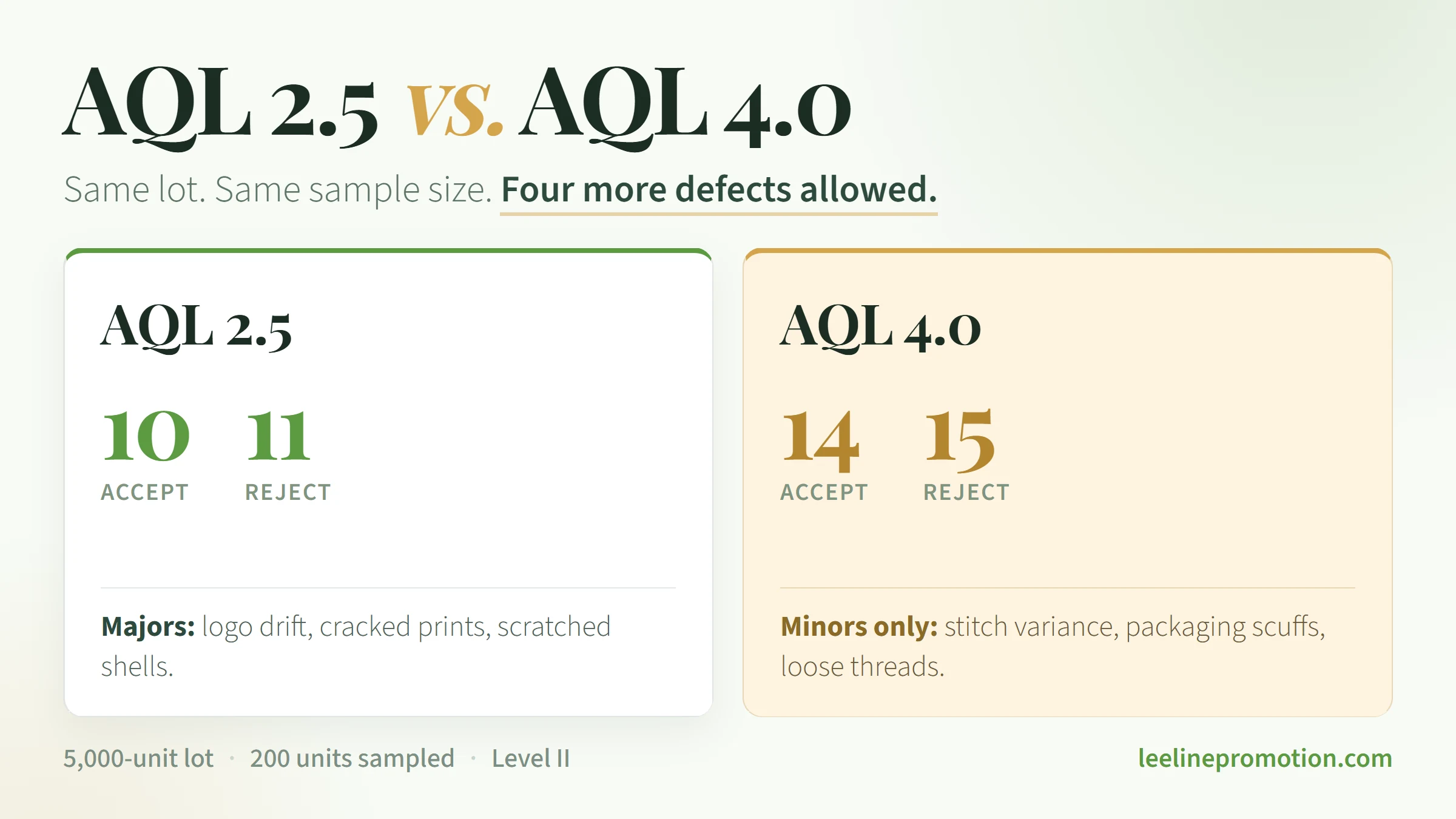

For most promotional product orders, AQL 2.5 is the safer standard for major defects. Reserve AQL 4.0 for minor cosmetic issues only. Items headed to a trade show, executive gifting, employee onboarding, or retail-adjacent merch should keep majors at 2.5.
The trade-off is explicit. AQL 4.0 reduces supplier friction and unit-cost pressure, but it raises the odds of visible, brand-damaging defects reaching customers.
We built this comparison on ISO 2859-1 sampling logic and anonymized trends from our inspection records. AQL is a sampling decision rule, not permission for that exact percentage of a shipment to be defective. Major and minor defects are judged separately, never added together.
Last spring, a buyer loosened majors to 4.0 on 10,000 tumblers. He saved about 4% on unit price. Scratched units still reached VIP attendees, and every scuff showed under booth lights. The next campaign restored the 2.5 / 4.0 split.
Below is the threshold table, promo-specific defect examples, and the SOP I use to draft a Defect Classification List.
I pulled the acceptance numbers from the ISO 2859-1 single-sampling table, the ANSI/ASQ Z1.4 equivalent. General Inspection Level II applies to each row, and Ac/Re means acceptance and rejection numbers.
| Lot size | Code | Sample | AQL 2.5 Ac/Re | AQL 4.0 Ac/Re | Promo example |
|---|---|---|---|---|---|
| 500 | H | 50 | 3 / 4 | 5 / 6 | Notebooks |
| 1,000 | J | 80 | 5 / 6 | 7 / 8 | Lanyards |
| 3,200 | K | 125 | 7 / 8 | 10 / 11 | Tote bags |
| 5,000 | L | 200 | 10 / 11 | 14 / 15 | Drinkware |
| 10,000 | L | 200 | 10 / 11 | 14 / 15 | Tumblers |
Code K covers lots up to 3,200 units; 3,201 jumps to L. Both the 5,000-unit and 10,000-unit lots use L, so each samples 200 units.
In our promo work, we assign AQL 2.5 to major defects such as peeling prints, wrong Pantone, and cracked lids. AQL 4.0 covers minor cosmetics such as hidden scuffs and stitch variance. Each class has its own threshold.
Drinkware with food contact also needs FDA 21 CFR 177 or EU LFGB documentation (food-contact standards).
What our shipment records showed
| Product group | First-pass rate at AQL 2.5 majors | Rework delay after a failed lot | Supplier price change with majors at 4.0 | Typical defect |
|---|---|---|---|---|
| Custom drinkware | 91% | 9 days | −$0.14 per unit | Scuffs, print rubs |
| Tote bags / soft goods | 88% | 6 days | −$0.09 per unit | Crooked seams, loose threads |
| Branded apparel | 84% | 12 days | −$0.22 per unit | Wrong Pantone, off-center logos |
Read that price column as a supplier quote response, not a property of the standard. Factories expecting fewer rejects may trim unit cost, and the saving disappears after one rework cycle.
AQL 2.5 vs. AQL 4.0: Four Differences That Change Your Order
I have walked 500+ promotional shipments on factory floors and receive no factory kickbacks. Every flaw is judged by hand, not on a spreadsheet.
1. Same Sample Size, More Defects Allowed
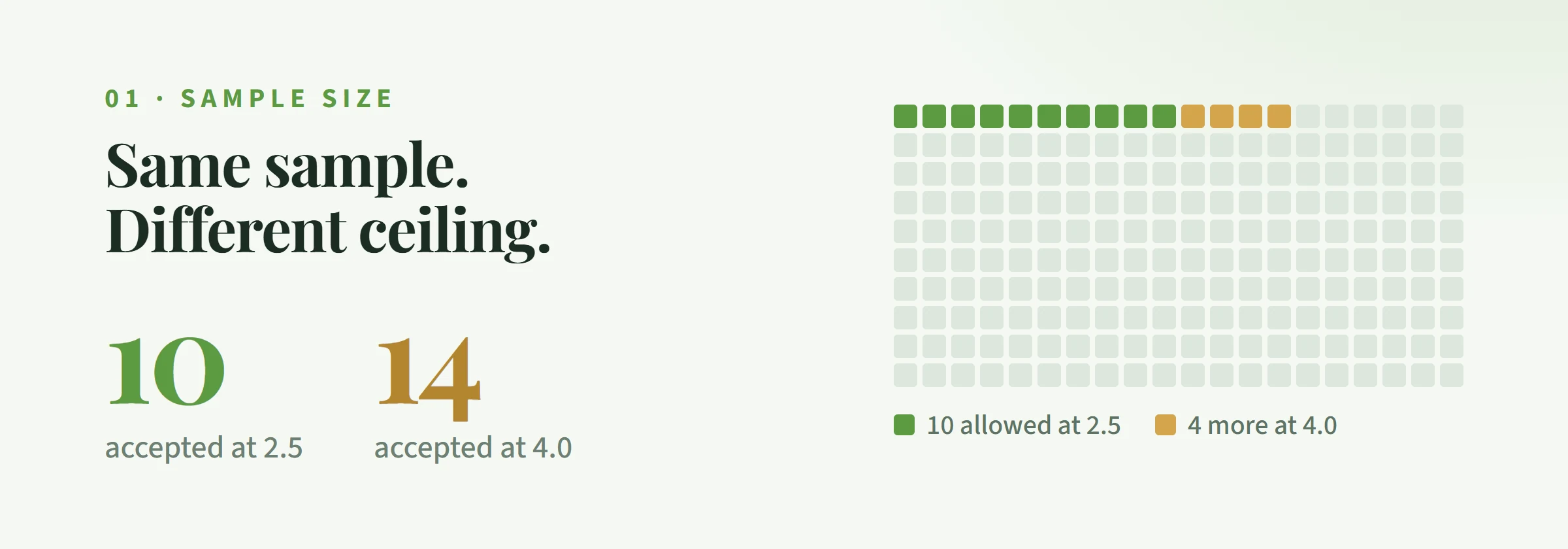
Under both standards, a 5,000-unit lot samples 200 units. AQL 2.5 accepts up to 10 defective units in that sample; AQL 4.0 accepts up to 14.
Those four extra units are not a cap on your lot. They are four more chances for a scratched tumbler or a crooked logo to ship, and the factory knows the allowance exists. At a single event, the gap can become four VIP complaints.
Winner: AQL 2.5 when brand reputation outweighs short-term factory convenience.
2. Major vs. Minor: Where to Draw the Line
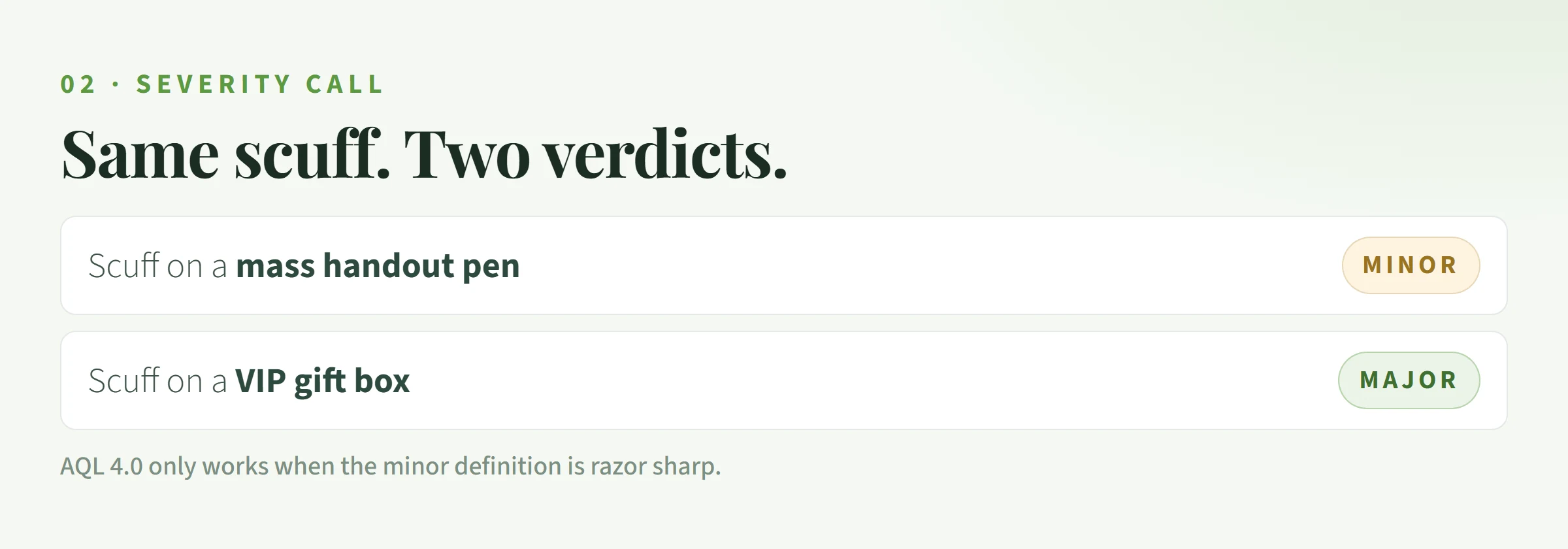
You cannot treat every flaw the same. I classify defects by product and campaign, then copy the result into POs and inspection briefs. Four calls cover most promo disputes.
Logo Pantone shifts. A logo that misses the approved swatch is a major defect on brand-sensitive campaigns. Even two shades of drift show clearly beside the Pantone book in daylight. Check the Pantone matching process before bulk approval.
Screen-print cracking or peeling. After a rub, flex, or wash test, any cracking or peeling is major. The brand mark fails in use, and cracked ink looks like white spiderwebs under booth lighting.
Loose threads. A purely cosmetic loose thread on a tote edge can be minor. If seam integrity is compromised, it becomes major. One quick pull check tells you which one you have.
Packaging scuffs. On mass handout pens, a scuff may be minor. On VIP kits or retail-ready gift boxes, it is major; a scratched box implies a cheap product.
On matte powder-coated tumblers, a scratch looks like chalk and does not wipe off. That is an automatic major for premium merch. Under AQL 4.0 it can pass as minor.
Winner: AQL 2.5 for anything the recipient notices instantly.
3. Unit Cost Savings vs Downstream Damage
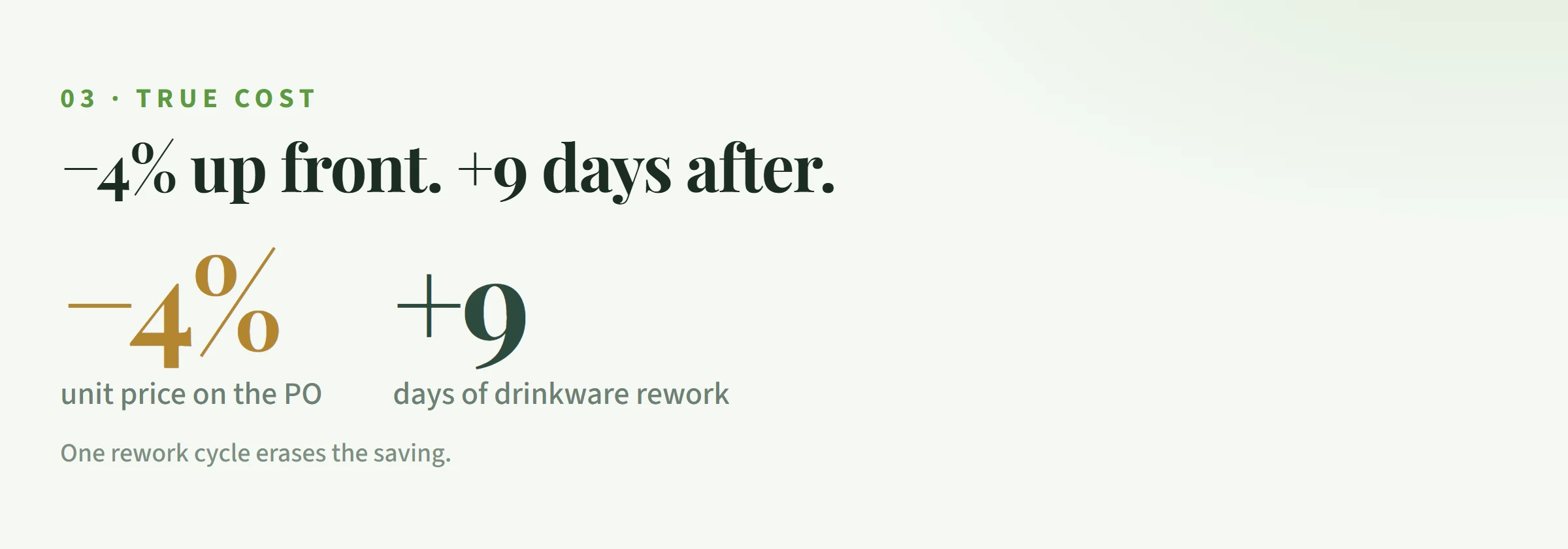
That tumbler order cost roughly 4% less per unit and still produced complaints. The hidden stack is brutal: rework delays, rush freight, executive escalations, distributor credits, and brand damage.
Every benchmark row points the same way. That saving disappears after one rework cycle, while a failed lot can push a launch by a week or more. Plan production lead time around a rework buffer, not against it.
Winner: AQL 2.5 on total campaign risk.
4. Which Product Categories Need AQL 2.5?
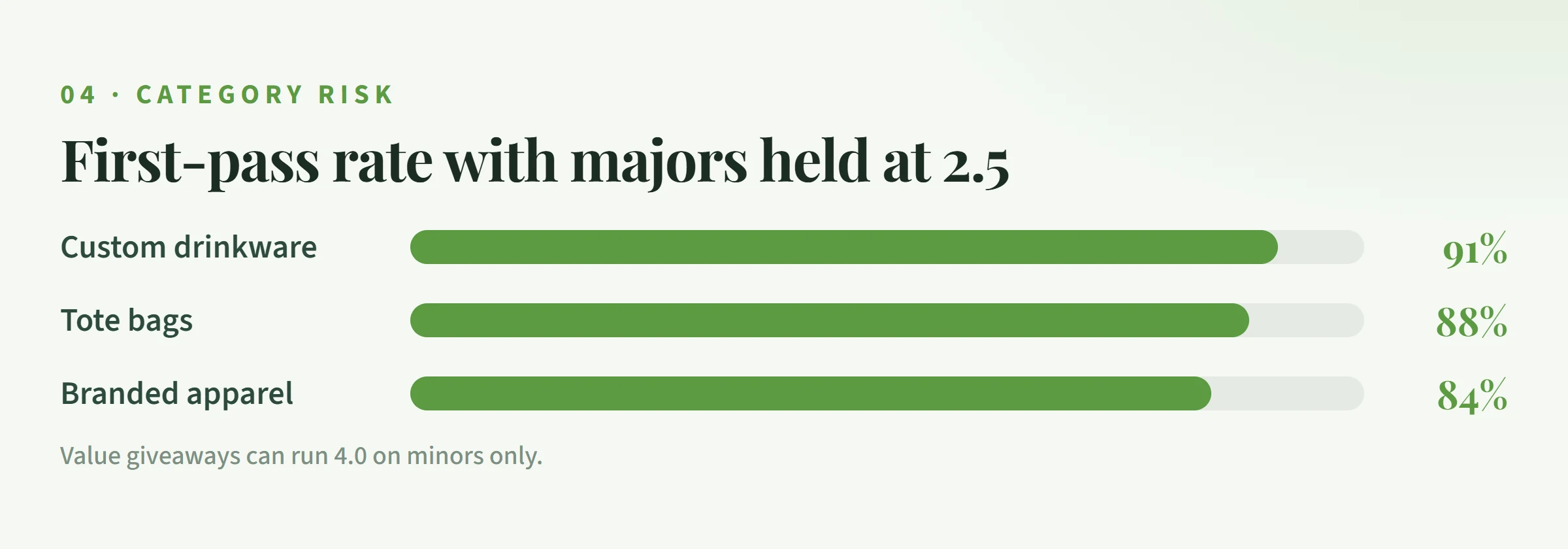
Custom drinkware. Surface finish, leak checks, logo placement, and lid fit are critical. Scratched shells and leaking lids are major defects, and premium custom drinkware rarely tolerates cosmetic variance.
Tote bags and soft goods. Watch stitching, seam strength, dimension tolerance, and print registration on custom tote bags. Loose threads stay minor while the seam holds; once it fails, the defect is major.
Branded apparel. Print durability, size consistency, and label accuracy decide the lot. Prints that crack after one wash are major, and so is a sizing shift across a batch. See the custom clothing process.
Value giveaways can absorb minor cosmetic variance. Premium merch, executive gifting, campus stores, employee onboarding, and conference VIP kits cannot. We treat those categories as zero tolerance for majors.
Winner: AQL 2.5 for premium and brand-sensitive categories; AQL 4.0 only for low-risk giveaways with strict minor definitions.
How to Write a Defect Classification List for AQL 2.5 and 4.0
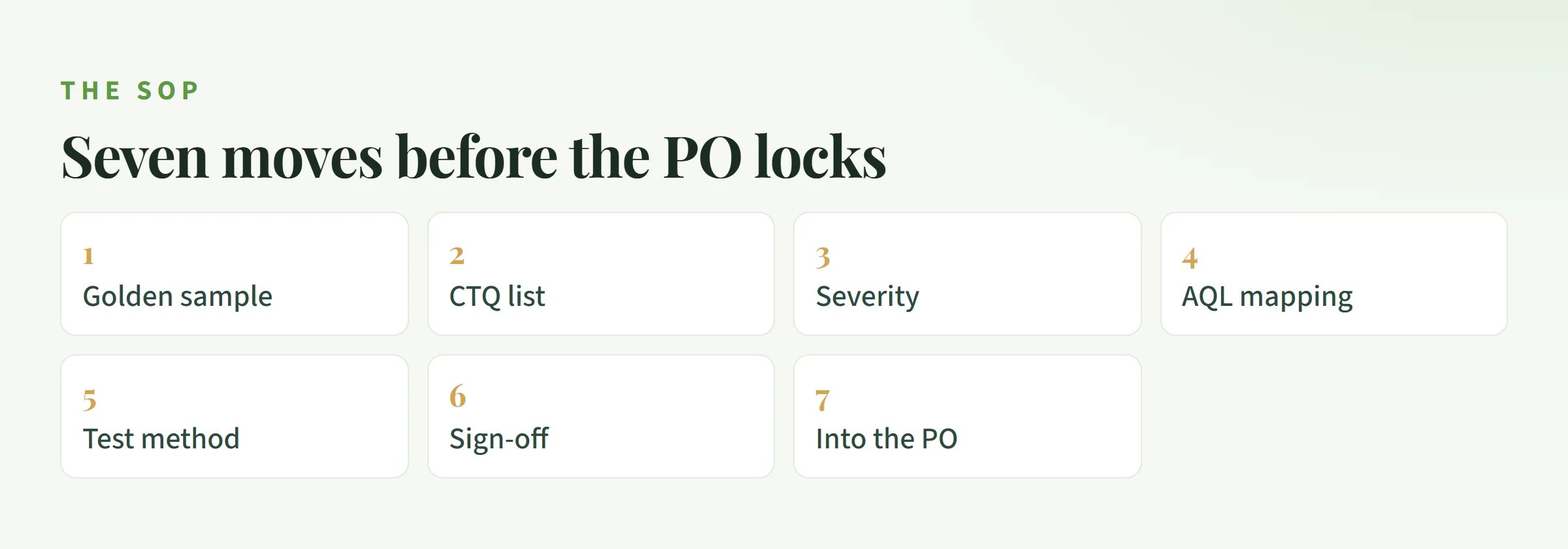
- Lock the golden sample, approved artwork, Pantone references, and packaging mockup. For artwork approval, follow this promotional product design guide.
- List every CTQ feature by product type: print, finish, dimensions, function, accessories, and packaging.
- Define critical, major, and minor defects in plain language, with photo examples.
- Assign AQL 2.5 to major defects and AQL 4.0 to minor defects. Keep critical defects at zero tolerance unless a special case is justified.
- Write the test method beside each defect: visual compare, rub, wash, pull, fit, count, carton drop, or barcode scan. Reference the approved spec sheet and the ASTM D3359 adhesion test.
- Add pass/fail notes and sign-off names for the buyer, factory QA, and third-party inspector.
- Put the list into the PO, QC checklist, and pre-shipment booking before production finishes.
For random sampling, inspect units in every carton and at each lot location. Do not pull from the front stack; I take at least one unit from the top, middle, and bottom of each pallet. Hidden defects surface that way.
Our full workflow sits in the inspection and quality control process and the four-gate QC guide.
Pros and Cons of AQL 2.5 and AQL 4.0
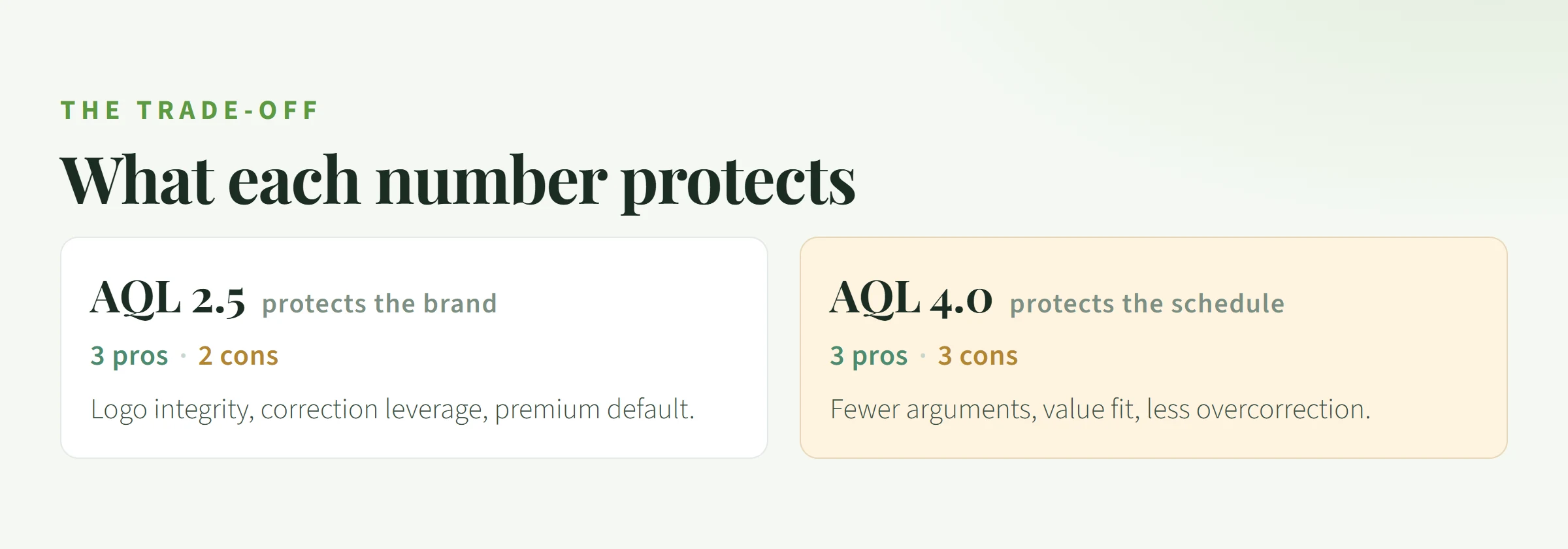
AQL 2.5
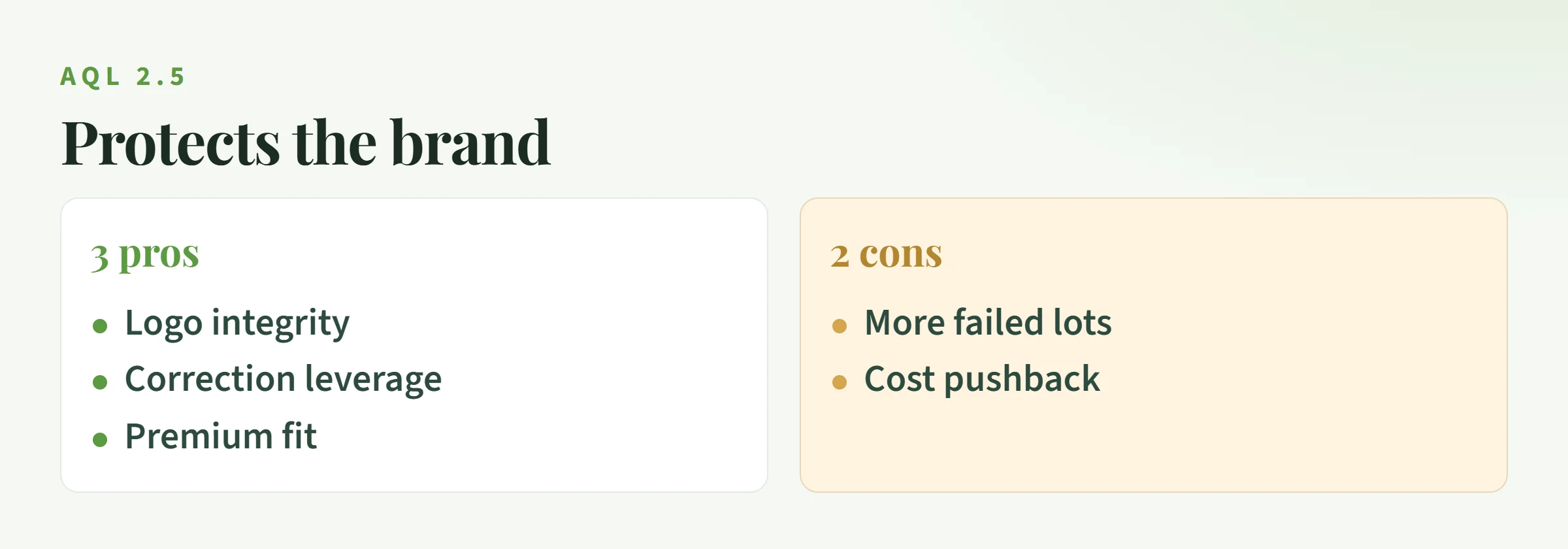
Pros
- Logo Integrity: Tighter major limits protect Pantone accuracy and saleable finish.
- Correction Leverage: A failed lot forces rework while goods are still at the factory. One 4,000-unit mug order failed 2.5 majors on handle glaze chips; rework added 6 days but saved the launch.
- Safer Premium Default: Fits VIP kits, retail-adjacent merch, and executive gifts.
Cons
- More Failed Lots: Weak factories fail faster, and re-inspection can stall tight dates. One low-capability supplier failed 3 of 10 lots on logo registration.
- Cost and Timeline Pushback: Some suppliers ask for more unit cost or lead time when majors stay tight. Expect pushback, then ask for the process fix.
🚀 Actionable Insight: If a weak factory fails AQL 2.5 majors, do not relax to 4.0. Add 100% sorting or fix the process before shipment.
AQL 4.0
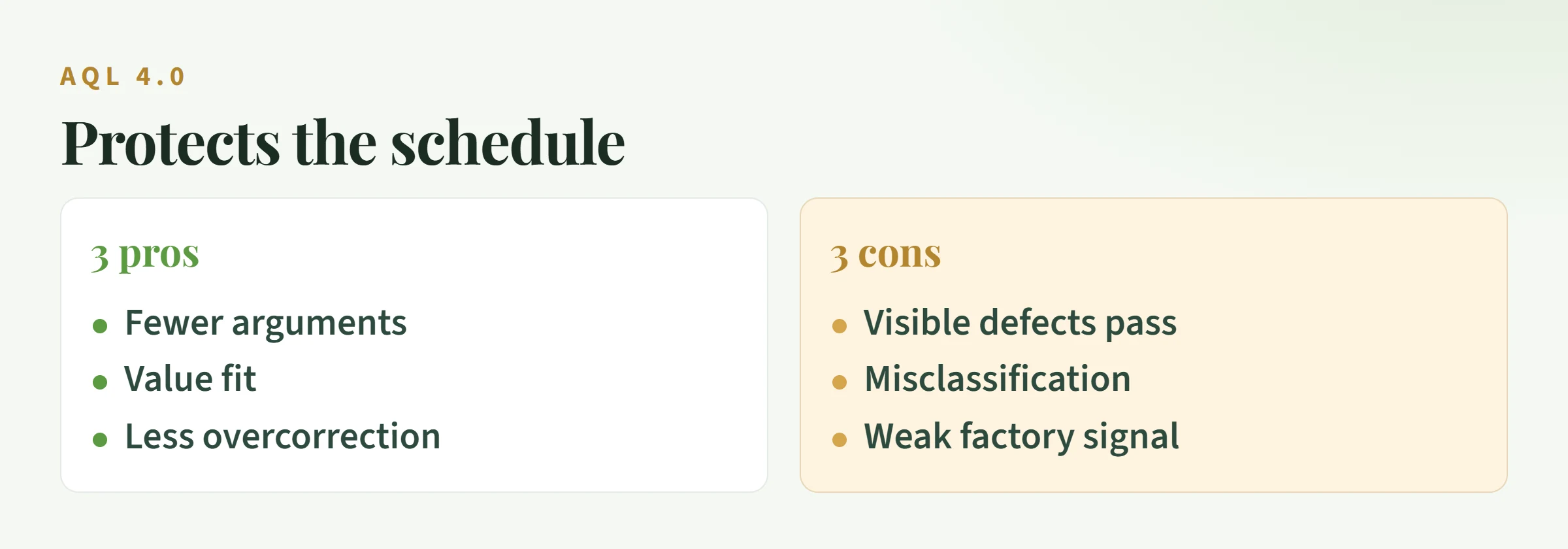
Pros
- Fewer Trivial Arguments: Ends fights over hidden scuffs and stitch variance nobody notices.
- Value-Giveaway Fit: Suits low-cost handouts where cosmetic perfection is not economically rational.
- Less Overcorrection: Keeps buyers from rejecting usable swag over tiny blemishes.
Cons
- Visible Defects Pass: The same sample can release more scratches, rubs, and crooked details.
- Misclassification Danger: It fails when buyers label brand-impact flaws minor. Loose wording has let peeling logos through.
- Weak Factory Signal: It tells the factory that finish quality matters less.
Each threshold has a valid role when severity is classified correctly. The best buyers rarely pick one number universally. They use AQL 2.5 for brand-sensitive majors and 4.0 only for tightly defined minor cosmetics on low-risk giveaways.
Frequently Asked Questions about AQL 2.5 vs. AQL 4.0
1. Is AQL 2.5 or AQL 4.0 safer for promotional products?
AQL 2.5 is safer for major defects. It inspects the same sample size as 4.0 but allows fewer defectives, so fewer visible flaws reach the recipient. Use 4.0 only for minor cosmetics on low-risk giveaways; premium items should stay at 2.5.
2. Can I use AQL 4.0 for all defects on low-cost giveaways?
No. AQL 4.0 belongs on minor defects. If you apply it to majors, visible flaws such as peeling logos or cracked lids slip through; that is how scratched tumblers reached VIPs when majors were relaxed.
3. How do I classify major vs. minor defects?
Major defects harm function or brand perception, such as wrong Pantone, print cracking, or seam failure. Minor defects are cosmetic and unnoticed at a glance, such as hidden scuffs or slight stitch variance. Write the list before production and attach photo examples to the PO.
4. What is the risk of using AQL 4.0 for major defects?
You accept more defectives in the same sample. The threshold table above shows the gap at each lot size. Those extra allowed units can become complaints at the event where the product is handed out.
5. Which AQL should I use for a first order?
We start with AQL 2.5 for majors and AQL 4.0 for minors, document both in the PO, and review defect photos before paying the balance. For a second opinion, contact the sourcing team.
Editorial Integrity Statement: At LeelinePromotion, our integrity is our currency. We operate with strict editorial independence: we receive no kickbacks from manufacturers, use our own independent QA teams for all audits, and fund our own testing equipment. The numbers here come from our inspection records and the published ISO 2859-1 acceptance tables, not from vendor marketing.