
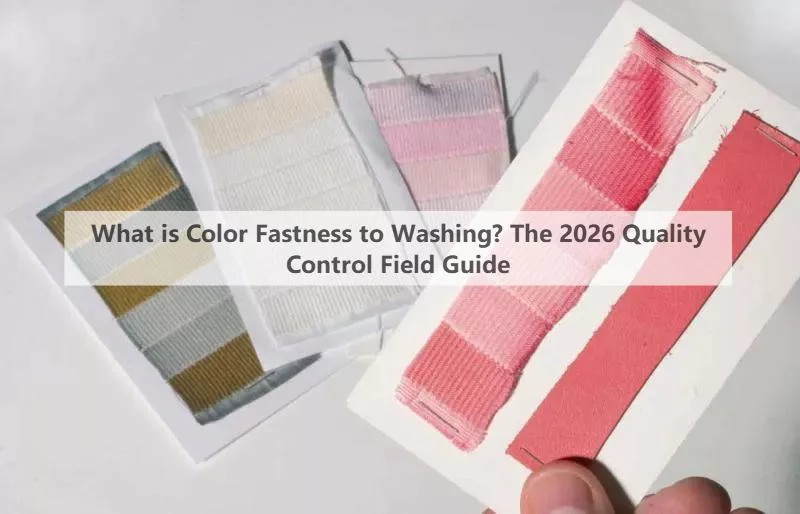

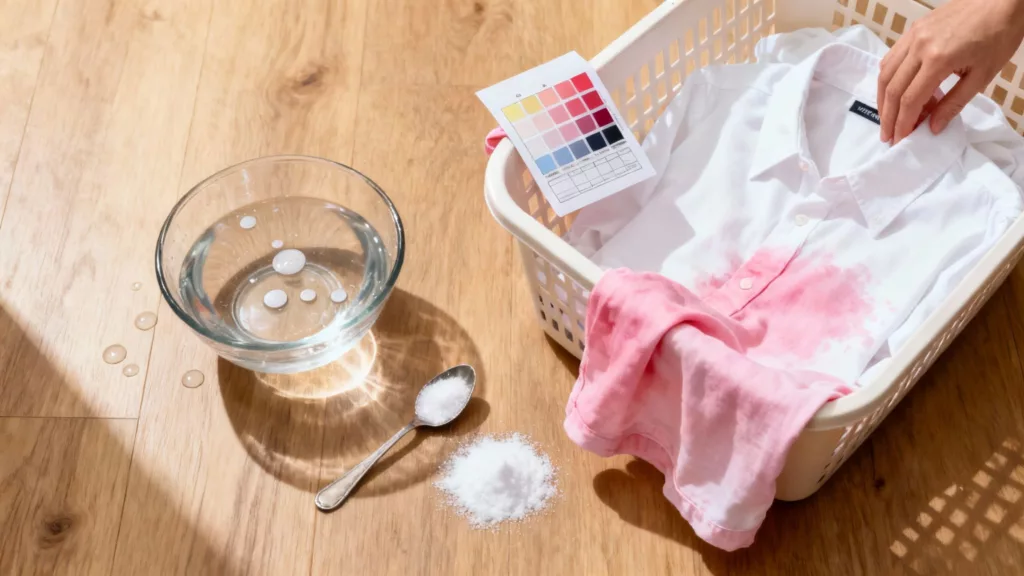
Red logo dye bleeding onto a white collar during the first wash can turn a finished order into a return — and a return into a chargeback.
For manufacturers and buyers, color fastness to washing is the primary defense against returns, "shade drift," and audit failures — not just another lab metric. While other tests measure resistance to sunlight or rubbing, this one predicts how a product behaves in the consumer's machine.
Preventing these failures comes down to specifying the right standard and reading the lab report correctly. This guide shows how to specify requirements and interpret results aligned with ISO 105-C06 and AATCC 61 protocols.
Whether the product is simple cotton or a complex apparel fabric type, the goal is the same: prevent cross-staining and make sure the merchandise survives the wash.
Key Takeaways
- Two grades, not one: A wash-fastness report scores color change on the specimen and staining on the multifiber strip separately — a pass requires both.
- ISO and AATCC do not convert: Grade 4 in ISO 105-C06 is not Grade 4 in AATCC 61; steel-ball agitation is more aggressive.
- Grade 4.0 is the retail floor: High-contrast goods (white body, dark trim) should clear 4.0, not sit on a borderline 3-4.
- Acceptance is contractual: There is no universal pass — the standard, condition, and minimum grade must be written into the PO.
- Prevention happens in the dye house: Insufficient soaping and poor fixation cannot be corrected by re-testing finished goods.
What is Color Fastness to Washing?
Color fastness to washing is the capacity of a dyed or printed textile to resist fading or transferring color during a standard wash cycle. In brand merchandise the stakes are concrete: a cracked logo is a visible defect, but a promotional polo that turns a client’s white laundry pink is a brand liability.
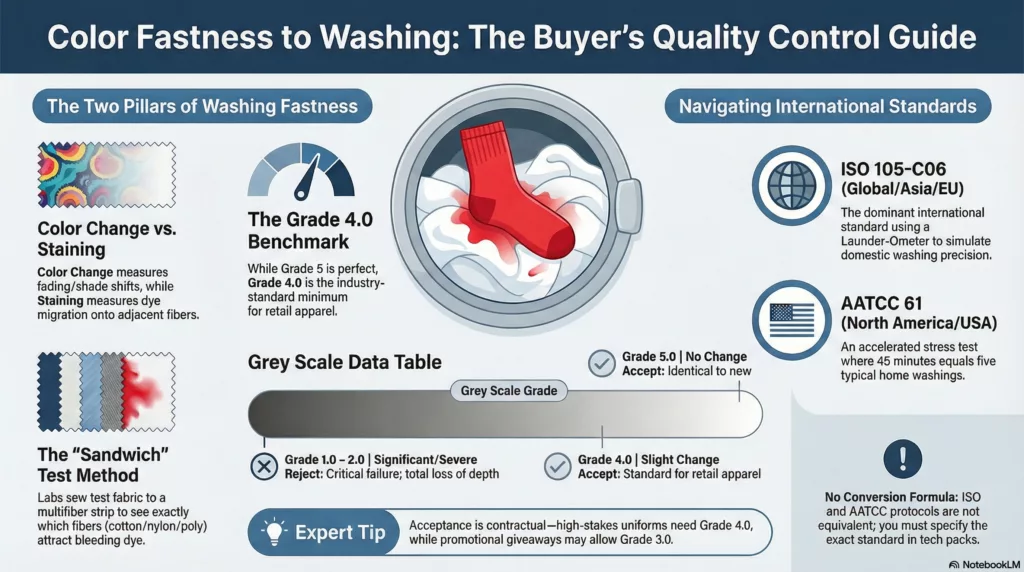
Results rest on two separate quality-control parameters:
- Color change: Did the original item lose depth or shift in shade? (e.g., navy blue fading to dull grey).
- Staining: Did the dye migrate onto other fabrics in the load? This measures color bleeding prevention.
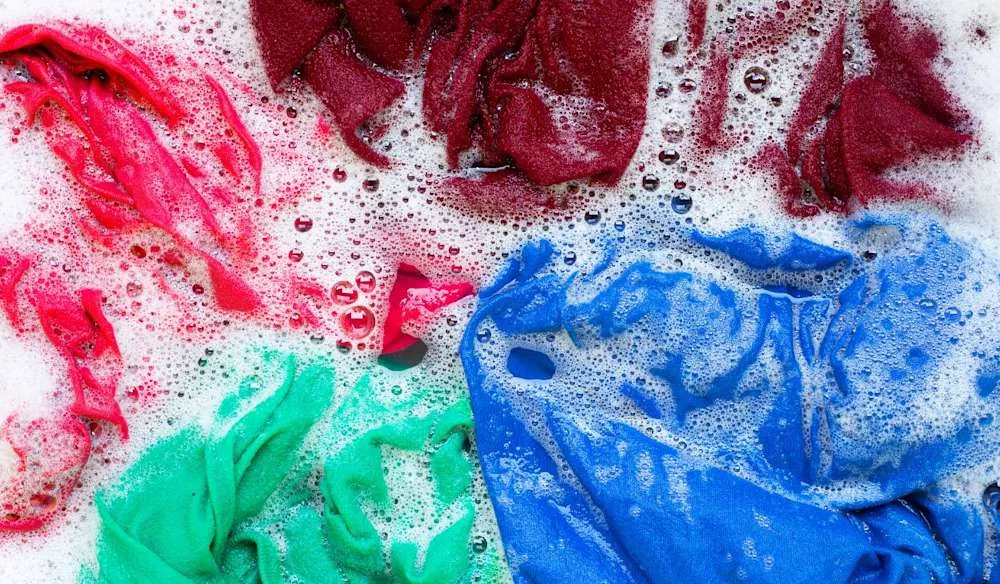
Think of the "red sock" scenario: if the sock turns pink, it has poor fading resistance; if it ruins the white shirt beside it, it has poor dye stability.
The Testing Mechanism: The "Sandwich" Method
Labs do not simply toss a garment into a washing machine. To isolate variables, technicians sew the test specimen to a multifiber adjacent fabric — a strip with bands of distinct fibers such as cotton, polyester, nylon, and wool.
This matters for troubleshooting. If staining appears on the nylon band but not the cotton, the failure lies with the acid dye fixation — a chemical fix that can be made before bulk production begins.
Decoding the Lab Report
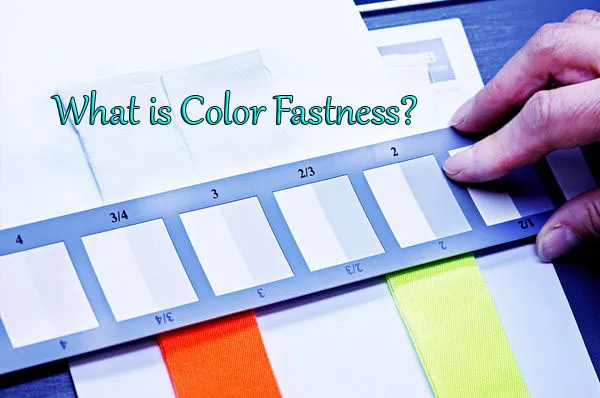
Factory results are graded on the Grey Scale (ISO 105 series), from Grade 1 (severe failure) to Grade 5 (no change), using two separate scales:
- Grey scale for color change: assesses the appearance of the specimen.
- Grey scale for staining: assesses the adjacent multifiber fabric.
Reports may also include a ΔE (Delta E) value from a spectrophotometer — a digital tie-breaker when visual grading is borderline.
Where this fits in production flow: Testing occurs during the Pre-Production Sample (PPS) stage. A fabric that fails here is rejected before bulk.
How Is Color Fastness to Washing Tested?
Every method below shares the same anatomy — a specimen stitched to an adjacent fabric, agitated in detergent under controlled heat — but the variables differ enough that they cannot be mixed. Choose the standard first, then lock the condition.
Choose the Right Standard (Don’t Mix Methods)
The most common specification error is blending standards. Buyers copy-paste requirements without realizing ISO and AATCC protocols use different detergents, agitation mechanics, and temperature curves.
There is no conversion formula. A Grade 4 in ISO is not a Grade 4 in AATCC. Use this logic gate when building a tech pack:
- ISO 105-C06: for Europe, Asia, or global markets; the dominant international standard.
- AATCC 61: for North American markets (USA/Canada); US retailers almost exclusively demand AATCC protocols.
ISO 105-C06: The Global Benchmark
ISO 105-C06 simulates domestic laundering with precision. The lab doesn't use a washing machine; it uses a Launder-Ometer — a device holding sealed stainless steel canisters in a rotating water bath.
Three variables are controlled to replicate a real wash cycle:
- Reference detergent: "ECE Reference Detergent" (without optical brighteners), so fading is caused by the wash process, not masked by fluorescent additives.
- Mechanical action: for severe stress tests, 10–25 stainless steel balls (6mm) are added to the canister, simulating zippers and buttons in a crowded load.
- Liquor ratio: a strict water-to-fabric ratio — 50:1 for ISO 105-C06. Too little water concentrates dissolved dye, which re-deposits onto the garment and causes false failures.
The hardware is standardized too: sealed steel canisters rotate at 40 ± 2 r/min inside 550 ± 50 mL cups, and the specimen is cut to 40 × 100 mm and stitched to a DW multifiber strip 15 mm wide.
AATCC 61: The Accelerated Stress Test
AATCC 61 is built for speed: 45 minutes of high-friction agitation equals five typical home launderings.
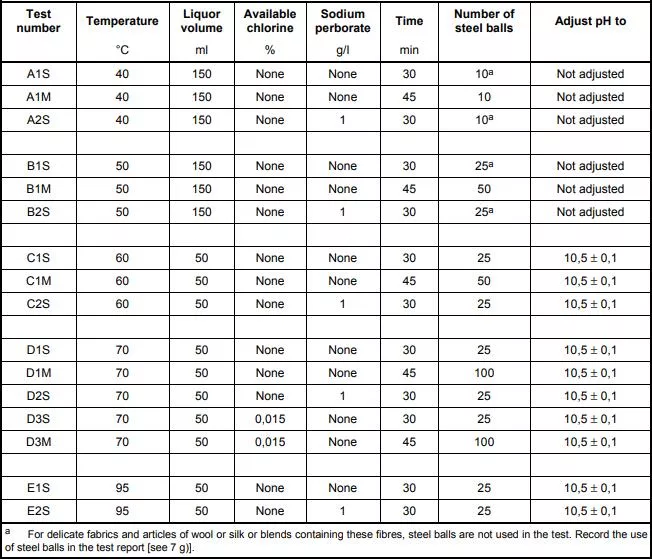
The test condition must match the fabric's intended use — 1A for hand washing, 2A for standard machine wash, 3A for heavy-duty washing, and 4A/5A for bleaching programs. Full parameters are in the table below.
🧠 Expert Insight: For most custom promotional clothing, Test No. 2A is the working default. It balances rigor with the reality of how end-users wash branded tees.
Method Comparison at a Glance
Use this table to match the standard to the destination market, then pick a starting condition. Always confirm the exact parameters against the current published standard — conditions are revised periodically, and the detergent, liquor volume, and ball count all change the result.
| Standard & condition | Market | Temp | Time | Mechanical action | Oxidizer |
|---|---|---|---|---|---|
| ISO 105-C06 A2S | EU, global | 40°C | 30 min | 10 steel balls | Sodium perborate |
| ISO 105-C06 B2S | EU, global | 50°C | 30 min | 25 steel balls | Sodium perborate |
| AATCC 61 1A | US, Canada | 40°C | 45 min | 10 steel balls | None |
| AATCC 61 2A | US, Canada | 49°C | 45 min | 50 steel balls | None |
| AATCC 61 3A | US, Canada | 71°C | 45 min | 100 steel balls | None |
| AATCC 61 4A / 5A | US, Canada | 71°C / 49°C | 45 min | 100 / 50 steel balls | Available chlorine |
| GB/T 3921 C3 | China domestic | 25°C | 10 min | Steel balls | Sodium carbonate |
| JIS L 0844 A-2 | Japan | 50°C | 30 min | Rotating bath | None (soap solution) |
| M&S C4A | UK retail | 50°C | 30 min | Steel balls | Sodium perborate |
Step-by-Step Lab Workflow
Third-party labs such as SGS and Intertek follow this linear journey for a test sample:
- Sandwich assembly: the specimen is stitched face-to-face with a multifiber adjacent fabric, which captures any dye that bleeds out during the test.
- Wash run: the sandwich goes into the steel canister with pre-heated detergent and steel balls, then runs for the exact duration.
- Rinsing and separation: the sample is rinsed in distilled water to stop the reaction, then the stitches are separated before drying to prevent dye migration while damp.
- Conditioning: the fabric rests in a climate-controlled room (20°C, 65% humidity) for 4 hours, since moisture content affects light reflection during grading.
Interpreting the Grey Scale
Results are rated with ISO Grey Scales — visual comparators used under standardized D65 artificial daylight, not subjective opinions.
The color-change scale measures contrast between the unwashed reference and the washed sample:
| Grade | Visual Meaning | Procurement Decision |
|---|---|---|
| 5 | No Change | Accept. Identical to new. |
| 4 | Slight Change | Accept. Standard for retail/apparel. |
| 3 | Noticeable | Risk. Acceptable for cheap giveaways; reject for retail. |
| 2 | Significant | Reject. Tone shift (e.g., navy turns purple). |
| 1 | Severe | Critical Failure. Total loss of depth. |
Note: Labs report half-steps (e.g., 3-4) when results fall between standards.
The staining scale looks at the multifiber strip, not the shirt itself. If a red cotton shirt stains the nylon band, the dye has an affinity for synthetics — a red flag if a polyester logo patch will be sewn onto that shirt.
How to Specify Acceptance Criteria?
Vague phrases like "good color fastness" are unenforceable. To protect an order, embed this clause template in the Purchase Order (PO):
Testing Requirement: Color Fastness to Washing
- Standard: ISO 105-C06
- Method: A2S (40°C, 30 min, steel balls and perborate)
- Acceptance criteria:
- Color change: min Grade 4.0
- Color staining: min Grade 3-4 (on all fibers)
- Retest protocol: failed lots re-tested at supplier expense.
For high-stakes categories: for types of clothing such as heavy canvas uniforms, raise the staining requirement to Grade 4.0 — a uniform that stains an employee's undergarments is a liability. For single-use event items, Grade 3.0 is often acceptable to reduce dye costs.
Why Do Strict Washing Standards Matter? The ROI of Quality Control
Testing is not a line item; it is insurance. A lab test typically costs a small fraction of a percent of total order value, while a recall costs 100% plus brand reputation. Strict protocols turn technical data into commercial advantages.
Benefit 1: Prevents Catastrophic Staining Incidents
Fading resistance matters, but "bleeding" kills profitability. Staining failures cluster in high-contrast goods like ringer tees or varsity jackets, where dark trim ruins a light body during the first wash — a "component-to-component transfer" that renders merchandise unsellable.
Catching loose dye molecules before bulk production keeps these irreversible aesthetic failures from ever reaching a customer.
Benefit 2: Eliminates Costly Rework & Shipment Holds
Early screening for washing fastness of textiles stops defects at the source. Poor fixation caught at the dyeing stage costs little to correct (via re-soaping); caught at final QC, it means stripping and re-dyeing thousands of finished garments — and risking a missed trade show deadline to last-minute work.
Benefit 3: Secures Audit-Ready Documentation
Standardized textile quality control is a financial shield.
- Defensibility: if a buyer claims a defect months later, the original pass/fail report proves the goods met specs at handover.
- Scorecards: the same data objectively ranks suppliers, removing low-performing dye houses from a network.
The same discipline should run through every order — see our inspection and quality control process for how it is applied.
🚀 Sourcing Insight: Consolidating color fastness to washing requirements across mixed material suppliers through a one-stop promotional manufacturing partner such as LeelinePromotion aligns a designer in New York and a lab in China on one verified standard — so a cotton cap and a polyester lanyard in the same welcome kit ship under the same bar.
Why Do "Passing" Results Still Fail?
A lab report is a snapshot, not a guarantee. "Perfect" results can still trigger consumer complaints when testing variables fall outside what standardized protocols capture.
Method Mismatch & Subjectivity
A factory may submit ISO 105 results (gentle mechanical action) to a buyer requiring AATCC 61 (aggressive steel-ball agitation). A fabric scoring Grade 4 in ISO often drops to Grade 2.5 under AATCC stress, because the steel balls physically abrade the fiber.
Visual grading also depends on human judgment — operator fatigue can shift results by 0.5 points.
Troubleshooting: A Diagnostic Playbook
When results drift, this logic isolates the root cause:
Symptom: unexpected staining. Check the adjacent fabric type. If a polyester logo stains the nylon band of a multifiber strip, the dye selection is incompatible. 🛡️ Mitigation: switch to high-energy disperse dyes or improve reduction clearing.
Symptom: lab vs. factory fluctuation.
- Hard water interference: calcium and magnesium precipitate soaps, trapping unfixed dye. Factories should document water hardness daily.
- Improper dye-bath ratios: a low water-to-fabric ratio (4:1) concentrates the dye and can redeposit color. ⚖️ The trade-off: raising the dye-bath ratio to 10:1 cleans the rinse but significantly increases water consumption.
Symptom: pass in lab, fail in home wash. Labs use neutral detergents, while consumers use brands loaded with optical brighteners that shift shades. 🛡️ Mitigation: run a "reproducibility wash" with consumer detergent and a home machine to stress-test the dye against real-world chemistry.
Process Prevention
Prevention happens in the dye house, not the lab. Audit two defects directly: insufficient soaping (skipping rinse baths to save time) and poor fixation (cheap agents on cotton). On synthetics, skipping "reduction clearing" guarantees surface dye will bleed later.
See the AATCC Technical Manual for detailed method limitations.
Putting Quality Control Into Practice
Color fastness to washing ultimately determines the lifespan of a brand’s reputation. Controlling color change (fading) and staining (bleeding) takes more than a factory's word — it demands rigid adherence to a specific standard, whether ISO 105-C06 or AATCC 61.
Without an exact procedure, even high-quality dyes fail under consumer scrutiny. Rigorous pre-production testing is also the only reliable defense as the industry shifts toward eco-friendly, natural dyes, which are inherently less stable.
The 6-Point Quality Control Checklist
Use this checklist to audit a lab report or tech pack. If any point is missing, the test is invalid.
- Specify the standard: state ISO 105-C06 or AATCC 61 explicitly, including the year and option (e.g., 2A).
- Define the variables: confirm temperature (e.g., 40°C), detergent type, and mechanical action (steel balls).
- Require dual grading: ensure the report lists grey-scale grades for both color change (the garment) and staining (the multifiber strip).
- Control the environment: verify grades were assessed under D65 artificial daylight.
- Check the liquor ratio: confirm the standard's ratio — ISO 105-C06 specifies 50:1 — so a low ratio is not causing false failures.
- The "one strike" rule: mandate immediate third-party re-testing for any result below Grade 3.0.
Frequently Asked Questions about Color Fastness to Washing
Is ISO 105-C06 the same as AATCC 61?
No. Both measure washing fastness, but they use different detergents, temperatures, and mechanical actions, so their grades are not interchangeable.
ISO 105-C06 is the global benchmark; AATCC 61 is the accelerated method most US and Canadian retailers require. Specify which standard the factory is testing to, not just a target grade.
What is a passing grade for color fastness to washing?
There is no universal pass — acceptance is contractual and belongs in the purchase order. A Grade 4.0 minimum is common for retail apparel and corporate uniforms, while Grade 3.0 is often accepted for single-use promotional items.
For high-contrast goods such as a white body with dark trim, set 4.0 as the contractual minimum rather than accepting a borderline 3-4.
Do China or Japan have their own washing fastness standards?
Yes. GB/T 3921 is the Chinese standard and JIS L 0844 is the Japanese standard; both apply the same principle with their own detergent, temperature, and adjacent fabric.
Goods made in China but sold in the US or EU usually still need ISO 105-C06 or AATCC 61 reports, so the destination market decides the standard, not the factory location.
What do the grey scale grades mean?
Two grey scales are involved, both graded 1 to 5. The color-change scale compares the washed specimen with an unwashed original; the staining scale compares the adjacent multifiber strip.
A report is only complete when it carries both grades. Labs record half-steps such as 3-4 when a result sits between two grades.
Why does a fabric pass the lab test but bleed in a home wash?
The lab run uses a neutral reference detergent at a fixed temperature and load. Real homes use consumer detergents with optical brighteners, at other temperatures and load sizes. That mismatch shifts shades even when the report passed, so a reproducibility wash with consumer detergent is the honest test.
What causes dye to transfer onto other fabrics in the wash?
Unfixed dye molecules leaving the fiber. The usual causes are insufficient soaping during dyeing, poor fixation agents on cotton, and skipped reduction clearing on synthetics. All three are cheaper to fix at the dyeing stage than to screen out of finished goods.
Related Resources
- Fabric Pilling Causes and How to Prevent Them
- Promotional Products Quality Control: A Buyer's Checklist
- Flammable Fabrics Act for Apparel: Compliance for Buyers
- What is GSM in Fabric? Weight, Quality, and Cost
- Mercerized Cotton: What It Is and When to Specify It
If you need help aligning test requirements across suppliers or preparing audit-ready QC documentation, contact our team.