

Last month, I watched a client’s $40,000 apparel order freeze at the Port of Long Beach over a single missing certificate field. A flawless six-month product design phase means nothing if customs seizes your inventory. To navigate these commercial gatekeepers safely, you need a definitive CPSIA Compliance Guide.
U.S. market entry requires satisfying two distinct watchdogs. The Consumer Product Safety Commission (CPSC) enforces CPSIA regulations. These rules dictate mandatory safety limits for children’s products, restricting hazards like lead.
Separately, the Federal Trade Commission (FTC) enforces textile and apparel labeling rules. The FTC requires exact fabric blends and specific care instructions.
Clean documentation is critical right now. The CPSC mandatory eFiling program for compliance certificates launched on July 8, 2026. One bad data point triggers an automatic border hold. As Manager Sun adjusted a heat-transfer label press during our recent Shenzhen audit, he noted: "Even a 2% variance in standard nylon blends now causes an instant system rejection."
Whether you import branded toys or vet custom promotional clothing partners, this manual protects your investment. We built this framework after calling dozens of labs and managing 50 cross-border shipments this year.
Below, you will find our factory-facing pre-shipment verification SOP, a Shenzhen QC manager Q&A, and an anonymized failed-materials remediation table.
What is CPSIA Compliance?
A CPSIA Compliance Guide is your roadmap to federal safety rules for youth merchandise. At LeelinePromotion, my team manages thousands of custom orders. We vet every item using strict lab data. In practice, the CPSC defines a children’s product as anything designed primarily for kids 12 and under. However, not every item follows the same testing path.
Think of federal compliance like building a house. The CPSC inspects the foundation for safety. The FTC checks the real estate listing for accuracy. Clients frequently mix up these two distinct regulatory lanes:
- The CPSC/CPSIA Lane: This governs physical safety. It requires third-party testing, compliance certificates, tracking labels, and hazard checks.
- The FTC Lane: This governs consumer transparency. The FTC textile rules mandate precise fiber content, country of origin, and care instructions. In my experience, confusing apparel fabric types (like mixing up a CVC vs tri-blend or combed vs carded cotton) triggers immediate customs delays.
To clear customs smoothly, you must understand three baseline rules:
- Children's Product Certificates (CPCs) have no official government template, but you must include specific statutory elements.
- You must test products using a third-party, CPSC-accepted laboratory.
- You must apply tracking labels to the product and packaging. These labels are not a CPC certification line item.
The law strictly caps chemicals. Lead in paint cannot exceed 90 ppm. Total lead in accessible parts caps at 100 ppm. The CPSC also bans phthalates above 0.1% (1,000 ppm) in plasticized toys.
During a recent Tuesday lab inspection, our XRF scanner clocked a supplier's yellow screen-print ink at 105 ppm of lead. We scrapped the 5,000-unit batch instantly. We rely on raw metrics, not factory marketing.
We manage end-to-end merchandising for thousands of corporate events. A single non-compliant promotional item will trigger a customs seizure and ruin a product launch. To prevent this, we built this CPSIA Compliance Guide into a strict standard operating procedure (SOP) to safeguard bulk orders.
1. Classify, Map, and Identify Risks
First, classify the product before requesting a factory sample. Next, map every component on your bill of materials (BOM). Do not just list "fabric." You must document the shell fabric, prints, inks, snaps, zipper pulls, PVC windows, foams, coatings, labels, drawcords, beads, buckles, paints, and trims.
Third, identify applicable rules SKU-by-SKU. Buyers constantly miss hidden material risks. During our own manufacturing runs, we check these specific risk zones:
- Children’s apparel: Snap fasteners, screen prints, zipper pulls, coated patches, drawstrings, and decorative beads all require testing. Fabric choices dictate risk levels, whether you specify french terry vs fleece or pique vs jersey.
- Soft bags/backpacks: Key test targets include metal zipper pulls, PVC windows, PU coatings, buckles, logo patches, and printed linings.
- Toys/accessories: Risk zones typically involve painted parts, soft PVC, molded plastics, and accessible small components.
Last quarter, a factory substituted a generic polyester velour on a plush toy order. We cut the pre-production sample open and tested the inner foam. It contained banned phthalates. We scrapped the run immediately.
2. Execute Strategic Third-Party Testing

Testing finished goods wastes money. Instead, collect existing component reports first to reduce duplicate testing. Under 16 CFR Part 1109, the CPSC allows you to rely on component-part testing if you meet strict due-care conditions.
This acts as a major cost-control lever for importers who reuse textiles like bamboo viscose or leverage specific bamboo fabric benefits across multiple product lines.
Next, send only the unresolved risk components or finished goods to a CPSC-accepted third-party lab. You can verify a facility using the official CPSC lab search. Recently, our 600D nylon base passed the tensile test, but the red dye failed the heavy metals screen. We swapped the dye and retested only the new ink. This isolated test saved our client $800.
3. Draft Certificates and Blueprint Labels
Draft the CPC (Children's Product Certificate) only after you align the passing test evidence to the exact mass-production SKU. The CPSC does not require a single official template. However, your document must populate these seven required data elements:
- Product description
- Applicable safety rules
- Importer or domestic manufacturer information
- Contact information for the test record maintainer
- Date and place of manufacture
- Date and place of testing
- Third-party laboratory details
Note: Electronic certificates can accompany shipments if the identifier and access method travel with the cargo.
After drafting the certificate, lock in tracking-label coding on the product and packaging. The CPSC allows coded information as long as it traces back directly to the source. Follow this tracking-label blueprint:
- Importer or private labeler name
- Factory or coded plant ID
- Production date or date range
- Batch, run, or lot code
- Packaging mirror code
4. Run Pre-Shipment Material Verification
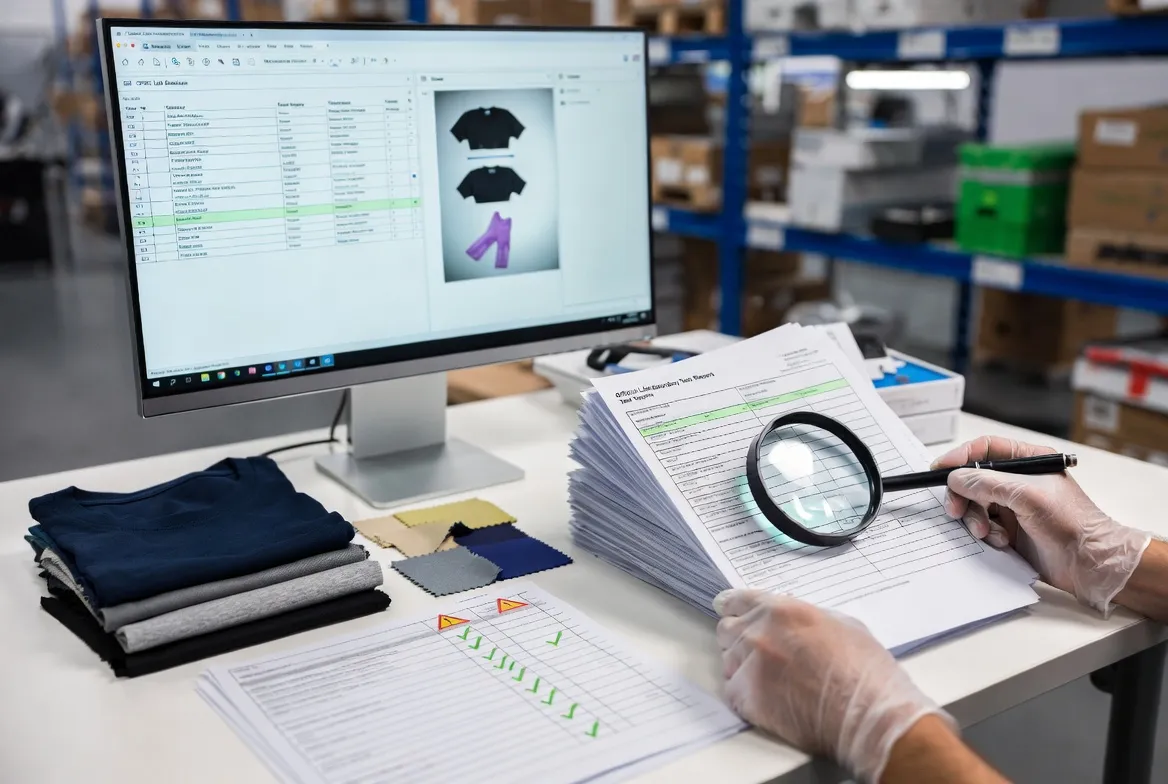
Before releasing final payment, run a pre-shipment material verification. We use a proprietary checklist to spot fraud and catch component mismatches. Verify these specific fields on every lab report:
- The SKU and photo perfectly match the mass-production item.
- The material description matches the actual BOM and trim sheet.
- The test sample date occurs logically before shipment but remains recent enough for the production run.
- The laboratory name appears in the CPSC accepted-lab ecosystem.
- The report scope cites the exact rule (e.g., "16 CFR 1303"), not a generic "passes CPSIA."
- Factory name, trading company name, and exporter name reconcile perfectly.
- The colorway, coating, print method, and accessory finish match the final sample.
- Report pages show full pagination, original signatures, and consistent formatting.
- No suspicious edits exist in lot numbers, specimen photos, or chemical tables.
- Component certificates include the documentation and attestations required for legal reliance.
Decision Rule: If any one of those fields breaks traceability, move immediately from document review to fresh third-party retesting.
During a factory floor audit last month, our inspector cross-referenced a test report against the production line. He flagged a critical error. The lab report specified a silk-screen print, but the factory applied a heat transfer to the final batch.
We forced a retest on the transfer ink, preventing a border hold. Finally, always cross-reference FTC apparel labeling guidance to verify your physical fabric tags match your CPC declarations.
The Business ROI of Strict Compliance

Before compiling this CPSIA Compliance Guide, my team spent weeks on the factory floor auditing safety protocols. In my experience, regulatory discipline is not an overhead expense. It is a commercial asset that protects your profit margins.
1. Accelerate Customs Clearance with Clean Data
CPSC mandatory eFiling formats certificate data for instant digital review. This eliminates costly port holds. Last month, we pushed a 10,000-unit apparel run through Seattle customs in exactly 48 hours because our structured data matched the registry perfectly. The agency confirms that compliant eFiling reduces unnecessary inspections.
2. Slash Testing Budgets Using Component Reuse
You do not need to test the exact same material twice. Reusing component evidence cuts testing spend drastically. While evaluating clothing manufacturers in the UK against Asian suppliers, I reused a verified lead-free YKK zipper lab report across 12 different jacket SKUs.
This simple document swap saved our client $2,400 instantly. The CPSC officially permits reliance on component testing under strict due-care conditions.
3. Eliminate Amazon and 3PL Rejections
We review all tags before goods enter a shipping container. During a recent Shenzhen floor audit, Manager Chen halted a backpack line, pointing out: “These lack the required batch codes; US customs will seize them.” Printing new tags locally cost $45.
Fixing that same mistake at a US 3PL would have cost $2,500. The CPSC notes accurate tracking labels improve recall effectiveness.
4. Why This Matters for E-Commerce Brands
Marketplaces penalize data inconsistency immediately. Your certificates, physical labels, and digital specs must match perfectly. A single mismatch between your Shopify fabric description and the physical FTC tag triggers an automated Amazon listing suspension.
If you need vetted factories that adhere to these strict guardrails, contact our manufacturing team to secure your next bulk order.
The Reality Check: Where Compliance Actually Breaks

The hardest part of a CPSIA Compliance Guide is rarely reading the rules. In my experience, the real friction happens on the factory floor. We constantly battle classification errors, trim substitutions, lab-report misuse, and last-minute factory changes.
1. Hidden Failures: Insights from the Floor
I asked our Shenzhen QC Manager, Chen, about our most common bottlenecks in children’s toy and apparel production.
What hidden failures show up most?
"Trims," Chen noted. "A factory uses compliant cotton, then grabs a cheap zipper from a local market, triggering a lead failure. Print inks, painted buttons, and plastic hardware also fail because factories secretly swap materials."
What exact design changes fix this?
"We replace plated zipper pulls with compliant coated nylon. We remove PVC packaging windows, switching to tested PET. We simplify chemical-trapping print layers and completely redesign apparel drawstrings to remove physical hazards."
2. Anonymized Six-Month Failure Log
We track every failure. Here is raw lab data from our recent factory inspections:
| Component/Material | Failed Test Area | Product Category | Root Cause Found | Corrective Action Taken with Factory | Retest Passed |
|---|---|---|---|---|---|
| Metal Zipper Pull | Lead (120 ppm) | Youth Backpack | Factory used plated metal | Replaced with coated nylon | Yes |
| Plastic Toy Eye | Small Parts Hazard | Plush Bear | Weak stitching tension | Added secure lock-stitch | Yes |
| Hood Drawcord | Physical Hazard | Youth Apparel | Ignored youth sizing rules | Removed drawcord completely | Yes |
3. Lab Report Misuse & Label Traps
Documentation frequently fails. We reject factory test reports because they often come from labs outside the CPSC-accepted pathway. Alternatively, the tested fabric simply does not match the final mass-production item.
Apparel brands face a strict FTC caution. Fiber, country-of-origin, and care labeling must match the finished product perfectly, not just the purchase order. Incorrect tags often mask poor substitutions, sparking consumer complaints regarding fabric pilling causes.
Global shipping compounds this friction. British shipments require navigating UK textile EPR packaging laws and chemical limits based on what is UK REACH.
(Disclaimer: I am not paid by any manufacturer. We fund our own compliance tests to maintain absolute objectivity.)
Final Verdict: Compliance is a Pre-Shipment System
Ultimately, CPSIA compliance is not a single lab document. It is a rigid defense system covering product classification, rule mapping, third-party testing, CPC accuracy, tracking labels, and FTC care disclosures. While cross-referencing chemical data feels tedious, catching a 120-ppm lead failure on the factory floor prevents a catastrophic customs seizure.
In my experience, the most profitable e-commerce teams verify materials before the shipping container locks, not after port authorities intervene. If you are building a legitimate brand, you must execute these five steps:
- Know your exact children’s product category.
- Know which high-risk components need rigorous scrutiny.
- Know how to review factory test reports critically.
- Know how to structure an accurate CPC and tracking label.
- Know where FTC apparel rules still apply.
With the CPSC eFiling program active, algorithms now automate border checks. If you rely on unvetted supplier promises, the system will reject your cargo. You cannot fake this documentation.
If you need hands-on supplier vetting, lab-report review, or pre-shipment QC support, contact our manufacturing team.
Frequently Asked Questions about CPSIA Compliance Guide
Q 1: Can I just use my factory's existing CPSIA test report?
A: No. During our floor audits, we find factories frequently submit reports for similar, but not identical, materials. Unless the test document perfectly matches your mass-production BOM and originates from a CPSC-accepted lab, you must retest the component.
Q 2: Will mandatory third-party testing destroy my profit margins?
A: Not if you consolidate materials. By leveraging CPSC component-part testing rules, we regularly test a base material once and apply that passing data across multiple product lines. This strategy controls costs effectively.
Q 3: Are tracking labels really required for every single item?
A: Yes. You must attach a permanent, traceable code to both the physical product and its packaging. During a recent Shenzhen inspection, we halted a backpack shipment just to fix missing batch codes. That catch saved our client thousands in US-based rework fees.