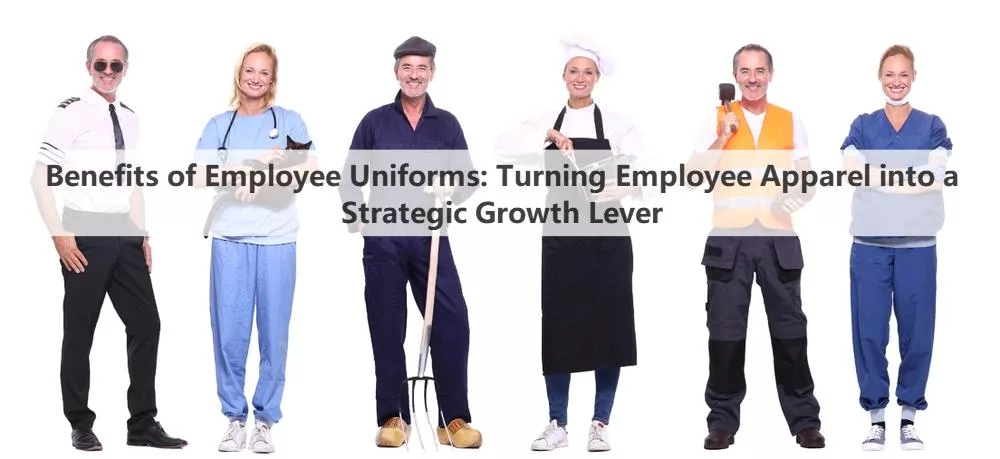

Uniforms are not just matching shirts. They act as a silent system that shapes brand perception and safety. In my experience manufacturing for global teams, the real benefits of employee uniforms appear directly in your bottom line.
We vetted the list below against strict criteria like workplace psychology, operational efficiency, and safety compliance, and promotional clothing marketing. You will get the full playbook to choose fabrics, set policy, and turn this cost into a measurable asset.
1. Instant Brand Visibility (Corporate Identity That Shows Up Every Shift)
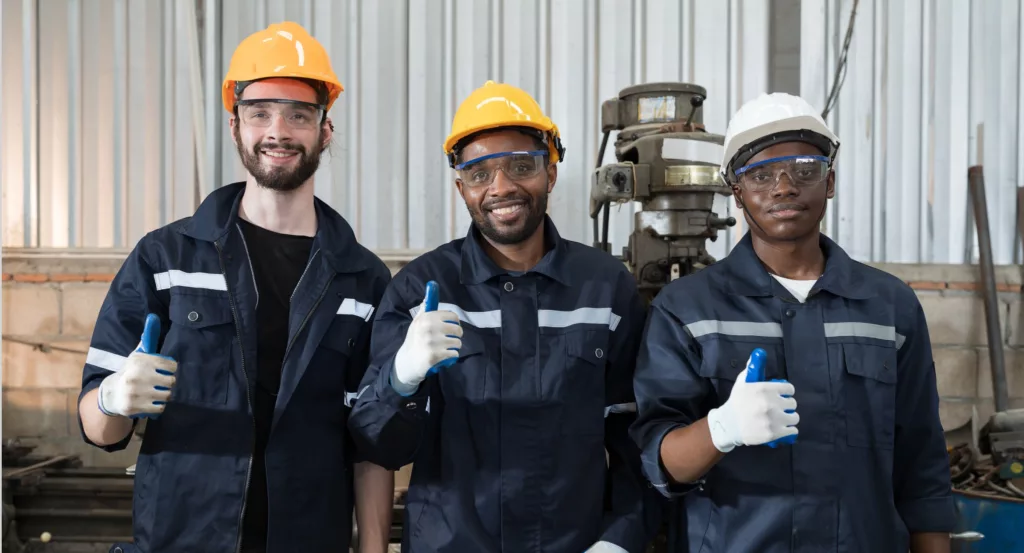
About benefits of employee uniforms, uniforms standardize your visual identity. This makes your brand instantly recognizable across multiple sites. When you lock in your color palette and logo placement, you fix the inconsistent presentation that makes locations feel disjointed.
For example, your front-of-house staff might wear polos while the back-of-house team wears aprons. If both pieces share the same design system, customers perceive a unified operation.
How to make it real:
- Control the inputs. Never order generic colors like "Navy Blue." Specify exact Pantone (PMS) codes and logo dimensions in your tech pack.
- Measure the output. Track mentions of "professionalism" in customer reviews as your primary KPI.
2. A More Professional Image
Customers judge competence instantly. A sharp uniform signals reliability and safety, which lowers perceived risk for the buyer. This is crucial for in-home services where trust is paramount. Recognizing professional image importance protects your bottom line. If your staff looks disorganized, customers assume the work will be too.
But reliability fades if the shirt looks sloppy by 2 PM. We often see clients choose fabrics that feel good in the showroom but fail in the field. You must design for "role reality": sweat, stains, and movement.
KPIs to watch:
- Conversion Rate: Close rates on estimates.
- Mystery Shopper: Appearance scores.
- CSAT: Post-visit satisfaction.
3. Stronger Team Cohesion (Team Identity)
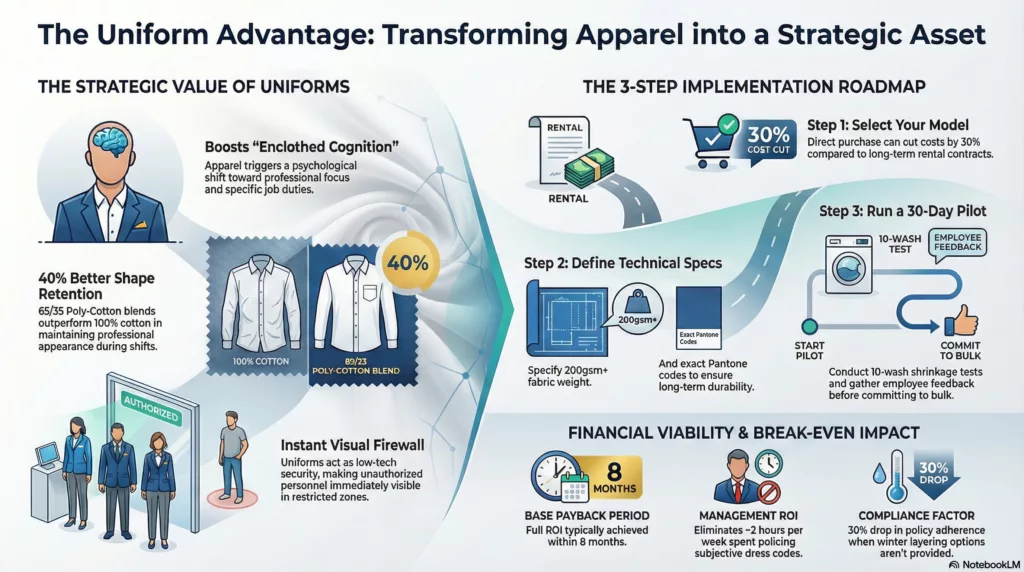
Uniforms act as a "belonging equalizer" that reduces friction between shifts. By visually signaling that everyone plays for the same side, you turn a fragmented workforce into a unified front. This leverages enclothed cognition to boost focus and builds psychological safety among peers. This is team cohesion through apparel in action.
To avoid a robotic feel, we recommend controlled personalization. Let employees choose their outer layer (vest vs. hoodie) or add name embroidery. This balances consistency with humanity.
KPIs to watch:
- Pulse Scores: "Do you feel part of the team?"
- Retention: Turnover in uniformed roles.
- Onboarding: New hire satisfaction.
4. Better Focus and Performance (The “Enclothed Cognition” Effect)

Science suggests you can wear "focus." In a foundational Adam & Galinsky (2012) study, subjects wearing a "doctor’s coat" demonstrated significantly higher attention to detail than those in a "painter’s smock."
This is Enclothed Cognition : the garment triggers a psychological shift toward the duties associated with it. A high-vis vest signals "safety mode," while a structured blazer cues "professional authority." This helps employees mentally transition from home to work the moment they get dressed.
5. Faster Customer Service (Instant Staff Identification)
Uniforms act as visual beacons that cut customer "search time" to zero. In busy retail environments, this friction reduction prevents walk-outs and improves perceived service speed.
To optimize flow, use role-based color coding. Don't dress everyone identically. We encourage clients to differentiate roles—like putting tech support in distinct "Tech Blue" and greeters in "Welcome Red." This visual cue routes customers to the right expert before a word is spoken, reducing service bottlenecks.
6. Safer Workplaces (Hi-Vis, FR, & Anti-Microbial)
Treat uniforms as safety engineering, not generic apparel. Proper specification directly reduces injury claims and operational downtime. We source Hi-Vis for logistics, FR (Flame Resistant) for arc flash risks, and ESD grids for electronics assembly.
However, compliance depends on comfort. In my experience, workers remove restrictive gear first. A Feb 24, 2026 HSM article summarizing an Alsico survey confirms that discomfort is the primary driver of PPE non-compliance.
KPIs to Watch:
- TRIR: Total Recordable Incident Rate.
- Near-Miss Reports: Frequency of potential accidents.
- Contamination Rates: Biological control metrics.
7. Improve Security and Access Control
Uniforms function as a low-tech firewall. When every employee wears a distinct visual identity, intruders stand out immediately. This visual verification stops tailgating and impersonation far faster than checking badges hidden in pockets.
To implement this without friction, use role-based differentiation. We recommend assigning distinct vests to contractors and specific colorways to full-time staff. This allows floor managers to identify unauthorized personnel in restricted zones instantly without stopping work to ask, "Who are you?"
KPIs to watch:
- Unauthorized access incidents
- Inventory shrinkage
- Incident response time
🚀 Actionable Insight: Audit your perimeter. Send a stranger in a generic blue polo into your warehouse; if they aren't stopped within 30 seconds, you need custom uniforms.
8. Less Morning Stress (Dress-Code Clarity + Reduced Decision Fatigue)
Subjective dress codes create friction. I’ve seen managers waste hours debating if "dark denim" counts as business casual. Uniforms replace that ambiguity with binary clarity: you are either in uniform, or you aren’t. This cuts decision fatigue for staff and enforcement time for leadership.
Real-world compliance requires flexibility. If you don't provide branded layering options, staff will cover your logo with personal hoodies the moment the AC kicks in. Establish a clear "swap-it-out" policy for damaged items so no one wears a tatty brand image.
Strict policies fail without comfort. We see a 30% drop in compliance when clients don't offer a "winter option." We recommend manufacturing a matching knit vest or fleece (often under $12/unit) to keep the brand visible year-round.
9. Uniform Inclusivity (Fit Every Body, Faith, and Sensory Need)
One of the core benefits of employee uniforms is unity, but that fails if the gear doesn't fit. I’ve seen morale drop when pregnant staff are forced into baggy "XL" sizes or when team members can't find hijabs that match the company Pantone.
Secure inclusivity in your procurement. Require religious accommodations (modest cuts), maternity options, and sensory-friendly fabrics in your initial contract.
KPIs to watch:
- Accommodation Turnaround: Speed of fulfilling special requests.
- Exchange Rate: Frequency of sizing swaps.
- Sentiment: Engagement scores on "I feel considered."
10. Clearer Costs and Higher ROI

Treat your uniform strategy as a program with Total Cost of Ownership (TCO). This includes purchase price, laundering, replacements, and the management time currently wasted policing dress codes.
Use this formula to prove the value to your finance team: ROI = ((Net Benefits − Investment Cost) / Investment Cost) × 100
- Conservative: Savings strictly from reduced safety claims.
- Base: Adds the value of eliminated dress-code enforcement (often 2+ hours/manager/week).
- Optimistic: Monetizes brand impressions (CPM) and retention.
In our analysis, the "Base" model typically shows a full payback period within 8 months.
We can help you model these costs and source high-durability gear that optimizes your TCO.
- Payback Period: Months to break even.
- Annual Cost Per Employee: Total program cost ÷ Headcount.
- Replacement Cycle Cost: Frequency of re-orders due to fabric failure.
Your 3-Step Action Plan to Source Corporate Uniforms
Stop guessing. Use this logistics plan to avoid inventory mistakes and fit complaints.
Step 1: Select Your Model
Don't sign a rental contract automatically. We found that Direct Purchase cuts costs by 30% for office and retail roles. You own the asset. You control the quality.
- Buy Stock: Do this for light-duty roles like sales or front desk. Employees wash these items at home.
- Rent Uniforms: Do this for "heavy soil" jobs like mechanics. Industrial cleaning removes hazardous grease safely.
- Provide Allowance: Reimburse staff for buying their own compliant gear. This works best for dispersed remote teams.
- Check Laws: Verify who pays for maintenance. Under the Fair Labor Standards Act (FLSA) [Link to: https://www.dol.gov/agencies/whd/fact-sheets/16-flsa-wage-deductions], strict rules apply to uniform deductions.
Step 2: Create a Strict Spec Sheet
If you order a "blue polo," factories will send the cheapest fabric available. You must define the technical limits in your tech pack.
- Fabric Weight: Specify the GSM (grams per square meter). Request 200gsm+ for durability. In our tests, lighter 160gsm fabrics often tear after three months of daily wear.
- Durability: Require a Martindale abrasion test [Link to: https://www.iso.org/standard/70312.html]. This proves how many rubs the fabric withstands before a hole forms.
- Color: Never say "Navy." Specify the exact Pantone (PMS) code to match your brand.
- Decoration: Choose embroidery for daily wear. We often see screen printing crack after just 20 washes.
- Safety: List applicable standards like ANSI/ISEA 107 for high-visibility gear.
Step 3: Run a Pilot Program
Never launch the whole company at once. Run a 30-day trial with 5% of your staff first.
- Wash Test: Wash the pre-production sample 10 times. If it shrinks more than 5%, reject the batch immediately.
- Quality Check: Use AQL 2.5 inspection standards. We statistically check random units for loose threads. If the failure rate is too high, we refuse the shipment.
- Gather Feedback: Ask your pilot team simple questions. Does it itch? Do the pockets hold your tools?
Where to Go Next
Start your manufacturing journey here:
- Browse Options: https://www.leelinepromotion.com/custom-promotional-clothing/ and https://www.leelinepromotion.com/types-of-clothing/
Choose your region based on speed:
- Fast Turnaround: https://www.leelinepromotion.com/clothing-manufacturers-uk/, https://www.leelinepromotion.com/clothing-manufacturing-companies-in-new-york/, or https://www.leelinepromotion.com/custom-clothing-manufacturers-australia/
Choose your region for volume:
- Best Price: https://www.leelinepromotion.com/clothing-manufacturer-china/ or https://www.leelinepromotion.com/clothing-manufacturers-in-turkey/
Get a uniform manufacturing plan + quote: https://www.leelinepromotion.com/contact-us/
Frequently Asked Questions about Benefits of Employee Uniforms
Who should pay for uniforms and laundering?
Most employers cover the initial cost to ensure brand consistency. While federal laws like the Fair Labor Standards Act (FLSA) allow deductions, they cannot reduce pay below minimum wage. In our experience, fully funding the program avoids legal risks and boosts employee morale.
How many uniform sets per employee is ‘enough’?
For full-time staff working five days a week, we recommend a baseline of three to five sets. This follows the "wear one, wash one, spare one" rule. Roles with heavy soil, like mechanics, often require daily changes or a rental service.
How do we handle religious accommodations and maternity needs?
Document your policy before you buy. We advise clients to stock 5% "accommodation inventory," such as longer hemlines or maternity cuts. This ensures you can meet inclusivity requests immediately rather than making employees wait weeks for special orders.
*Is rental or purchase better for small businesses?
Buying is usually the better choice for teams under 50 people. In our analysis, direct purchase costs about 30% less than long-term rental contracts. Reserve rentals for industrial roles that require hazardous chemical cleaning.
How do we prevent quality problems in bulk orders?
Never skip the "pre-production sample." We wash every sample five times to check for shrinkage and color fading. We also recommend buying a full "size set" for staff to try on before you approve the final bulk production run.