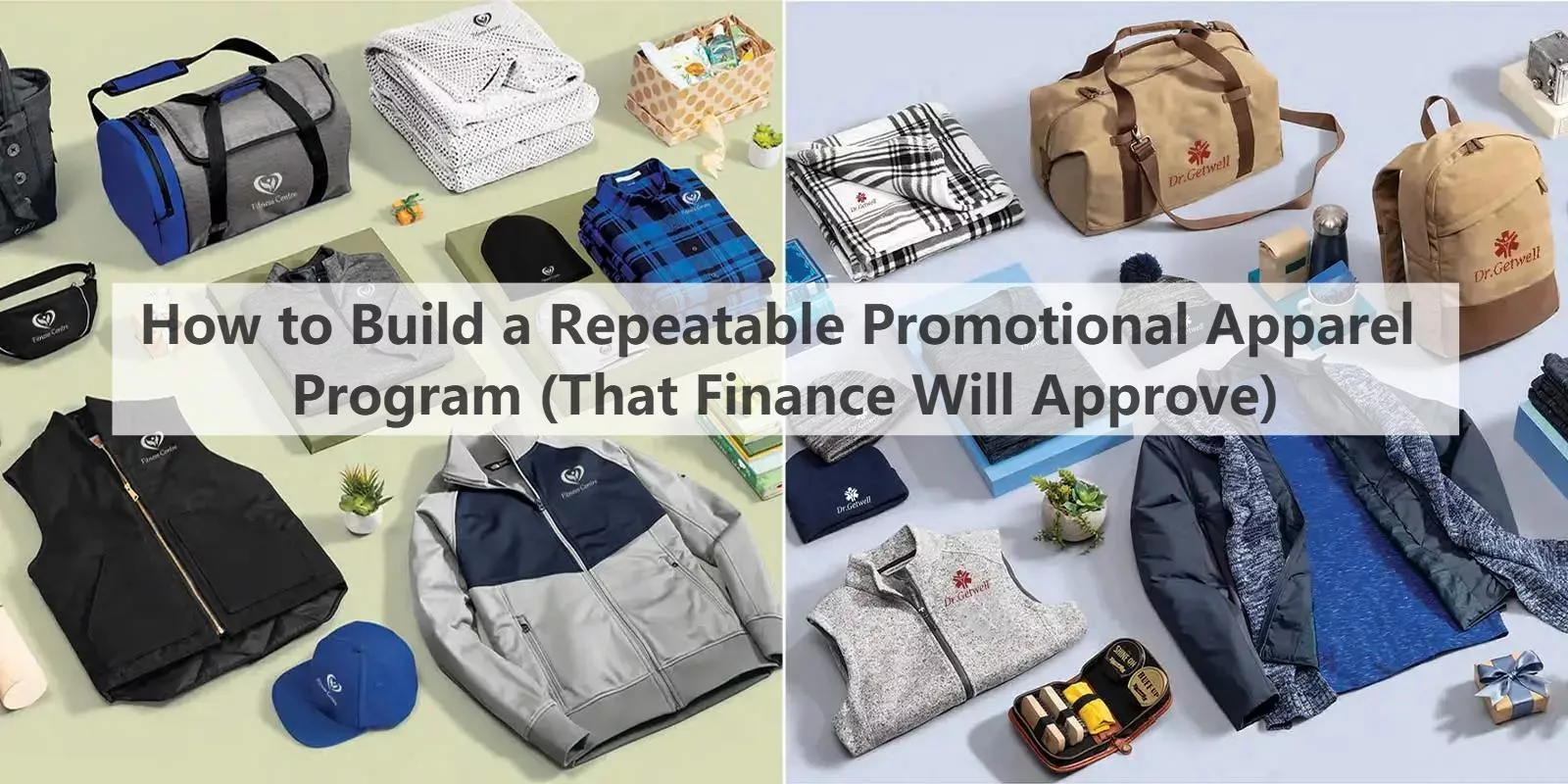

Digital ads vanish in seconds. A high-quality hoodie enters a customer's weekly rotation for years.
Most companies treat branded apparel as a panic purchase. The result is usually ill-fitting swag that ends up in a landfill. In my experience manufacturing for global events, the difference isn't budget. It is the operating system behind the procurement.
You need a repeatable promotional clothing marketing program that satisfies Finance with clear ROI logic and delights recipients. We leverage the PPAI Product Power 2026 framework to align your standards with modern consumer expectations.
Plan to spend 2–4 weeks building this foundation. Start by locking your purpose and success metrics before you look at a catalog.
What You Need Before Manufacturing
In my experience managing global swag programs, 80% of production delays stem from missing assets rather than factory slowness. Gather these items before requesting a quote to prevent costly rework.
- Vector Art Files (.AI, .EPS, .PDF): Raster images (JPG/PNG) pixelate during production. I strictly require vector files to ensure embroidery and screen prints remain crisp.
- Pantone (PMS) Targets: Screen colors drift. Specify exact Coated (C) or Uncoated (U) codes (e.g., PMS 286 C) to guarantee your "Navy" doesn't arrive as "Royal Blue."
- Compliance Guardrails: Verify regulations based on destination. For California, I check Prop 65 lists; for EU shipments, REACH standards. If manufacturing youth sizes, CPSIA documentation is mandatory.
- QC & Sampling Plan: Never rely on digital proofs. Schedule 7–10 days for a physical pre-production sample and enforce an AQL 2.5 inspection standard (max 2.5% minor defects).
- Logistics Profile: Define your "Ship-to" strategy immediately. I found that splitting shipments to individual residential addresses (vs. a single dock drop) increases logistics costs by ~40%.
- Budget Decision Rule: Decide early: do you want fewer premium pieces or high-volume disposable items?
🧠 Expert Take: The*PPAI Product Power 2026 report indicates ~90% of consumers view a brand more favorably after receiving quality products. Once you have these specs ready, browse our custom promotional clothing category page to select your base garments.*
Step 1: Establish the Garment's Primary Purpose
I have seen expensive heavy jackets go completely unworn simply because the recipients lived in a humid region. To avoid waste, you must visualize the specific end-state first.
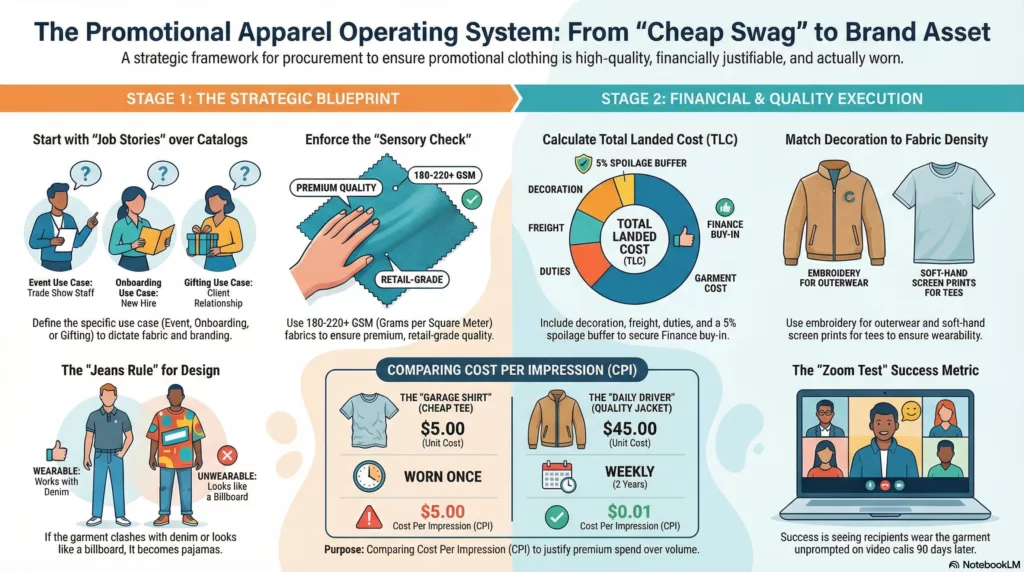
- Select a Primary Use Case Focus on a single goal to dictate your material choice:
- Event Uniform: Prioritize high visibility and breathable fabrics.
- Employee Onboarding: Focus on cultural inclusion and durability.
- Client Gifting: Ensure high perceived value and subtle branding.
- Write a "Job Story" Clarify the ROI for stakeholders using this specific formula:
"When [Situation], I want [Recipient] to feel [Outcome], so that [Business Result]."
Define Context & Behavior Match the fabric to the role. If your team travels, choose wrinkle-resistant blends. If the goal is public wear, keep branding minimal. In my experience, recipients rarely wear giant corporate logos during their personal time.
Set Verification Criteria Success isn't distribution. It is spotting the garment in candid social media photos or seeing staff choose to wear it unprompted on weekends.
🧠 Author's Verdict: Run a "Sensory Check" Pilot. Don't guess the size curve. For diverse teams, I strongly recommend running a 50-unit Print on Demand (POD) pilot to test fit and fabric appeal before committing to a bulk order. This prevents sitting on pallets of XS shirts nobody wants.
Step 2: Calculate Total Landed Cost (TLC) & Define KPIs
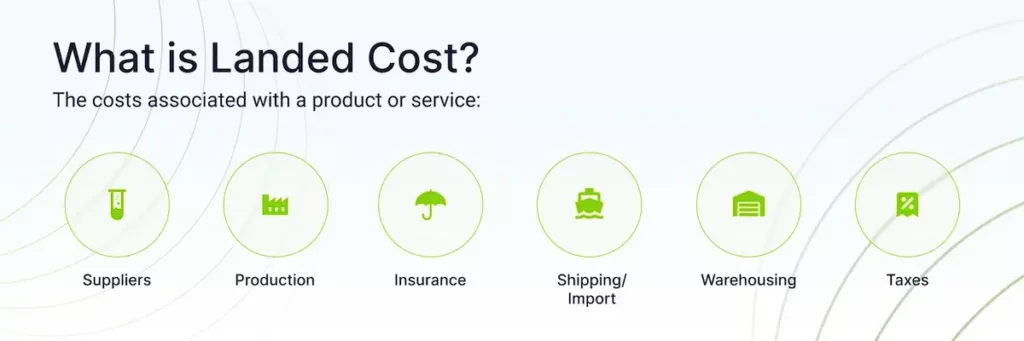
Finance teams often reject "swag" but approve "Customer Acquisition Costs." To secure buy-in, you must calculate the Total Landed Cost (TLC), not just the factory sticker price. I have seen project budgets overrun by 30% simply because a manager ignored customs duties.
1. Build the TLC Formula Open a spreadsheet and sum these specific line items: Product + Decoration + Packaging + Freight + Duties + Last-Mile Shipping
- Add a 5% spoilage buffer for misprints or lost packages.
2. Define Efficiency KPIs Calculate Cost Per Impression (CPI) to justify premium spend over volume:
- The "Garage Shirt": A $5 tee worn once costs $5.00/impression.
- The "Daily Driver": A $45 jacket worn weekly for two years costs $0.01/impression.
3. Draft the One-Slide Case Structure your pitch to Finance using this flow: Why Now (2026 Trends) → What → Who → Distribution → Measurement. Cite the PPAI Product Power 2026 report to prove high-utility items boost brand lift, while cheap items damage perception.
4. Verify the Limit Ensure your model outputs a Max Allowable Cost per unit. If the TLC exceeds your allowable cost-per-lead, adjust your garment choice now.
Step 3: Audit the Fabric Quality (The Sensory Check)
Treat the garment as your media channel and the fabric as the signal quality. You must physically handle "blanks" (unbranded samples) to verify their tactile value before production.
Build a Sensory Test Kit Order samples of your top three choices. Test Hand-Feel and Drape. In my manufacturing projects, I found that anything under 150 GSM (Grams per Square Meter) feels sheer and cheap, while 220+ GSM signals premium "streetwear" quality.
Stress-Test Durability Stretch the collar ribbing hard. If it doesn't snap back instantly, reject it. I have seen loose collars make a team look sloppy after just two wears.
Compare 2026 Staple Materials
- Tencel™/Lyocell: Offers extreme softness and drape, though care is delicate.
- Recycled rPET: Great for sustainability claims. I recommend Cotton-rPET blends to avoid the heat-trap effect of pure polyester.
- Combed Ring-Spun Cotton: Always specify this over Carded Cotton to prevent pilling (fuzz balls).
- Align Hero Items to Use Cases
- Events: Use breathable Bulk Blanks (150–180 GSM) for easy staff identification.
- HR Retention: Source Retail-Grade hoodies (e.g., heavy French Terry) to ensure they are actually worn.
- Client Gifting: Opt for Co-Branding (e.g., Patagonia, Nike) where allowed for maximum perceived value.
Step 4: Match Decoration to Fabric Density
A heavy print on a lightweight tee creates a "plastic shield" effect that ruins wearability. You must align the decoration method with the garment's specific weight and texture.
1. Consult the Sensory Decision Matrix Use this guide to predict how the logo will feel against the skin and survive washing.
| Method | Best For | Sensory Profile & Durability |
|---|---|---|
| Embroidery | Polos, Caps, Outerwear | Raised Stitch. Adds weight and value. Indestructible, but puckers on thin fabrics. |
| Screen Print | Cotton Tees, Hoodies | Soft Hand. Ink merges with fibers. Breathable; fades to a vintage look over time. |
| DTF Transfer | Synthetics, Gradients | Rubberized Patch. Sits on top of fabric. High detail, but peels if dried on high heat. |
| Woven Label | Hems, Sleeves | Fabric Feel. Zero ink texture. Subtle branding that outlasts the garment. |
2. Enforce Placement Dimensions Limit left-chest logos to 3.5–4 inches wide. This signals "premium gift" rather than "billboard." Reserve full-back prints strictly for high-visibility staff uniforms.
3. Standardize Tech Pack Labels Avoid ambiguous descriptions like "the green logo." Explicitly name the location and file in your tech pack: Placement: Left Chest / File: Logo_White_Vector.ai.
4. Execute the "Bacon Neck" Test ⚠️ Warning: Decoration shrinks differently than fabric. Run a physical sample through 5 wash/dry cycles. If the collar ripples ("bacon neck") or transfer edges lift, the tension is wrong. Consult the FTC Care Labeling Rule to ensure your care tags remain compliant after modification.
🧠 Author's Verdict: The "Soft-Hand" Requirement For large chest prints, I always explicitly request Soft-Hand Additives or Discharge Ink in the manufacturing contract. Without this, standard plastisol ink creates a non-breathable sweat patch, ensuring the shirt is retired to "pajama duty" immediately.
Step 5: Design the Aesthetic for Real-World Wearability
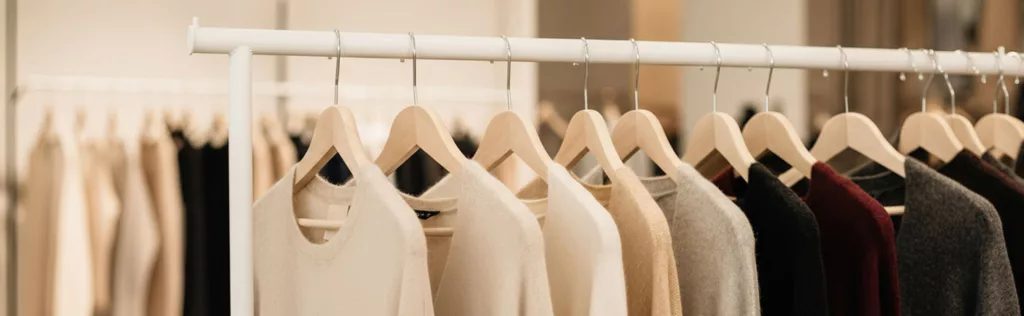
To ensure your investment actually gets worn, you must prioritize retail aesthetics over loud branding.
1. Execute the "Jeans Rule" Hold the physical fabric swatch against medium-wash denim under natural sunlight, not just conference hall fluorescents. In my experience, if the garment clashes with jeans, users relegate it to pajama duty immediately.
2. Apply 2026 Design Cues Select modern neutrals (Stone, Sage, Navy) as your base. Use a "campaign color" (like Teal) strictly for accents.
- Texture: Request tone-on-tone embroidery (thread one shade lighter than the fabric).
- Contrast: Convert multi-color logos to single-color White or Black.
3. Verify the Production Proof Check the digital proof for exact placement. Ensure the chest logo width stays under 3.5 inches. If you are unsure if the fabric can hold the stitch count, review the specific apparel manufacturing methods first.
Step 6: Execute the Manufacturing & Sampling Loop
Design is theory; production is reality. In my supply chain audits, I found that 80% of errors stem from ambiguous instructions, not factory incompetence.
1. Select Your Manufacturing Route Align the vendor with your deadline and margin goals.
- Strategic Bulk: For the best unit economics on 500+ units, source via a clothing manufacturer China. Allow 30–45 days for production.
- Rush Pilot: If you need goods in under two weeks, use clothing manufacturing companies in New York. You pay a premium for domestic speed and oversight.
2. Submit a "Tech Pack-Lite" Never just email a logo file. Send a single PDF defining:
- Fabric Spec: Composition and weight (e.g., 100% Cotton, 180 GSM).
- Placement: Exact measurements (e.g., "Center logo 3 inches down from collar seam").
- Packaging: Individual polybags versus bulk fold.
3. Run the "Sensory Check" I never approve production based on a digital proof. Demand a physical sample and verify:
- Visual: Look for "haloing" (fuzzy ink edges) or off-center neck labels.
- Fit & Wash: Measure dimensions against your tolerance chart. Wash the sample three times; if the print cracks or seams twist, reject it.
4. Verify Compliance If you claim sustainability, prove it. Demand valid OEKO-TEX or GRS certificates to avoid greenwashing liability.
Step 7: Engineer the Distribution & Logistics Workflow
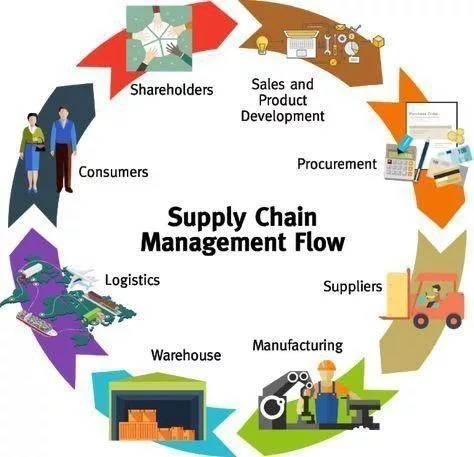
The unboxing moment—crisp folds and quality packaging—defines perceived value. However, on-site reality is often chaotic. You must bridge the gap between premium presentation and rugged logistics.
- Select your distribution model.
- Events: Segregate inventory. Lock away premium staff uniforms and keep general giveaways accessible.
- HR Onboarding: Never guess sizes. Use a digital form to collect data, then drop-ship kits directly to remote employees.
- Client Gifting: Use a custom promotional clothing partner to handle kitting. Bundling a shirt with a notebook creates a "gift" experience rather than a "marketing handout."
Calculate the "Exchange Buffer." Add a 15% inventory buffer weighted heavily toward L and XL. In my experience, telling a VIP you are out of their size destroys brand equity instantly. Label every box on all four sides for rapid sorting.
Verify Venue Receiving Rules. Confirm the Marshalling Yard schedule. Union docks frequently reject unplanned deliveries. Book your dock appointment at least 48 hours in advance.
Step 8: Measure Organic Engagement
Distribution volume is irrelevant if the items end up in a landfill. You must shift your primary KPI to retention.
- Define audit windows. Schedule a "Buzz Check" at 2 weeks (social tags) and a "Retention Check" at 60–90 days.
- Track active signals. Monitor Opt-in Rates and Repeat Sightings. In my experience, if an employee asks for a spare for their spouse, the campaign is a success.
- Link to digital. Print a QR Code on the care label. Link this to your brand story and track scans as a proxy for engagement.
- Verify sustainability. Archive GOTS or GRS certificates immediately. Use these to defend premium unit costs.
- Produce the report. Summarize Total Landed Cost against these outcomes in a one-page document.
🚀 Actionable Insight: Ready for gear that passes the "Zoom Test"?Request a manufacturing plan from LeelinePromotion. We specialize in retail-quality merchandise that earns organic engagement.
Troubleshooting Common Failures
In my experience managing supply chains, 90% of apparel disasters are predictable logistical errors. Use this rescue plan to salvage your campaign when production goes wrong.
- Problem: Shipment missed the event deadline.
- Likely Cause: Customs holds or optimistic freight estimates.
- The Fix: Immediately trigger a domestic rush order for 10% of the stock to cover VIPs. Hand out "IOU" cards to other attendees.
- Prevention: Build a strict 10-day buffer into your critical path.
- Problem: Employees complain sizes fit "too small."
- Likely Cause: You ordered "Asian Standard" sizing for a Western audience.
- The Fix: Open an exchange window immediately.
- Prevention: Never trust the label. Order a full size run (XS–3XL) of samples to verify the cut before bulk production.
- Problem: Logo color is off or crooked.
- Likely Cause: Approving digital PDFs instead of physical proofs.
- The Fix: For minor shade variance, negotiate a discount. For major errors, demand a reprint.
- Prevention: Mandate Pantone (PMS) matching and require a photo of the "first off the line" unit.
- Problem: Print cracks or peels.
- Likely Cause: Using heavy Plastisol ink on stretch performance fabric.
- The Fix: Switch to water-based or silicone inks for future runs.
- Prevention: Perform a "Stretch Test." If the dried ink cracks when you pull the fabric, reject the batch.
- Problem: Sustainability claims get questioned.
- Likely Cause: Marketing claimed "eco-friendly" without proof.
- The Fix: Contact the factory for Transaction Certificates (TC) immediately.
- Prevention: Require Global Recycled Standard (GRS) documentation attached to every Purchase Order.
- Problem: Recipients throw the item away.
- Likely Cause: "Billboarding"—the logo is too large or the fabric is scratchy.
- The Fix: Pivot to subtle branding (like hem tags) on the next run.
- Prevention: Use the "Grocery Store Rule." Ask yourself: Would I wear this to the store on a Saturday?
- POD / Local Rush: 3–14 Days (High cost, low customization).
- Domestic Decoration: 2–4 Weeks (Medium cost, standard blanks).
- Overseas Bulk: 8–12+ Weeks (Lowest cost, freight dependent).
Conclusion
Building a promotional apparel program that generates ROI requires more than just picking a color from a catalog. It requires an operating system: define the purpose, audit the fabric, match the decoration method, secure compliance, and engineer the logistics.
If you treat this process as a supply chain operation rather than a shopping trip, you shift the outcome from "expensive trash" to "retained brand asset."
To move forward, simply copy and paste this checklist to your vendor:
Vendor Request Spec:
- Item: [e.g., Heavyweight Hoodie, 350 GSM]
- Quantity: [e.g., 500 units]
- Size Breakdown: [e.g., 100 S / 150 M / 150 L / 100 XL]
- Fabric: [e.g., 80/20 Cotton-Poly Blend, Ring-Spun]
- Decoration: [e.g., Embroidery, Left Chest, Max 3.5" Width]
- File: [Attached Vector .AI file]
- Timeline: In-hands date of [Date] at [Address]
- Compliance: Must meet [Prop 65 / REACH] standards.
For immediate options, browse our custom promotional clothing collection. If you need deeper technical details on specific print methods, review our guide on apparel manufacturing methods.
The Verdict: Stop buying cheap shirts that shrink. The goal is fewer, better garments that actually get worn.
Contact LeelinePromotion today to build a manufacturing plan that delivers retail-quality apparel at wholesale efficiency.
Frequently Asked Questions about Promotional Clothing Marketing
Is it cheaper to buy blanks and print locally or source fully finished from China?
It depends entirely on your timeline and volume. In my experience, if you have 45+ days and need 500+ units, manufacturing fully finished goods from a clothing manufacturer in China saves 30–50% on unit cost. However, if you need 50 shirts in two weeks for a trade show, the air freight and rush fees from overseas destroy those savings.
For tight deadlines, I always recommend buying domestic blanks and using a local decorator.
How do I prevent "Asian Sizing" from ruining my order?
Never rely on a generic size chart. "Large" in Shanghai is often "Small" in Chicago. When we manage manufacturing, I require the factory to follow a "Golden Sample" approach. We send them a standard US-sized tee (like a Hanes or Bella+Canvas) and instruct them to clone those exact dimensions.
If you cannot do this, explicitly order one size up for the entire run or request a physical size set before bulk production starts.
What is the best fabric for longevity?
Based on our wash tests, Combed Ring-Spun Cotton or a Tri-Blend (Cotton/Poly/Rayon) withstands the most cycles without pilling. Avoid standard "Carded Cotton" or cheap 100% Polyester unless it is specifically engineered for performance (wicking). I have found that standard polyester retains odors and feels cheap, ensuring the garment ends up in the trash after one wear.
Can I get a physical sample before committing to a bulk order?
Yes, and you should never proceed without one. Most suppliers charge a sampling fee (often $50–$150), which is usually refundable upon placing the bulk order. In my opinion, this is the best insurance money you can spend. I once caught a logo placement error on a pre-production sample that would have ruined a $20,000 order had we skipped this step.
What are the hidden costs in manufacturing promotional apparel?
Beyond the unit price, you must factor in Setup Fees (screens or digitizing), Pantone Matching fees, DDP (Delivery Duty Paid) shipping, and internal distribution costs. Many buyers forget that shipping 500 hoodies to individual remote employees costs significantly more than shipping one pallet to an office. Always calculate the Total Landed Cost before approving the budget.