

Two t-shirts both list "100% cotton" on the tag. One feels crisp and substantial, while the other feels flimsy. The fiber composition is identical, but the structural density is not.
This discrepancy comes down to a specific metric. If you need to know what is gsm in fabric, the technical definition is simple: Grams per Square Meter. It is the global standard for measuring the mass of a textile per unit of area.
However, a higher number does not automatically signal higher quality. A heavy 400 GSM hoodie serves a different functional purpose than a lightweight 130 GSM summer tee. For fashion students, sewists, and procurement officers ordering promotional apparel in bulk, understanding this distinction is critical. You cannot touch a product image on a screen.
Consequently, GSM becomes the only objective specification available to predict drape, warmth, and opacity before a purchase is made.
Ignoring these metrics often leads to costly manufacturing errors. We analyze how to interpret weight categories, convert measurements, and validate manufacturer claims to help you secure the correct materials. Whether you are comparing apparel fabric types or vetting a factory sample, spec literacy is your first line of defense.
What is GSM in Fabric?
GSM stands for grams per square meter (g/m²). It is the universal metric used to measure the mass (weight) of a fabric per unit of surface area.
To visualize this, use a simple mental model: If you cut a square of fabric exactly 1 meter long by 1 meter wide and weigh it on a digital scale, the result in grams is the GSM.
For B2B buyers and designers, this number is critical. It allows you to gauge the density and substance of a material remotely—vital when reviewing tech packs or manufacturing from overseas suppliers—without needing to physically touch the roll.
Mass vs. Bulk: The Common Confusion
While GSM provides a precise weight, it does not strictly dictate thickness. Two fabrics can share the exact same GSM yet behave differently based on their structure.
- GSM vs. Thickness: A 300 GSM denim is thin and dense. A 300 GSM fleece is thick and fluffy because it has high "loft" (air trapped between fibers).
- GSM vs. Warmth: Weight often correlates with warmth, but fiber type matters more. A 200 GSM wool sweater insulates better than a 200 GSM cotton shirt due to wool’s thermal properties.
Understanding these distinctions is essential when selecting specific apparel fabric types for different seasons or drapes.
Industry Standards (E-E-A-T)
In professional supply chains, GSM is not a guess; it is a tested value. To ensure consistency across apparel manufacturing methods, factories verify mass per unit area using specific international standards:
- ISO 3801: The standard for determining mass per unit area in woven fabrics.
- ASTM D3776: The standard test method for mass per unit area (weight) of fabric. You can view the scope of ASTM D3776 here to see how weight is validated in North American markets.
GSM at a Glance
- Lightweight (30–150 GSM): Chiffon, linen, basic t-shirts.
- Midweight (150–350 GSM): Velvet, sateen, standard hoodies.
- Heavyweight (350+ GSM): Upholstery, heavy denim, thick fleece.
💡 Key Insight: GSM measures weight, not quality. A low GSM silk can be premium, while a high GSM polyester can be cheap. Always use GSM to determine*suitability for the product's function, rather than its value.*
3. Core Concepts: Measuring and Interpreting Weight
What is gsm in fabric? Turning the abstract concept of GSM into an actionable manufacturing skill requires understanding the mechanisms of measurement, calculation, and conversion. You cannot simply look at a spec sheet; you must deconstruct the data to verify if the fabric matches the intended application.
Think of GSM as the "chassis weight" of the fabric. Just as a heavier chassis implies a truck meant for hauling, a higher GSM implies a fabric meant for structure and durability. However, without looking under the hood at density and finishing, weight alone does not guarantee performance.
3.1 Fabric Weight Guide: Lightweight vs. Heavyweight
To bridge the gap between a number on a spreadsheet and the physical garment, industry standards categorize fabrics into three primary weight classes. These ranges help buyers categorize inventory and manage customer expectations regarding drape and hand feel.
| Weight Class | Range (GSM) | Typical Applications | Hand Feel & Characteristics |
|---|---|---|---|
| Lightweight | 80–150 | Linings, summer voile, sheer blouses, performance mesh. | Airy, fluid, translucent. Often requires layering; lacks structural rigidity. |
| Midweight | 150–250 | Standard t-shirts, jersey dresses, chinos, poplin shirts. | Versatile, opaque, structured. Balances breathability with durability; the standard for daily wear. |
| Heavyweight | 250–400+ | Hoodies, denim, canvas, outerwear shells, upholstery. | Dense, stiff, protective. Holds shape firmly; provides thermal insulation and abrasion resistance. |
For a deeper technical breakdown of how these weights interact with different weaves, review the classification standards used by textile engineering resources like Textile School’s guide to fabric properties.
3.2 Real-World Benchmarks
When manufacturing custom promotional clothing, context is everything. A "heavy" t-shirt and a "heavy" hoodie operate on completely different scales. Use these physical anchors to calibrate your expectations:
- Summer Base Layer (120–150 GSM): Think of a vintage, burnout style band tee. It feels barely there.
- Standard Cotton T-Shirt (160–180 GSM): The industry standard "Gildan-style" weight. Opaque but breathable.
- Premium Streetwear Tee (200–260 GSM): Boxy, stiff, and thick. This is the current trend for high-end merchandise.
- French Terry / Sweatshirt (250–350 GSM): Loop-back fabric used for light pullovers.
- Hoodie Fleece (300–450 GSM): Heavy winter gear. Anything under 300 GSM in this category will feel "cheap" to the end user.
💡 Promo Product Insight: In the promotional world,canvas tote bags are a frequent point of confusion. While apparel uses GSM, bags are often discussed in ounces (e.g., a "6oz tote"). A standard 6oz canvas tote converts to approximately 200 GSM. To source a truly durable "grocery quality" bag, you should aim for 10oz (approx. 340 GSM) or higher.
3.3 How to Calculate GSM
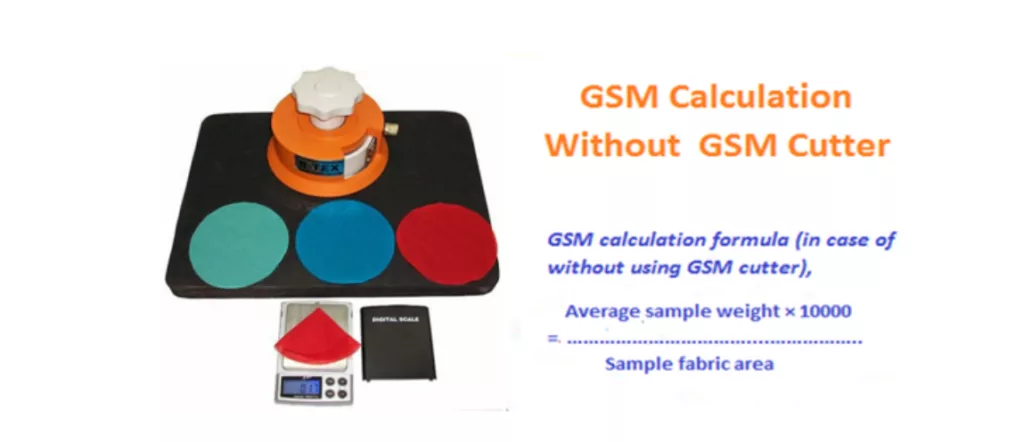
You should never blindly trust a factory's stated GSM without verification. There are two primary ways to validate weight: the precise lab method and the approximate home method.
Method A: The Home Method (No Special Tools)
If you have a sample yardage and a standard kitchen scale, use this formula.
- Cut: Cut a perfect square sample, exactly 10 cm × 10 cm.
- Calculate Area: 0.1 m × 0.1 m = 0.01 m².
- Weigh: Place the sample on a precision scale to get the weight in grams (e.g., 1.8g).
- Compute: Divide weight by area: 1.8g ÷ 0.01 m² = 180.
- Shortcut: Multiply the 10x10cm sample weight by 100.
Method B: The Factory Method (The GSM Cutter)
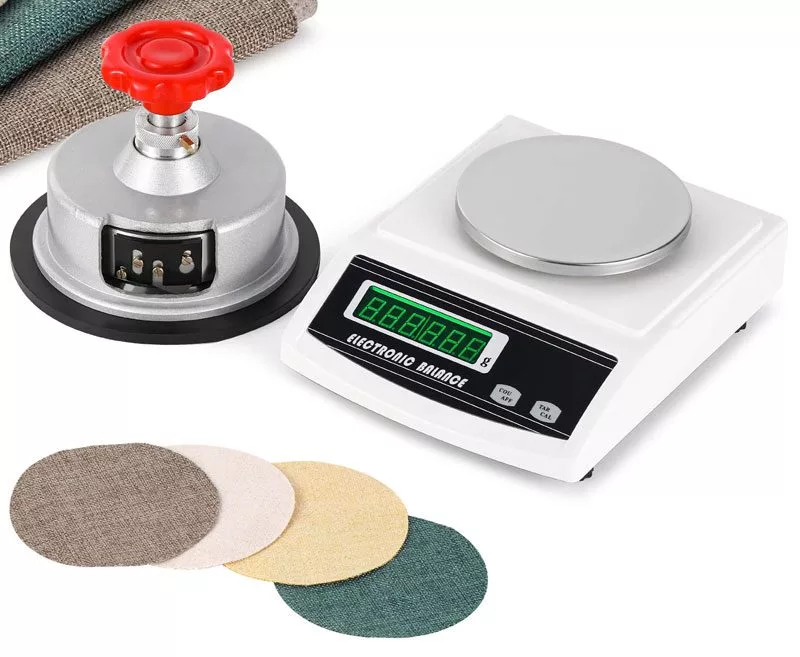
Professional QC environments use a circular GSM Cutter. This tool uses internal blades to cut a circle with an area of exactly 100 cm². The cut sample is placed on a calibrated balance, and the resulting weight is multiplied by 100 to get the GSM instantly.
Measurement Accuracy Checklist:
- Conditioning: Fabric absorbs moisture. Weigh samples in a dry, humidity-controlled environment for accuracy.
- Location: Never cut from the selvage (edge) of the roll; take samples from the middle.
- Avoid Construction: If measuring a finished garment, cut away from seams, hems, or prints, as thread and ink add mass.
See how professional testing labs perform this using standard equipment described in ISO 3801 standards.
3.4 GSM vs. Oz/yd²: The Conversion
North American suppliers often use ounces per square yard (oz/yd²), while the rest of the world uses GSM. Manufacturing errors frequently occur when buyers confuse the two (e.g., thinking a "6 oz" fabric is 60 GSM, which would be incredibly sheer).
The Magic Number: 33.906
- To convert oz/yd² to GSM: Multiply by 33.906.
- Example: 6 oz × 33.906 = 203 GSM.
- To convert GSM to oz/yd²: Divide by 33.906.
- Example: 300 GSM ÷ 33.906 = 8.8 oz.
Downloadable Asset: We have prepared a Fabric Weight Quick Chart (PDF) covering common conversions (100–400 GSM) to keep on your desk during supplier negotiations.
3.5 Textile Density: Why Weight Isn't Texture
A common misconception is that GSM equals stiffness. This is false. A 200 GSM Jersey knit (t-shirt fabric) will feel floppy and drape over the hand, while a 200 GSM Piqué holds more body — see our piqué vs. jersey breakdown. A 200 GSM Canvas (woven fabric) will stand up straight.
This difference is caused by density.
- Wovens pack fibers tightly in a grid, creating high structure at lower weights.
- Knits loop fibers together, creating air gaps and stretch, which results in a heavier feel for the same surface area.
- Fiber Gravity: Rayon is denser than cotton. A rayon shirt will have a higher GSM than a cotton shirt of the same thickness, giving it that heavy, "slinky" drape.
3.6 Manufacturing & QC: Tolerances and "Grey Goods"
When creating a spec sheet for apparel manufacturing methods, precise language protects your investment.
Tolerance Guidance
Textile production is not molecular science; it involves natural variations. Suppliers work to a target GSM.
- Standard Tolerance: ±3% to ±5%.
- The Trap: If you order 180 GSM fabric, a factory may deliver 172 GSM, claiming it is "within tolerance." If 180 is your minimum requirement, specify "180 GSM Minimum" rather than "180 GSM Target."
Coatings and Finishing
Be wary of the difference between Base Weight (Grey Goods) and Finished Weight.
- ⚙️ Under the Hood: A factory might quote a waterproof jacket as "300 GSM." This could mean a 200 GSM base fabric with 100 GSM of heavy PVC coating. The fabric itself is thin; the chemical coating provides the weight. Always ask: "Is this weight pre-coating or post-coating?"
Denier vs. GSM
While GSM measures fabric area, Denier (D) measures the weight of the fiber itself. You will see this in bags and outerwear (e.g., "600D Polyester").
- Rule of Thumb: Use Denier for synthetic durability (luggage, nylon shells). Use GSM for cotton/blends and hand feel (apparel).
- For technical specifications on fiber mass, refer to ASTM D1907.
3.7 Fabric Type Reference Chart
To visualize how GSM correlates with different apparel fabric types, use the reference table below.
| Fabric Type | Common GSM | Primary End Use | "Hand Feel" Descriptor |
|---|---|---|---|
| Chiffon / Organza | 20–50 | Overlays, evening wear | Sheer, floating, delicate |
| Poplin | 100–130 | Button-down shirts | Crisp, paper-like, cool |
| Single Jersey | 140–180 | Standard T-shirts | Soft, stretchy, fluid |
| Interlock Knit | 200–250 | Premium Polos, Dresses | Smooth, double-sided, dense |
| Twill / Chino | 220–280 | Pants, lightweight jackets | Structured, durable diagonal weave |
| Fleece / French Terry | 280–400 | Hoodies, sweatpants | Lofty, warm, spongey |
| Denim | 350–500+ | Jeans, Jackets | Heavy, rigid (unless elastane added) |
For a broader look at garment categories, explore our guide on types of clothing to match these fabrics to their final forms.
Frame GSM as a Decision Tool (Not a Magic Quality Badge)
Understanding what is GSM in fabric transforms how you source materials. It is the only reliable metric to forecast hand feel, performance, and opacity without physically touching the textile.
By treating GSM as a predictive data point rather than a generic "quality score," you gain control over the financial and functional outcome of your production.
1. Eliminates Design Guesswork
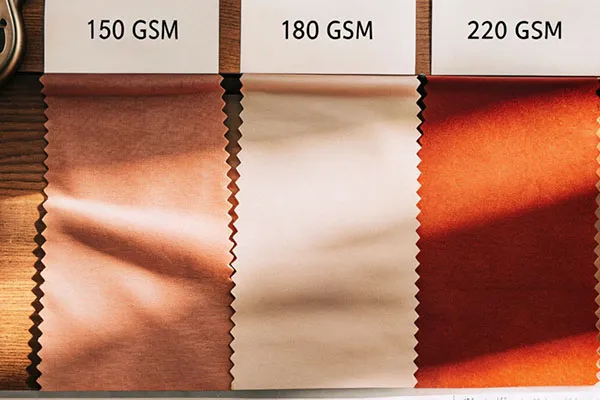
GSM acts as a numerical proxy for drape (flow) and structure (shape retention). A 300 GSM fabric resists gravity and holds rigid lines, whereas a 100 GSM fabric clings and flows.
- The Payoff: This metric prevents structural collapse in garment construction. It ensures the fabric's body matches the pattern's engineering, allowing for safe material substitutions when stock is low.
2. Reveals True Price-to-Value
GSM provides an objective baseline to compare "value per wear," stripping away brand marketing.
- The Payoff: It protects margins. If a supplier charges a premium for a "luxury" tee that clocks in at a sheer 110 GSM, the metric reveals the markup is for branding, not fiber density. Higher density directly correlates with opacity and pill resistance.
3. Standardizes Manufacturing Communication
In bulk manufacturing, subjective adjectives like "heavy" cause costly production errors. GSM is absolute.
- The Payoff: Specifying "180 GSM ±5%" creates a contractual standard. This precision prevents factory material substitutions and ensures custom promotional clothing orders pass Quality Control (QC) before shipping.
4. Optimizes the Durability Tradeoff
Heavier isn't automatically sustainable, but it often dictates the replacement cycle.
- The Payoff: This enables "Fit for Purpose" buying. While lightweight fabrics save raw materials upfront, workwear sourced through custom clothing manufacturers in Australia requires higher GSM to survive industrial washing.
- Proof: According to WRAP, extending the active life of a garment by just nine months reduces its carbon, water, and waste footprints by 20–30%.
📉 Authority Check: Technical Standards
Professional tech packs use international standards to validate weight claims. Familiarize yourself with these citations:
- ISO 3801: Determination of mass per unit length/area.
- ASTM D3776: Standard Test Methods for Mass Per Unit Area of Fabric.
Challenges & Limitations: Why GSM Numbers Can Be Misleading
While GSM is the industry standard for weight, treating it as a definitive proxy for "quality" is a common manufacturing error. Relying solely on this metric without context leads to procurement failures and unexpected costs.
1. GSM Is Not a Quality Score
Marketing often equates "heavyweight" with "premium," but GSM measures mass, not finesse. A 300 GSM fabric can be produced using short-staple, rough yarns that pill after minimal use, while a 120 GSM fabric might use long-staple Egyptian cotton with superior tensile strength. ⚖️ The Trade-off: High GSM often provides thickness, but yarn quality (combed vs. carded) dictates durability and hand feel.
2. Fiber Physics Distort Perception
Two fabrics with identical GSM ratings often behave differently due to fiber density. A 200 GSM rayon shirt feels heavy and "slinky" because it drapes, whereas a 200 GSM cotton canvas feels stiff and structured. Additionally, knit fabrics require higher GSM to achieve the same opacity as woven fabrics; a 150 GSM knit may still appear semi-sheer compared to a 150 GSM woven shirt.
3. Measurement Variability & Tolerances
Fabric manufacturing is rarely molecularly precise. Weight fluctuates across a roll (selvage vs. center) and depends on humidity levels. Standard apparel manufacturing methods typically operate with a tolerance of ±5%. 🛡️ Mitigation: Specify a "Minimum GSM" limit in your contract rather than a flat target to ensure compliance.
4. Finished vs. Base Weight
Chemical treatments can artificially inflate weight. A fabric listed at 350 GSM may be a 200 GSM base heavily coated with PU or PVC. This satisfies the scale but lacks the textile warmth of a true heavyweight weave. ⚠️ Critical Warning: Standardize testing using ASTM D3776 methods to verify if weight is determined by fiber mass or added finishing agents.
5. The Logistics Penalty
Higher GSM directly correlates to shipping weight. Upgrading from a 160 GSM tee to a 240 GSM version increases carton weight by ~50%. For air freight or bulk courier orders, this seemingly small specification change can push shipments into higher freight brackets, eroding profit margins.
Spec Check: Before You Trust a GSM Claim
- Method: Confirm if the weight was tested via ISO/ASTM cutter or estimated.
- State: Clarify Base Weight vs. Finished Weight (after print/coating).
- QC: Request an incoming QC report for the bulk batch, not just the pre-production sample.
Conclusion: Mastering Fabric Weight for Strategic Manufacturing
Ultimately, GSM serves as the foundational metric for fabric selection, acting as the universal language between designers and manufacturers. While it precisely defines mass per unit area—predicting critical factors like warmth, opacity, and structural rigidity—it is not a standalone proxy for quality. A high GSM does not guarantee a premium feel if the fiber content or finishing is inferior.
To leverage GSM effectively in your supply chain, move beyond the raw number and adopt a holistic manufacturing strategy:
- Standardize Your References: Save the GSM ↔ oz/yd² conversion chart to prevent costly unit errors between international suppliers.
- Compare Contextually: Only compare GSM values within the same category (e.g., compare t-shirt jersey to t-shirt jersey, not to hoodie fleece).
- Align Design & Weight: Ensure your selected weight complements the garment’s intended drape. Heavy fabrics will distort bias-cut patterns, while light fabrics may fail to hold structured silhouettes.
- Specify Your Terms: When issuing purchase orders, clearly define the test method (ISO/ASTM), acceptable tolerance (e.g., ±5%), and whether the spec applies to base or finished weight.
Request Professional Guidance
If you are developing custom apparel or manufacturing bulk promotional clothing and need to ensure your specifications match your brand standards, our team can validate your tech packs and manage the manufacturing process.
Further Resources:
- Explore our full range of clothing categories to match GSM to garment types.
- Learn more about our custom promotional clothing programs for corporate branding.