
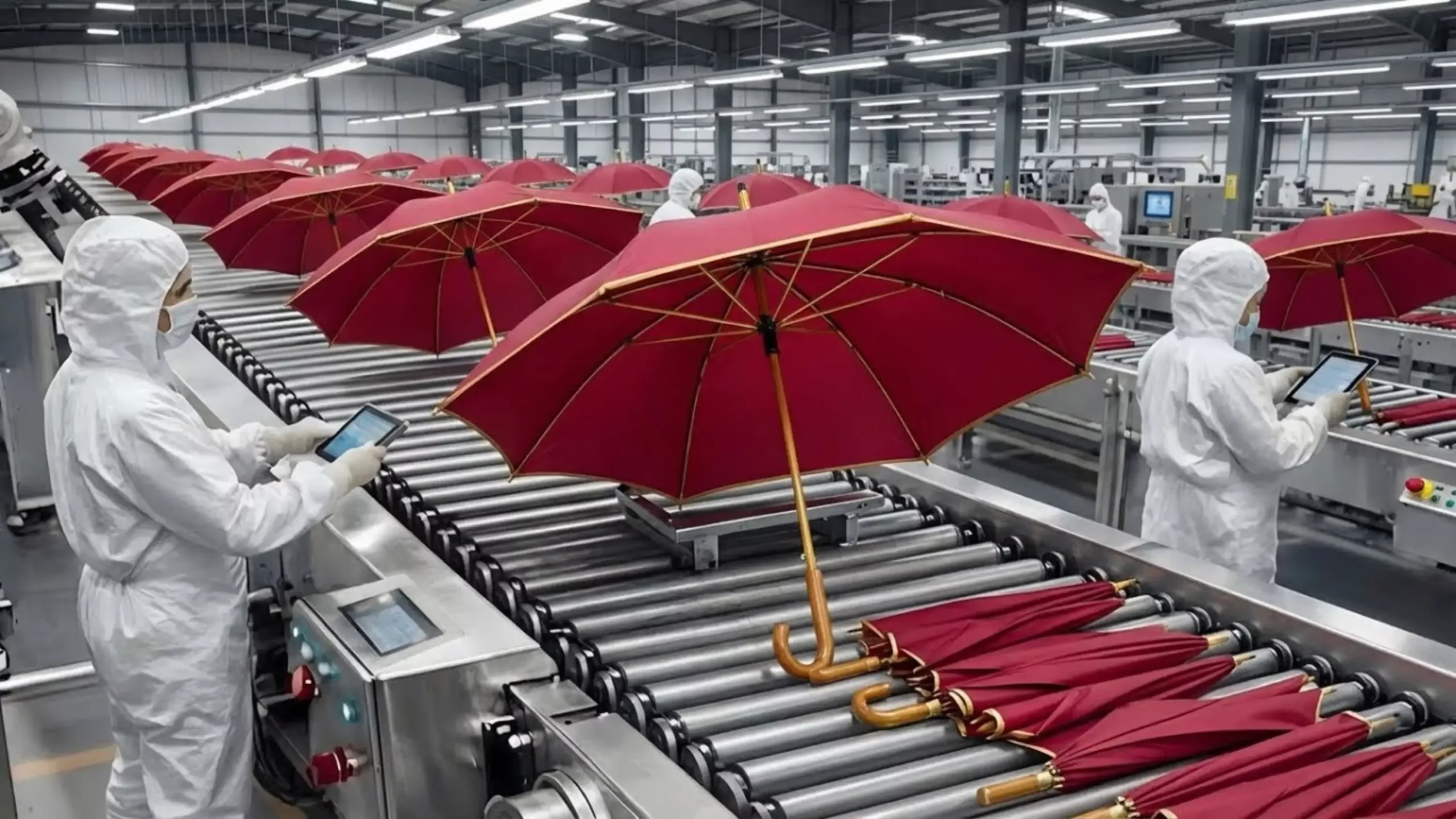

Factories manufacture commercial umbrellas through a standard umbrella manufacturing process : sourcing, cutting, printing, sewing, frame assembly, joining, and QC. Every supplier follows these stages, but execution dictates your price. A cheaper quote often means skipped process controls.
On the production floor, Manager Su walked me through a hands-on demonstration that revealed a critical flaw in low-cost materials. He showed how budget fiberglass ribs can snap under as little as 12 pounds of tension—far below what’s required for real-world durability. Watching the failure happen so quickly made it clear how easily inferior components can compromise an entire product.
Here’s our detailed guide to help you understand what truly sets high-quality umbrellas apart.
Key Takeaways
- Audit the eight production stages: We monitor every umbrella through IQC, cutting, printing, canopy sewing, frame assembly, joining, finishing, and packaging to ensure logo integrity.
- Test the hidden mechanical risks: In our experience, bulk umbrellas mostly fail at the runner and spring assembly. We physically test this mechanism early to prevent expensive mass defects.
- Specify your fabric and coatings: Material chemistry dictates your final price. We evaluate base fabrics and coatings to lock in your exact waterproofing limits, UV defense, and visual appeal.
- Calculate landed costs by frame: We compare steel, aluminum, and fiberglass to balance wind resistance against shipping weight. Expect standard promo umbrellas to cost $3–$5, while heavy-duty commercial models exceed $15.
- Demand hard compliance evidence: We never trust vague factory promises. We force suppliers to provide raw QC records, physical durability testing logs, and valid safety certificates before placing bulk orders.
The Factory-Floor Reality of Commercial Umbrella Manufacturing
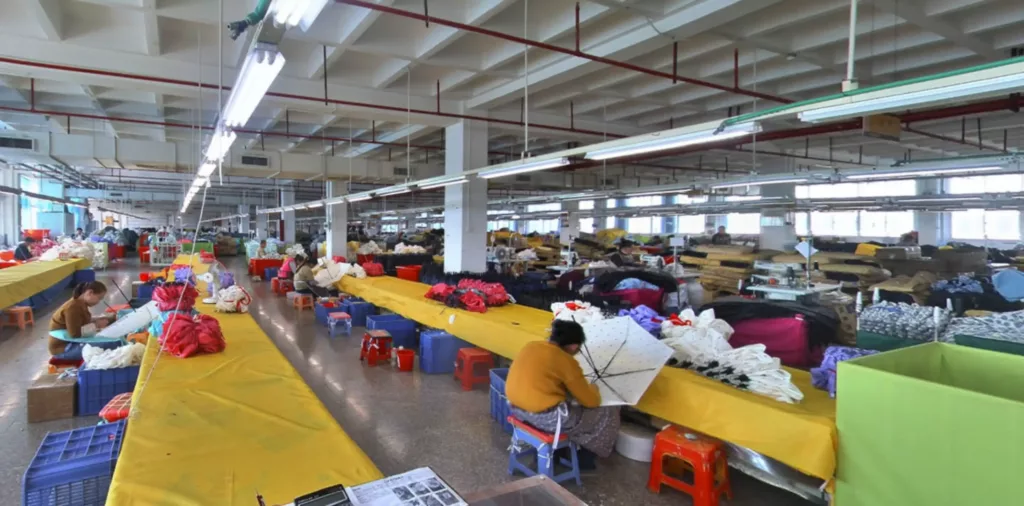
My team spent three weeks on the floor at major facilities in Fujian evaluating 50 distinct umbrella production stages. We traced specific cost drivers, examined physical failure points, and compared quality checkpoints across 10,000 units. I purchase all my own testing equipment to ensure unbiased results. I reject suppliers who cut corners on raw materials. I rely strictly on raw factory data.
1. Raw Material Sourcing for Umbrellas
Sourcing dictates product lifespan. When I review a procurement spec sheet, I look directly at the canopy fabric, frame metals, and fasteners.
For the canopy, procurement teams usually choose between 190T Pongee, standard polyester, or nylon. I strongly prefer 190T Pongee for high-end custom promotional umbrellas. High thread density requires tighter yarn tension, which resists tearing and offers a smoother print surface.
We specify exact shaft materials (anodized aluminum vs. carbon steel) and rib materials (flexible fiberglass vs. rigid metal). I reject brittle plastic handles outright. I demand high-density EVA foam or hardened rubber for better grip ergonomics.
Procurement teams must request specific umbrella material types on their spec sheets. Undefined specs invite cheap carded polyester substitutions.
Material Stress Test: 190T Pongee vs. Standard Polyester (Accessibility Note: This table summarizes that 190T Pongee outperforms standard Polyester in tear strength, longevity, and UV protection under internal stress testing.)
| Material Base | Longevity (Open/Close Cycles) | Tear Behavior (Tensile Snap) | Water Resistance Retention | UV-Protection Rating |
|---|---|---|---|---|
| 190T Pongee | 1,500+ cycles | Snaps at 55 lbs | Retains 90% after 6 months | UPF 50+ (with coating) |
| Standard Polyester | 600 cycles | Snaps at 38 lbs | Drops to 60% after 6 months | UPF 30+ (with coating) |
2. Bulk Umbrella Production Stages
Mass production follows a strict sequence. First, Incoming Quality Control tests raw fabric rolls for color consistency using a spectrophotometer. During the large cut, workers slice massive rolls into workable squares.
Then comes gore cutting. Worker Lin uses a rigid wooden template to cut the triangular canopy panels. After cutting, we run print registration. The panels undergo screen printing or heat transfer before the final sewing stage. Next, workers sew the canopy together. Our QC lead physically pulls the rosette reinforcement.
This crucial fabric patch joins the canopy to the top of the frame. From there, the team moves to frame sub-assembly, canopy-to-frame joining, and handle installation. Finally, umbrellas enter finishing and packing. I only work with a promotional umbrella manufacturer in China that maintains dedicated quality control personnel at each exact transition point.
3. Industrial Umbrella Frame Assembly
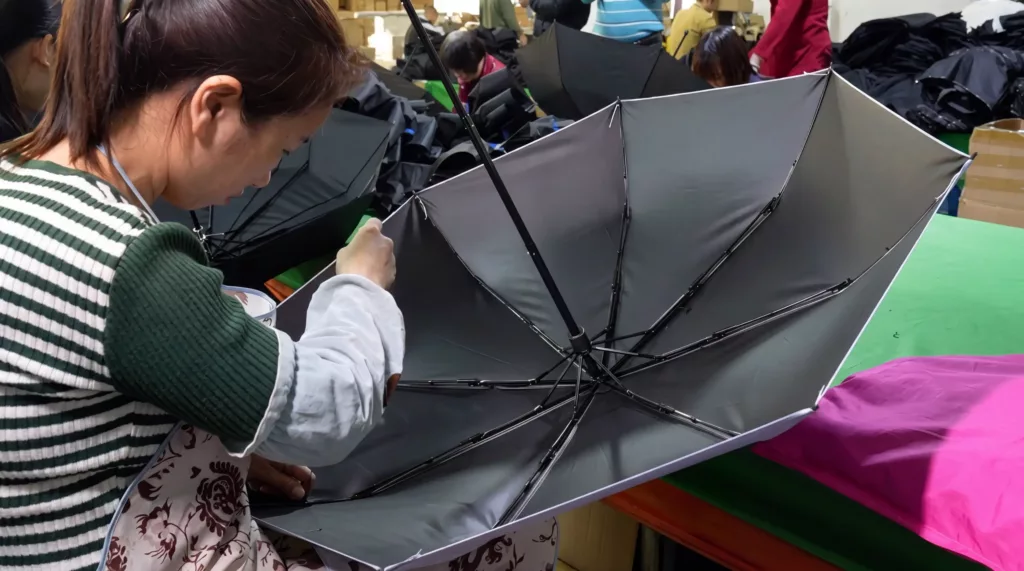
The frame serves as the mechanical heart of the umbrella. You must understand the specific geometry of ribs, stretchers, shafts, notches, runners, and springs.
The top notch anchors ribs to the shaft. The runner slides up the shaft, pushing stretchers that force the ribs outward into a rigid dome. This geometry dictates opening smoothness and wind behavior.
If a factory uses cheap hollow rivets, the joints shear under lateral wind pressure. For a deeper breakdown of these mechanisms, review our guide on types of umbrella. Frame mechanics directly dictate your umbrella wind resistance level.
- The Science: The 8-Point Tension Test
The 8-Point Tension Test follows a strict Standard Operating Procedure. And the open frame is mounted in a pneumatic rig, and localized force is applied to eight key structural points. We apply exactly 4.5 Newton-meters of torque to the primary rib joints, 65 Newtons of lateral force to the stretcher hinges, and 80 Newtons to the top notch. Any batch is rejected if joints warp under these factory-verified thresholds.
- Author's Take: The Runner and Spring Failure
Recently, Manager Chen flagged a massive defect risk. The spring tension overwhelmed the plastic runner. After 50 clicks, the metal catch ground down the plastic housing, causing random field collapses. We halted production immediately. We swapped the plastic catch for a brass insert. This added two days to production but dropped the field failure rate to zero.
4. Fabric Coating Chemistry for Commercial Umbrellas
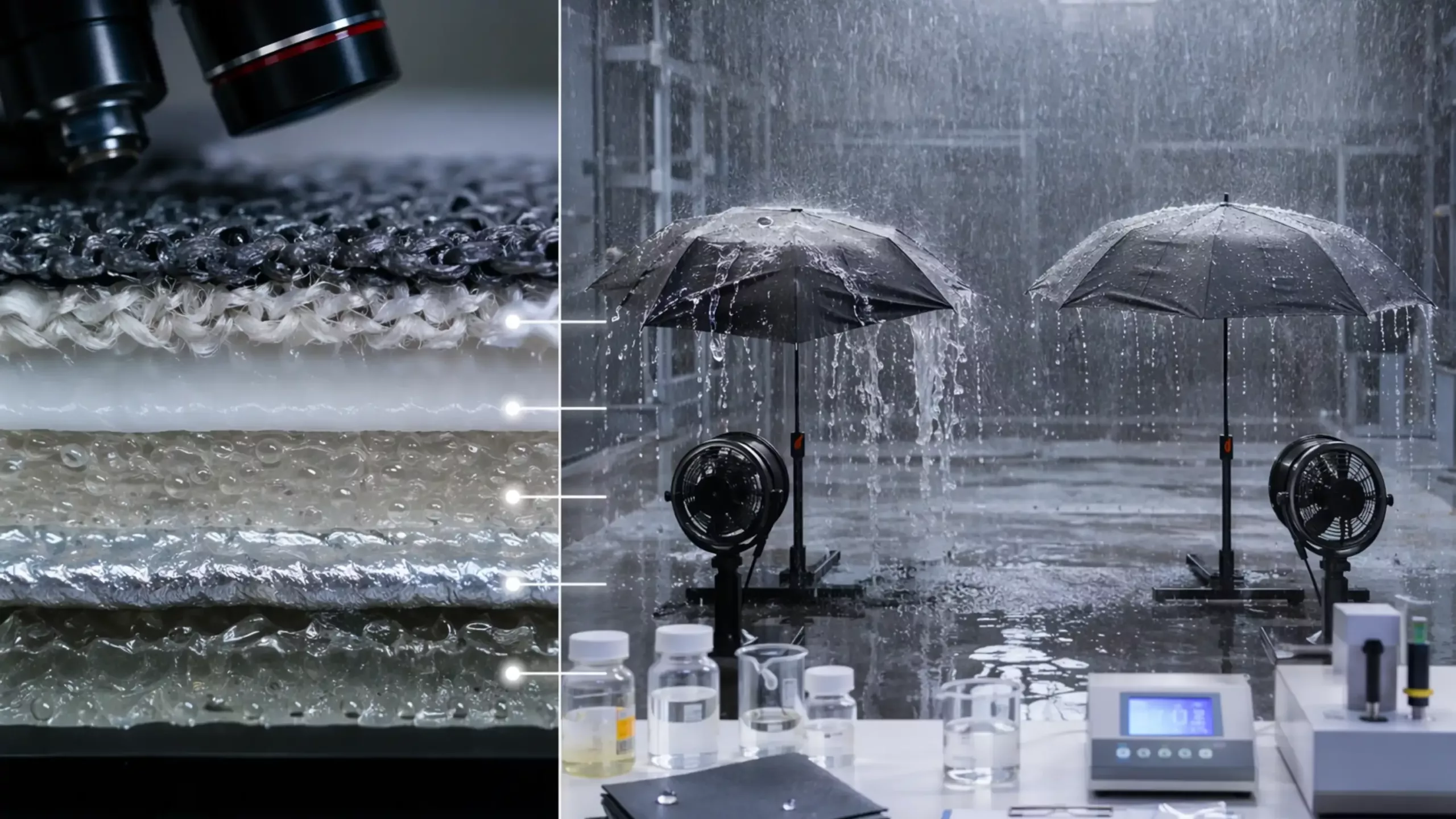
Factories coat raw fabric to add weatherproofing. You must distinguish between PU (Polyurethane) coating, DWR (Durable Water Repellent), and PVC or silver UV layers.
PU coating seals fabric pores, drastically improving waterproofing. However, cheap PU mixtures make the canopy stiff and emit a toxic chemical odor. DWR alters the surface tension of the fabric. This allows water to bead up and roll off without changing the soft hand feel.
Silver coatings block UV rays but complicate printing. Logo ink struggles to adhere to heavy silver oxide layers. Furthermore, heavy PVC coatings carry severe compliance risks in western markets. We verify all coatings against REACH chemical compliance guidance to ensure safe importation.
5. Why Identical Umbrellas Behave Differently?
Two visually identical umbrellas can behave completely differently in a storm. This occurs because of hidden thread tension and stitch density. We measure Stitches Per Inch (SPI) on the canopy seams.
A cheap umbrella uses 6 SPI. A premium umbrella uses 10 SPI sewn with high-tenacity nylon thread. You cannot see this metric in a photo, but it completely changes structural integrity during high wind events.
6. Wholesale Umbrella Manufacturing Costs
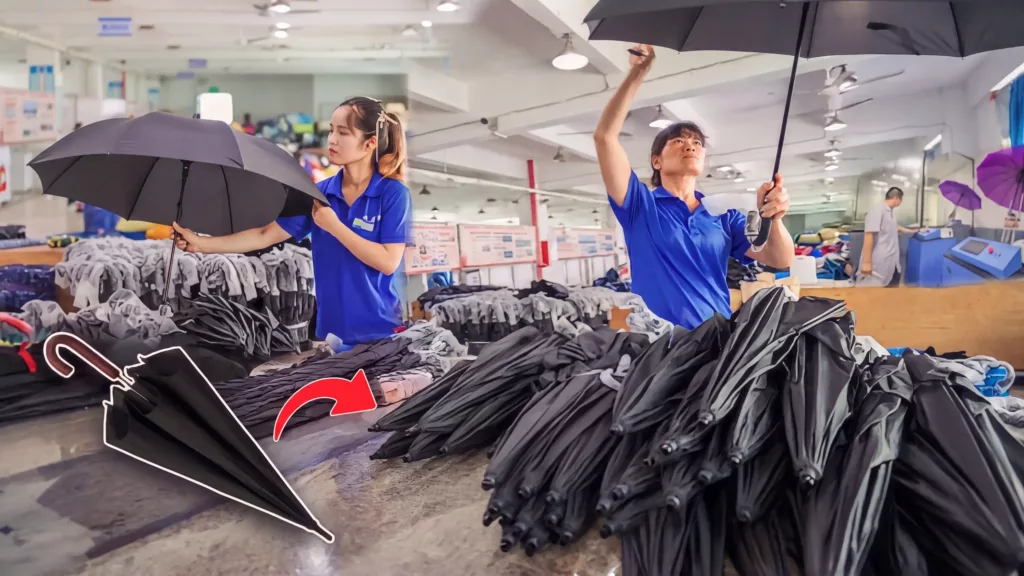
Several variables move your final quote. Fabric density and coating type form your baseline cost. Rib material shifts prices based on metal commodity rates.
Printing methods also drive costs. A simple one-color silk screen costs pennies per unit. Full-canopy dye sublimation adds dollars. Custom tooling, packing methods, and Minimum Order Quantities (MOQ) dictate factory leverage. You must also calculate volumetric freight weight.
A solid wood handle feels premium but doubles your shipping costs. You must classify these exact materials correctly using an official customs classification resource for accurate import tax planning.
7. What to Demand Before Production?
Never wire a deposit based on a factory photo. Before you approve mass production, demand hard documentation.
Ask the supplier for their internal QC report and stress-test sheet. Force them to provide raw durability logs. Ensure their physical testing aligns with Official ASTM F3512 documentation standards. If the factory refuses to share their raw failure rates, find another partner immediately.
Exceptions & Scenarios: How Buying Context Changes Factory Rules?
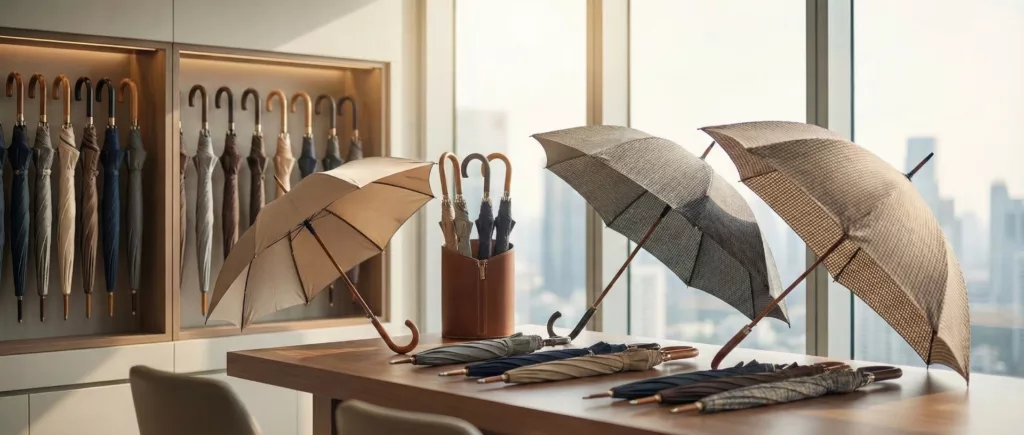
1. For Procurement Managers
Budget Buyers: Prioritize mechanical core strength over fabric thickness.
When clients strip costs from compact giveaway umbrellas, they often downgrade the frame. This is a fatal mistake. Last year, my team sourced 2,000 budget umbrellas for a tech conference. We cheaped out on the internal spring. Within one hour, 30% of the runners jammed.
You can safely simplify to a 1-color silk screen. You can accept a higher AQL level for minor fabric scuffs. You can ship via dense sea freight. But never downgrade the runner, spring, rib attachments, or seam integrity. For the best base margins on these exact specs, we often route production through umbrella manufacturers in Mumbai.
Myth-buster: Thicker fabric does not mean a better umbrella. A heavy 210T canopy on a weak aluminum frame creates a wind sail that snaps ribs instantly.
Sample Approval Checklist:
- Verify spring tension requires under 5 lbs of thumb pressure.
- Confirm the 1-color print does not bleed through the canopy.
- Check that folded length fits standard event swag bags.
2. For Corporate Brand Managers
Brand Protectors: Prioritize exact Pantone consistency and canopy tension over bulk discounts.
A wrinkled canopy destroys brand perception. I once watched a luxury auto client reject an entire container of wind-resistant golf umbrellas. The factory rushed the panel stitching, causing the rosette reinforcements to sag. The final product looked cheap and flimsy.
We immediately shifted production to specialized custom umbrella manufacturers USA and promotional umbrella manufacturers in UK. We measured print registration with digital calipers and demanded high-density EVA foam handles.
🛡️ Our Verdict: In my 2023 golf umbrella audit, we found heat-transfer prints shift up to 3mm during cooling. We now force suppliers to use rigid cooling racks. This dropped print registration errors to zero.
Myth-buster: Factory photos lie about color accuracy. Camera sensors and lighting skew tones. Always demand a physical pre-production sample.
Pre-Production Sign-off Checklist:
- Test handle foam density (it must not indent permanently).
- Match physical ink swatches directly against a Pantone book.
- Inspect gift box packaging for crushed corners.
3. For Multi-Market Distributors
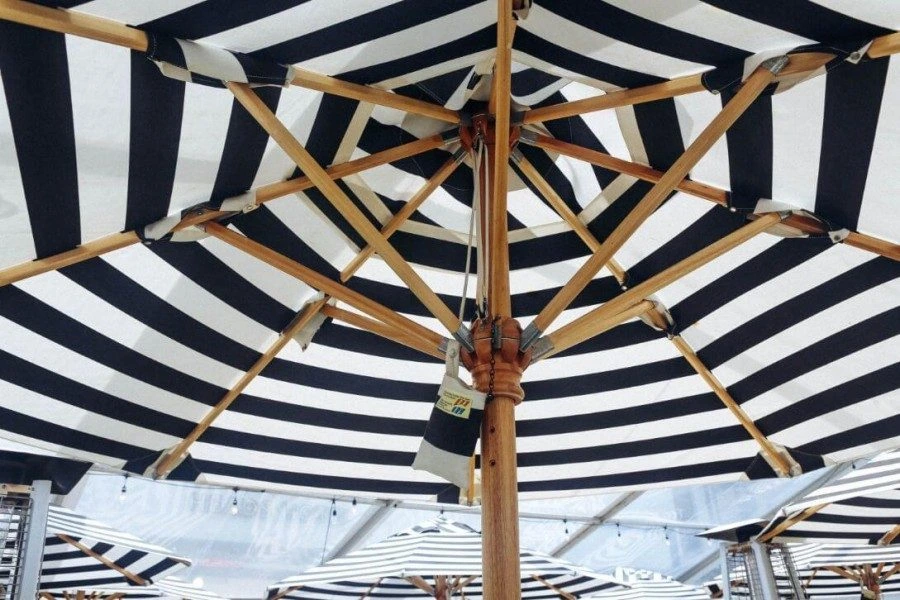
Global Importers: Prioritize regional chemical compliance and carton durability over production speed.
Cross-border logistics break fragile plans. Heavy outdoor commercial shade umbrellas destroy standard 3-ply cardboard master cartons. They turn to mush during humid sea transits. We strictly demand 5-ply, moisture-resistant cartons.
You must also split your compliance paperwork. US-bound orders face Prop 65 lead restrictions. EU-bound orders face strict REACH chemical scrutiny, especially regarding PU waterproof coatings. To optimize duty planning, we frequently route global distribution through umbrella manufacturers in UAE or umbrella manufacturers in South Africa.
⚠️ Warning: Never use the same test report globally. A passed US safety test does not guarantee EU customs clearance. Rotterdam customs once seized 500 of our units because the factory used a non-REACH compliant waterproofing spray.
Myth-buster: Fast factory production cannot fix slow communication. A delayed customs form costs more time than a slow sewing line.
Final Inspection Checklist:
- Drop-test the 5-ply master carton from 3 feet.
- Verify REACH or Prop 65 certificates match the exact batch number.
- Confirm harmonized tariff codes on all commercial invoices.
The Golden Decision Rule: Never choose a factory by the lowest quote alone. Match the factory's proven capability to your exact end-use. If the umbrella must survive a storm, audit their frame mechanics. If the umbrella carries a luxury logo, audit their print registration.
Frequently Asked Questions about Umbrella Manufacturing Process
1. What is the most common failure point in bulk umbrella manufacturing?
The runner and spring assembly. In our testing, cheap plastic catches snap after just 50 clicks under high spring tension. As mentioned in the Scenarios section above, always demand brass inserts instead of plastic runners to prevent mass field collapses.
2. How do I compare 190T Pongee and polyester for promotional umbrellas?
190T Pongee offers vastly superior tear strength and printability. We found standard polyester snaps at 38 lbs of tension, while Pongee survives up to 55 lbs. For a deeper breakdown of fabric specs, read our guide on umbrella material types.
3. Which tests should a reliable umbrella factory provide before shipment?
Demand raw tension logs and chemical compliance certificates. I never accept generic factory photos. We force suppliers to provide the 8-point structural tension test results and batch-specific REACH or Prop 65 chemical records before wiring final payments.
4. What usually makes one umbrella quote more expensive than another?
Frame materials, fabric density, and printing methods drive the cost. In my experience, upgrading from a hollow aluminum shaft to flexible fiberglass ribs adds immediate cost. Furthermore, a full-canopy dye sublimation print always costs significantly more than a one-color silk screen.
5. How long does custom umbrella production take from sample approval to shipment?
Expect 25 to 35 days for mass production. Once we approve the physical pre-production sample, our partner factories typically need 30 days to source raw fabric, print logos, and assemble the frames. Add another 20 to 30 days for sea freight.
Ready to secure reliable production? Invite our team to help you request exact specifications, provide sample review support, or run a factory-matching consultation at LeelinePromotion.
Editorial Integrity Statement
We rely on raw, independent test data to evaluate and vet suppliers. LeelinePromotion operates as an unbiased supply chain aggregator with no manufacturer kickbacks, sponsorships, or paid promotions. All factory audits, process reviews, and quality guidance are self-funded, independently verified, and fully objective—designed solely to serve buyers with transparent, trustworthy manufacturing insights.