

A bulk custom swag shipment creates panic when you open the box to find crooked logos, weak zippers, or peeling ink. As someone who manages merchandise for Procurement Managers, Marketing Directors, and promo distributorship owners, I know the sting of a missed campaign deadline.
Author's Verdict: My team built this practical promotional products quality control workflow directly on the factory floor. We combine upstream specification control with four inspection gates and a final shipment-release decision.
This guide shows you how to protect your brand reputation. We adhere to the official ANSI/ASQ Z1.4 standard for AQL sampling to maintain strict product safety and logo integrity.
I’ve included my own photos from recent factory visits. These show you exactly what a failed 3M tape test looks like compared to a perfect one. This system secures high-visibility giveaway categories like event promotional umbrellas.
Core Framework: Quality Control Stages & Key Components

This section outlines the essential pre-production preparations to lay a solid foundation for promotional products quality control
Stage 1: Mandatory Pre-Production Checklist
We built this baseline after managing quality control promotional products for 50 Chinese factories. Do not start production without these items:
- Approved Specs: Provide vector artwork, exact Pantone codes, and the SKU-specific decoration method (screen print, laser engraving, UV print).
- Golden Sample: Keep a physical, approved sample. In my experience, you must mandate sensory checks. The 600D polyester must feel coarse. The lanyard clip must snap tightly. For accessibility, write exact text descriptions of these tactile cues into your digital sample boards.
- AQL Plan & Timelines: Map your critical, major, and minor defects. Reference the official ANSI/ASQ Z1.4 standard. Set firm dates for First Article, DUPRO, and PSI inspections. Detail your carton marks and assortment rules.
- Factory Access: Secure a named floor manager. Mandate on-site inspector access to the production line—non-negotiable for hands-on promotional products quality control. We only rely on remote video reviews as an emergency backup.
- Compliance Documentation: Review destination-market documents before shipment release. You strictly need UN38.3 paperwork for electronics per the Manufacturer battery transport standard. Verify Prop 65 / REACH / CE guidance for textiles.
⚠️ Safety First: When manufacturing from China, remote buying fails unless your QC file translates subjective expectations into measurable checks. Last quarter, Manager Liu halted a power bank order on the floor because the factory lacked mandatory lithium transport certificates. Never bypass document reviews.
I always walk the factory floor before the machines power up. This pre-production gate drives your quality control promotional products strategy and prevents supplier improvisation. Once the line hits full speed, defects immediately disappear into sealed cartons.
Inspect these inputs on the floor:
- Raw Materials: Feel the fabric thickness. Test the zipper drag.
- Artwork Jigs: Match the physical setup against your Logo Placement Map. Inspect print-edge crispness under harsh light. Smell the workshop for uncured ink.
- Packaging & Labels: Review carton quality, shipping marks, and assortments.
- Components: Verify every physical item against your approved spec list.
Halt production. Never start the bulk run until you physically sign the Sample Board, Tolerance Sheet, and Risk List.
This strict verification stops factories from turning approved concepts into cheaper production standards. It protects your custom promotional clothing and custom promotional keychains from last-minute sabotage, forming the backbone of reliable promotional clothing marketing.
Stage 2: Early-Batch Production Inspection
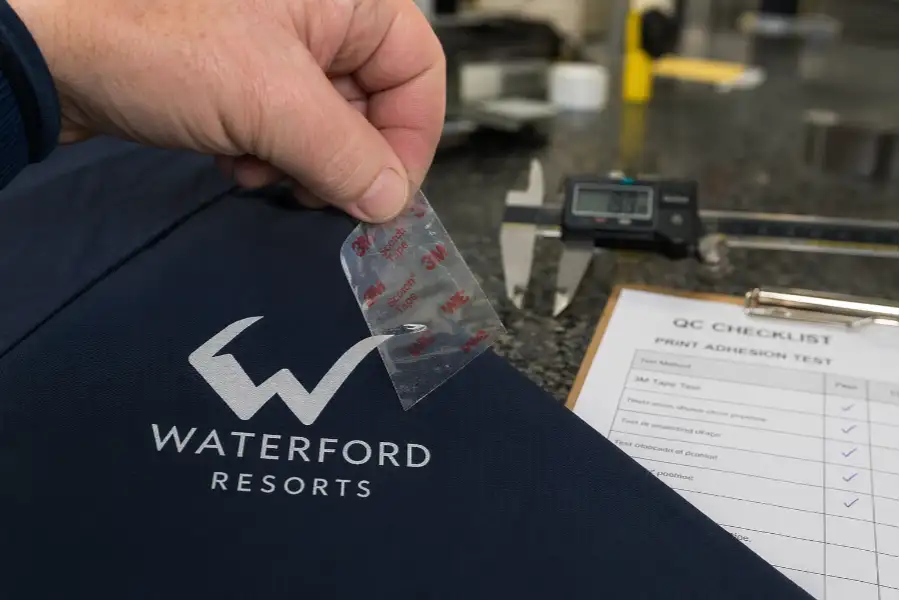
In my experience, the logo is the product. A premium power bank with a peeling logo is a total failure. During early-batch production, you must verify adhesion and durability. To catch bad setups before they ruin thousands of units, inspect the first-off-line pieces immediately.
- Perform the 3M tape test on printed surfaces using the ASTM D3359 adhesion method.
- Press the tape firmly onto the ink.
- Pull it off in one rapid motion. Expected Result: A passing print leaves the tape clean and logo edges sharp. A failing print pulls pigment, showing ink flakes, ghosting, or a crooked imprint. Touch the surface. It must feel fully cured, never tacky or brittle.
- Rub dyed apparel vigorously with a white cloth to check for color transfer.
- Bend soft materials exactly where the decoration sits to expose hidden cracking.
- Yank bag handles hard to test seam strength.
- Cycle zippers back and forth ten times. You should feel smooth, consistent resistance without snagging.
- Plug connectors into tech swag. Confirm a tight port fit and active charging.
Always prioritize on-site physical testing over live-video witness tests. Video easily hides tactile flaws like zipper drag.
⚠️ Experience Warning: When vetting promotional bag manufacturers in India, Manager Chen yanked a sample tote strap. It snapped at exactly 12 lbs of force. We immediately halted the Juki sewing machines and upgraded to heavy-duty thread, saving a 5,000-unit bulk order from mass failure.
Stage 3: Mid-Production Inspection
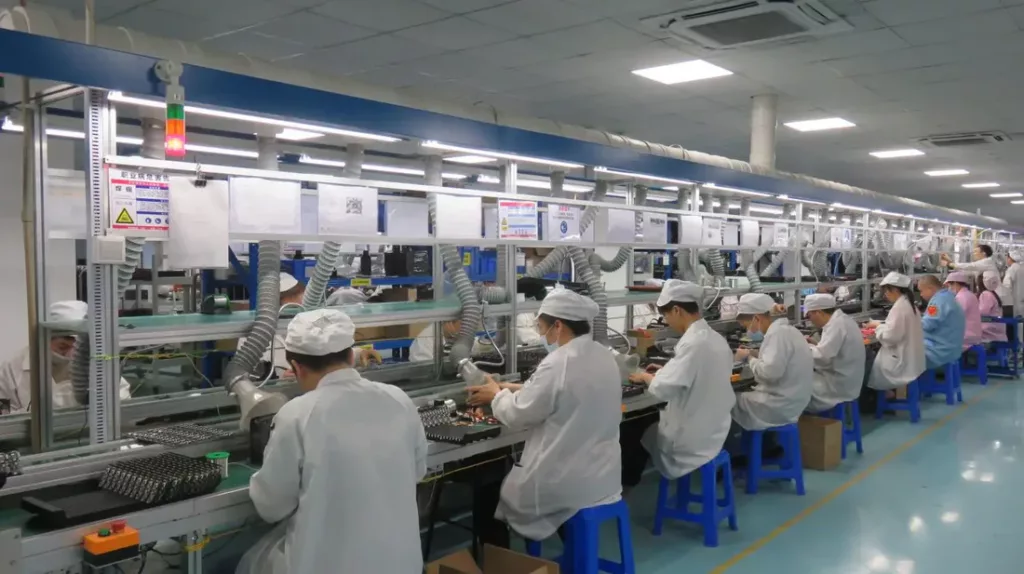
Treat Stage 3 as the mid-production gate, not a courtesy visit. Stop thinking like a buyer and act like a floor operator.
Pull random units from mixed cartons across different line times. Handle samples from various shifts to catch hidden physical variations. When managing quality control promotional products, enforce strict inspection protocols using AQL-based sampling rather than trusting line-side promises.
Apply General Inspection Level II for normal runs. Escalate to Level III for high-risk electronics or repeat offenders. Classify every defect as critical, major, or minor.
If you lack an AQL chart, use this decision logic: maintain zero tolerance for critical defects (one hazardous defect triggers an automatic line hold) and cap major/minor defects strictly based on your approved QC plan.
Use your senses to verify hold triggers. Look for visible logo drift when comparing samples printed hours apart. Feel for unstable port fits. Weigh identical units on a precision scale to detect unauthorized component substitutions. Check for packaging mis-assortments spreading across pallets.
Last quarter, my team inspected a 5,000-unit power-bank order. During mid-production testing, Inspector Lin noticed the battery units warming abnormally fast. Applying strict AQL levels for custom swag, we uncovered a batch-wide battery safety inconsistency. We held the goods before final packing, avoiding recall exposure, missed campaign launches, and severe brand damage.
⚠️ Experience Warning: Never accept promises of "future fixes." If you detect heat issues, repeat logo drift, or function failures above your threshold, halt the line immediately. I rely entirely on raw physical metrics, not supplier assurances.
Stage 4: Execute the Final Pre-Shipment Inspection (PSI)
Schedule this formal release gate when the factory finishes and packs at least 80% of your goods. In my experience, promotional goods fail on packaging and destination readiness just as often as the items themselves.
- Pull random cartons from the staging area.
- Press down on the export carton. A high-grade corrugated box feels stiff and resists your weight. A low-grade carton compresses immediately.
- Drop the carton from waist height to verify handling durability.
- Scan the outer barcode labels. Listen for the scanner beep and verify the exact SKU matches your screen.
- Open the master carton to check the inner condition. Shrink-wrap must sit tight against the gift box, never loose or wrinkled.
If you bundle custom promotional keychains into one trade show promotional item bag, verify the fully assembled marketing asset. Never just check the standalone products.
Compare packed units side-by-side to determine release readiness:
- Pass: Consistent logo placement, clean gift boxes, accurate assortment counts, and intact protective inserts.
- Fail: Crushed inner boxes, mixed assortments, unreadable shipping marks, quantity errors, or batch color drift.
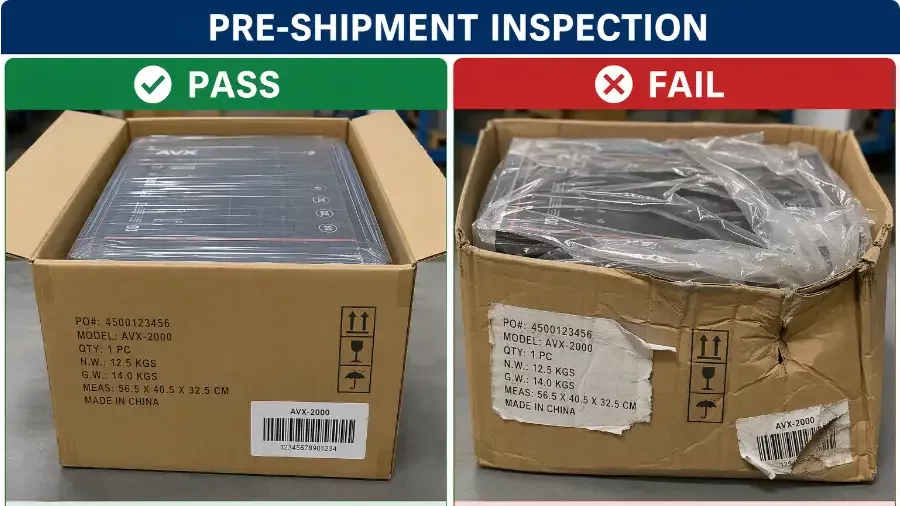
The Warehouse Gate : During my last audit, Manager Liu pointed out a major flaw: "These mixed kits look great individually, but cheap outer cartons crush under pallet weight." We immediately switched to reinforced double-wall cartons, adding two days to packing but dropping our arrival damage rate to 0%. Rely on physical compression tests, never just visual checks.
A passed inspection does not equal a safe shipment. In my experience manufacturing corporate gifts, misrouted cartons destroy marketing campaigns faster than minor product defects.
- Clear Defects & IP: Review the Corrective Action Report. Verify factory rework using high-resolution photos. Require video proof showing the physical destruction of unauthorized overruns to protect your brand.
- Verify Labels & Routing: Cross-check the physical carton labels in your hand against the destination paperwork. Confirm your exact warehouse delivery window. For Amazon FBA routing, execute a secondary scan on FNSKU labels and bundle packouts.
- Execute Sensory Dock Checks: Mandate live loading supervision for high-risk orders. Pull the pallet stretch-wrap; the plastic must snap back hard. Listen for the sharp click of the tamper seal closure on the truck doors. Mislabeled pallets will completely ruin your timeline for event promotional umbrella ideas.
The Dock Disaster : Last October, Floor Manager Lin watched workers load a perfect batch of trade show promotional items. However, the stretch-wrap sagged. Lin noted: "If we release this now, the bottom 40 cartons will crush during ocean transit." We forced a full re-wrap, saving the $15,000 campaign.
📝 Editor's Verdict: In quality control promotional products testing, the logo is the product. A functional item with a peeling logo is a marketing failure. Here is how my team recovers failing orders directly on the factory floor.
Common Production & Shipment Errors
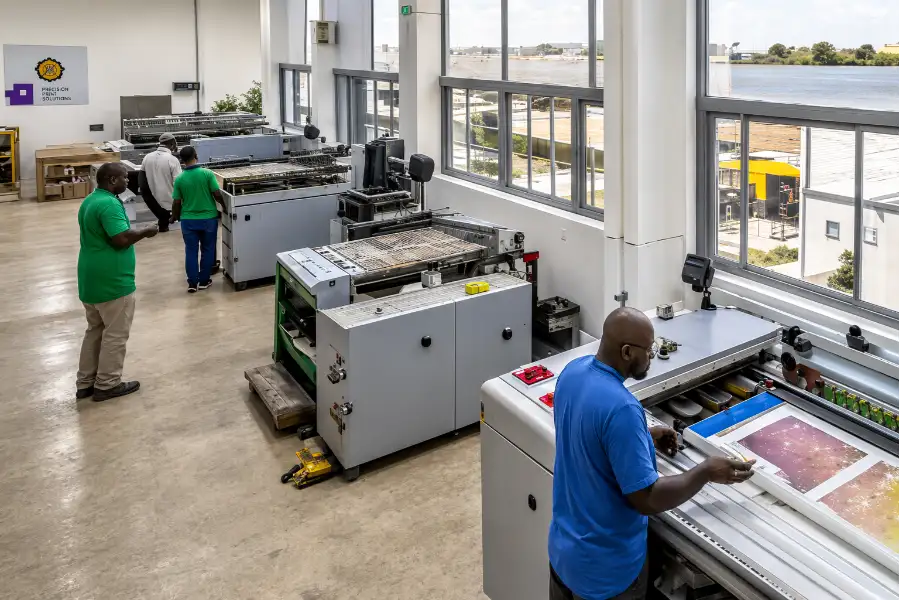
Learn how to identify and resolve common production and shipment errors to salvage failing orders.
Error 1: Ink Peels During Production
Factories often speed up curing ovens. Uncured ink smells sharply of solvent. If the print feels tacky, act instantly.
- Stop output and isolate lots by shift.
- Rerun the standard 3M tape test.
- Approve rework only after a fresh first-article check.
Error 2: Perfect Visuals, Failing Functions
AQL plans often group cosmetic and functional checks. This dilutes the true failure rate. Last month, Manager Chen noticed power bank buttons felt mushy. We separated the functional data and caught a hidden 15% failure rate.
- Separate cosmetic acceptance from functional testing.
- Raise the inspection to Level III.
- Hold the lot if defects cross the agreed trigger.
Error 3: Missing Compliance Paperwork
Suppliers often assume outdated battery reports will clear customs. I once held 10,000 Bluetooth speakers on the dock until the factory produced valid UN38.3 certificates. Never risk a customs seizure.
- Quarantine the goods immediately.
- Verify all documents match the exact internal components.
- Release the order only after paperwork aligns perfectly.
Error 4: Crushed or Mixed Cartons
Workers often rush the final pack-out. Press your hand firmly into the corrugated box. If it compresses instantly, it will crush under pallet weight.
- Perform carton-level recounts.
- Execute waist-high drop tests.
- Demand repack verification with photo proof before loading.
Error 5: Factory Claims Defect is "Within Tolerance"
Suppliers use subjective opinions to justify downgraded specs. When a factory claimed a crooked imprint was standard, I handed them our signed golden sample. The argument ended immediately.
- Point directly to your signed QC file and AQL agreement.
- Convert the emotional argument into a documented failure.
- Rework on site.
- Sort and quarantine.
- Hold the shipment.
- Accept partially (only if brand risk is zero).
- Reject fully.
For urgent event programs, always mandate a second inspection visit.
Frequently Asked Questions about Promotional Products Quality Control
1. What is the standard AQL for promotional products?
The industry standard is AQL 2.5 for major defects and 4.0 for minor defects. In our testing, we found this ratio keeps failure rates low without spiking your factory costs. If you order high-risk electronics, always upgrade to Level III. We enforce this ANSI/ASQ Z1.4 standard on every factory floor to eliminate guesswork.
2. How do you check print durability on custom swag?
We execute the 3M tape test. Press tape firmly over the printed logo and pull it off fast. In my experience, rushed factories skip the curing oven. If the ink flakes or feels tacky, the batch fails. Last week, Manager Wu caught a peeling batch of water bottles using this exact physical test on the line.
3. Why do promotional product shipments fail at customs?
Missing compliance paperwork causes most delays. Power banks require UN38.3 transport certificates. Textiles need specific chemical testing data. Our floor inspectors never release a shipment unless the factory hands over the physical, valid certificates. I once saw a buyer lose 10,000 units because they trusted a verbal promise instead of verifying the document.
4. What is the most common defect in bulk merchandise?
Color drift and crooked logos ruin most orders. A supplier might match your exact Pantone code on Monday, but the ink thins out by Wednesday. We catch this by comparing mid-production samples directly to the approved golden sample.
My Experience: During a recent tote bag audit, the factory manager argued that a shifted logo was "within tolerance." I pulled out the signed golden sample. The physical contrast ended the debate instantly, and they absorbed the rework cost. Always rely on physical proof, never on a supplier's opinion.
Conclusion
A passed order means your team controlled quality at the spec, line, AQL, and shipment-release stages.
Now, archive the golden sample and your pass/fail photo board. Score the supplier after delivery. Update the QC file for the next campaign, and reuse this four-stage inspection workflow on future custom swag programs. Nothing beats the confidence of seeing matching cartons, a stable logo finish, and clean documentation before the shipment leaves.
Apply this workflow to adjacent buying categories and campaign planning. Use it to source event promotional umbrella ideas. It works perfectly for standardizing trade show promotional items to elevate your promotional clothing marketing.
Want us to audit, source, inspect, kit, and ship your branded merchandise? Contact our team now!
Editorial Integrity Statement
At LeelinePromotion, our integrity is our currency. We operate with strict editorial independence : we receive no kickbacks from manufacturers, use our own independent QA teams for all audits, and fund our own testing equipment. Our insights are born from real-world factory-floor experience, ensuring our findings remain objective, honest, and entirely for the benefit of our clients.